A carboxylic acid contains the functional group . Loss of its hydroxyl proton gives a carboxylate ion, whose electronic structure distributes negative charge over two oxygen atoms.
Acetic acid is a small example; fatty acids combine the same group with a longer hydrocarbon chain. Formation and cleavage of esters connect carboxylic acids with both organic synthesis and lipid chemistry.[ref]
A dicarboxylic acid is a carboxylic acid containing two carboxyl groups. The groups may be attached to an aliphatic framework, as in malonic acid, or an aromatic framework, as in terephthalic acid.[ref] The definition counts functional groups rather than specifying chain length, ring substitution or acid strength.
A dicarboxylic acid can supply two acidic protons through its carboxyl groups. In the simplest diprotic acid model, write the successive equilibriaThe two acid dissociation constants and characterize different equilibria. Two chemically similar groups do not justify treating the two proton-removal steps as identical. Other ionizable groups, if present, require additional equilibria.
For an original ideal dilute-solution example, use concentration-form constants , and hydrogen-ion concentration . Mass balance and the two equilibrium relations give species fractionsHere . The average charge is per acid-derived species even though only of the molecules are monoanions: equal neutral and dianion populations balance around that mean. The constants are stipulated for illustration, not assigned to a particular compound. Precise thermodynamic calculations use activities rather than equating them with concentrations.
A titration that fully removes both carboxyl protons consumes two moles of hydroxide per mole of initially neutral dicarboxylic acid, in the absence of other reactions. For example, 0.50 mmol requires 1.00 mmol hydroxide by stoichiometry. Two stoichiometric equivalents do not guarantee two separately resolved features on a titration curve; the acid dissociation constants and measurement conditions determine their separation.
Two carboxyl groups also provide two possible connections in esterification. Terephthalic acid and a diol can therefore build a polyester, illustrating how the same functional-group count matters both to acid-base measurements and to polymer connectivity.[ref]
Organic Chemistry by John McMurry. Section 31.4, Step-Growth Polymers, terephthalic acid and ethylene glycol
Terephthalic acid is benzene-1,4-dicarboxylic acid, an aromatic dicarboxylic acid with two carboxyl groups attached at opposite positions of a benzene ring. Its neutral molecular formula is . The positions of the groups are part of its identity, not information recoverable from the elemental formula alone.[ref]
The two carboxyl groups make it a useful difunctional building block. Reaction with ethylene glycol, which has two alcohol groups, forms ester connections in polyethylene terephthalate, a polyester. This is step-growth polymerization: growing molecules react through their remaining functional groups.[ref]
Organic Chemistry by John McMurry. Section31.4, Step-Growth Polymers, terephthalic acid and ethylene glycol example
An original repeat-unit bookkeeping calculation isUsing rounded masses, per repeat-unit contribution. The subtraction represents two esterification connections per repeat in the long-chain description; it is not an elementary reaction equation for one isolated pair of monomers forming a complete polymer.
For a finite linear chain assembled from acid molecules and glycol molecules, with no ring closure or side reaction, there are connections. The chain therefore loses water molecules, rather than . End groups supply the difference: its mass is approximately under the same rounded-mass convention.
The molar mass and end-group balance consequently matter alongside conversion. Measuring consumption of acid groups and formation of ester connections tests the reaction model; identifying an aromatic diacid does not determine the final chain length or material properties.
Malonic acid is propanedioic acid, a dicarboxylic acid in which two carboxyl groups are separated by one methylene group:Its neutral molecular formula is and its average molar mass is approximately .[ref]
Two of the four hydrogen atoms belong to carboxyl OH groups; the other two belong to the central carbon. Complete neutralization of both carboxyl groups therefore requires two equivalents of a suitable base, not four merely because the formula contains four hydrogens. An original stoichiometric model isFor acid, the two-equivalent amount of hydroxide solution is . The pH at an experimental endpoint also depends on acid-base equilibria and the measurement method; the equivalent count alone does not determine it. Malonate names the corresponding deprotonated system, whose protonation state should be specified.
Heating can promote decarboxylation, producing acetic acid and carbon dioxide. Malonic-acid derivatives underlie the carbon-chain construction described in the malonic ester synthesis.[ref]
Organic Chemistry by John McMurry. Section22.7, Alkylation of Enolate Ions, malonic ester hydrolysis and decarboxylation
For the unsubstituted acid, the stoichiometric balance isAn original ideal mass balance for converted by only this reaction gives about acetic acid and carbon dioxide from starting material. Following evolved gas and residual material would test conversion, whereas a change in sample mass alone would not distinguish this reaction from evaporation or another decomposition pathway.A beta-hydroxy acid is a carboxylic acid with a hydroxyl group on the beta carbon: the carbon two carbon–carbon bonds away from the carboxyl group carbon. For a simple chain numbered from the carboxyl carbon as carbon 1, the beta carbon is carbon 3. The hydroxyl within the carboxyl group itself does not establish the additional hydroxy substitution.
The small example 3-hydroxypropionic acid has structureStarting at the carboxyl carbon, the adjacent is alpha and the terminal is beta. The primary ChEBI record gives the systematic name 3-hydroxypropanoic acid, formula and its classification as a 3-hydroxy monocarboxylic acid.[ref]
An alpha-hydroxy acid instead places the additional hydroxyl group one carbon closer to the carboxyl group. Thus lactic acid, , and 3-hydroxypropionic acid, , have the same molecular formula but different atom connectivity. They are constitutional isomers; counting oxygen atoms or measuring molecular mass alone cannot distinguish them. The distinction is structural, not a statement about acidity or biological activity.[ref]
The two functional groups also describe different possible transformations. Removing the carboxyl proton forms a carboxylate while preserving the beta-hydroxy carbon skeleton. Converting the hydroxyl group to a carbonyl changes the hydroxy-acid functionality. Which transformation occurs depends on reagents and conditions; the class name alone supplies no reaction rate or treatment claim. Tracking positions relative to the carboxyl group makes such structural changes easier to compare.
3-hydroxypropionic acid is a three-carbon beta-hydroxy acid with structureIts carboxyl group carbon is numbered 1; the additional hydroxyl group is on carbon 3. The primary ChEBI record identifies the systematic name 3-hydroxypropanoic acid, formula and average molecular mass . The acid and its conjugate base, 3-hydroxypropionate, are distinguished chemical species.[ref]
3-hydroxypropionic acid in ChEBI. CHEBI:33404, structure, Formula, Average Mass, Names and conjugate-base relation
Moving the hydroxyl group by one carbon gives the different connectivity of lactic acid, . The two acids have the same molecular formula but are constitutional isomers. Molecular mass alone cannot decide which one a sample contains. The terminal alcohol and the carboxyl group also provide different sites for chemical transformation; the compound’s name specifies the initial structure rather than guaranteeing one reaction pathway.
An experimentally demonstrated motivation is production as a chemical building block by metabolic engineering. In the 2016 primary study by Chan Woo Song and colleagues, engineered Escherichia coli produced of 3-hydroxypropionic acid in fed-batch culture. The study screened enzyme combinations and altered the strain, so the observation concerns a particular engineered production system rather than a universal property of the species.[ref]
Using the record’s molecular mass, that mass concentration corresponds to approximatelyof acid equivalents. This conversion is an original calculation, not a separate measurement. Product concentration alone gives neither production rate without a time interval nor mass yield without substrate consumption. Chemical identity, accumulated amount and process performance remain different experimental questions.
3-hydroxypropionate is the conjugate base formed when the carboxyl group of 3-hydroxypropionic acid loses a proton. Its structure isThe primary ChEBI record gives formula , net charge and the systematic name 3-hydroxypropanoate. The terminal hydroxyl group remains present; the acid-to-base change occurs at the carboxyl group, not by moving that hydroxyl or removing the carbon skeleton.[ref]
The acid–base pair can be represented asIn a dilute-solution approximation with activity coefficients treated as equal, the Henderson-Hasselbalch equation givesAt a pH one unit above the relevant , the ratio is , so about of the acid-plus-conjugate-base pool is anionic in that model. This is an illustrative equilibrium calculation; no numerical for this compound is being supplied.
Speciation and total amount answer different analytical questions. If no other reactions occur, changing pH can redistribute and while preserving their sum. A negatively charged 3-hydroxypropionate ion in a bulk solution is accompanied by compensating positive charge elsewhere; it is not the same molecular species as the neutral acid or a complete named salt.
The record’s average mass of applies to the anion’s composition. Reporting a concentration as acid equivalents instead uses the acid’s reference mass, while reporting a particular salt requires the salt’s complete composition. This distinction matters when comparing metabolic engineering measurements that use an acid name for a total analytical product pool.[ref]
An alpha-hydroxy acid is a carboxylic acid with a hydroxyl group on the carbon immediately adjacent to the carboxyl group. That neighboring carbon is the alpha carbon; in simple systematic numbering it is carbon 2 because the carboxyl carbon is carbon 1. The hydroxyl oxygen within the carboxyl group itself is not the additional hydroxyl that defines this class.[ref]
Organic Chemistry by John McMurry. Chapter 20, carboxylic-acid structure and nomenclature
For a common saturated monocarboxylic example, the local structure can be writtenwith representing hydrogen or carbon-containing substituents. Glycolic acid, , has two hydrogens at that carbon. Lactic acid, , has hydrogen and methyl groups there and is also called 2-hydroxypropanoic acid.[ref]
Glycolic acid in the NIST Chemistry WebBook. Identity and structural record
[ref]Lactic acid in the NIST Chemistry WebBook. Identity and Other Names
Position distinguishes the class. The structure has its additional hydroxyl group at carbon 3 and is a beta-hydroxy acid, even though it has the same molecular formula as lactic acid. A molecular formula therefore does not determine whether a compound is an alpha-hydroxy acid; the connectivity is essential.
The alpha carbon can also be a stereogenic centre. In lactic acid it is bonded to four different groups: hydrogen, hydroxyl, methyl and carboxyl. Its two enantiomers share the alpha-hydroxy classification but differ in three-dimensional arrangement. Glycolic acid does not have that stereogenic centre because two substituents are identical hydrogens.
Both functional groups participate in the chemistry. Loss of the carboxyl proton gives a carboxylate, such as lactate from lactic acid, while the additional hydroxyl remains part of the structure. Distinguishing group identity, position, protonation and stereochemistry makes the class useful in organic and biological chemistry without reducing it to a list of commercial uses.
A carboxyl group is the functional group : one carbon has a double bond to oxygen and a single bond to a hydroxyl group. It gives a carboxylic acid its characteristic acid functionality. In acetic acid, the group is attached to a methyl group, giving .[ref]
Loss of the acidic hydrogen produces a carboxylate, the conjugate base:The pH influences the balance between these forms. A structural drawing of the neutral acid therefore need not show the predominant charge state in every solution. The carboxyl group is a part of the molecule, while acetic acid names the entire compound.
Nicotinic acid, , is pyridine-3-carboxylic acid: a pyridine ring bearing a carboxyl group at position 3. It is one form included under vitamin B3, and can contribute to production of the coenzymes nicotinamide adenine dinucleotide and nicotinamide adenine dinucleotide phosphate.[ref]
PubChem Compound database by National Center for Biotechnology Information. Nicotinic acid, CID 938, formula and pyridine-3-carboxylic-acid structure
[ref]Niacin Fact Sheet for Health Professionals by the Office of Dietary Supplements. Introduction, niacin forms and NAD/NADP production
The related nicotinamide has a carboxamide group in place of the acid group. Their related names reflect related structures, while the different functional groups make them distinct chemical compounds. “Niacin” can be used broadly for the vitamin family, so an experiment reporting a particular chemical form should specify which molecule was used.
A keto acid contains both a ketone group and a carboxylic acid group. The position of the ketone relative to the acid group distinguishes α-keto acids, β-keto acids, and more remote arrangements.
Pyruvic acid and 2-Oxoglutarate are metabolically important examples of the α arrangement. Their carbonyl groups participate in transformations connecting carbohydrate metabolism with amino acid metabolism.
2-Oxoglutarate is the conjugate-base form of a five-carbon dicarboxylic keto acid, also called alpha-ketoglutarate. Its ketone carbon is adjacent to a carboxylate group.
In the citric acid cycle, isocitrate is oxidatively decarboxylated to 2-Oxoglutarate, which is then converted to succinyl-CoA. Through transamination, the same carbon skeleton connects with glutamic acid, linking energy metabolism and nitrogen metabolism.[ref]
The citric acid cycle by Hans Adolf Krebs. Table 1, cycle intermediates
Gluconic acid is the carboxylic acid obtained by oxidizing the aldehyde end of glucose while retaining the rest of its six-carbon framework. Gluconic acid can form gluconate by loss of its acidic proton.
Oxidation at a particular carbon gives a distinct chemical product: oxidation of the terminal alcohol instead would produce a different sugar acid. This makes gluconic acid an example of how chemoselectivity determines molecular identity.[ref]
Gluconate is the conjugate base of gluconic acid. Its carboxylate group and multiple hydroxyl groups give a polar framework that can interact with dissolved metal ions.
A gluconate salt contains a counterion as well as gluconate. Thus sodium gluconate and a calcium gluconate are chemically distinct substances, even though they share the same organic anion.
The deprotonated counterpart of butyric acid.
An association of two neutral acid molecules, commonly a cyclic pair joined by two reciprocal hydrogen bonds. Its abundance depends on concentration and competing solvation.
The acid CF3COOH. Its electron-withdrawing substituent makes it useful for acid-labile protecting-group removal; anhydrous tert-butyl ester cleavage need not follow water-assisted acyl hydrolysis.
A short-chain fatty acid, including major microbial fermentation products such as acetate, propionate and butyrate. Chain-length conventions vary with context.
Oxalic acid is the simplest dicarboxylic acid, with structure . Stepwise loss of two protons gives hydrogen oxalate and then oxalate.
Oxalic acid combines acid-base chemistry with metal-ion binding. Some oxalate salts have low solubility, so the behaviour of an oxalate-containing system depends on both pH and the available metal ions.
Oxalate is the dianion formed by loss of two protons from oxalic acid. Its oxygen donors can bind a metal centre as a chelate.
Precipitation of calcium oxalate illustrates the difference between a dissolved molecular ion and a solid salt. Changing the metal counterion or the pH can change solubility and hence whether oxalate remains in chemical solution.
Pyruvic acid is a three-carbon α-keto acid, . At ordinary cellular pH, its conjugate base, pyruvate, predominates.
The pyruvate carbon skeleton is a branch point connecting glycolysis with acetyl-CoA formation, lactic acid formation, and alanine metabolism. The different names distinguish protonation states without implying unrelated carbon pathways.
Tartaric acid has two hydroxy groups and two carboxylic acid groups. Its meso compound form illustrates why two stereocenters need not make a chiral molecule.
A tartrate is an anion or salt derived from tartaric acid, a four-carbon dicarboxylic acid bearing two hydroxyl groups. The arrangement of the two stereogenic centres permits distinct stereoisomers.
Tartrate chemistry has a historical connection with chirality: salts of different handedness can have different crystal forms. Metal binding adds another distinction, as in potassium antimony tartrate, where the organic anion is part of a metal-containing chemical substance.
Potassium hydrogen tartrate is , often written . It contains a singly charged hydrogen-tartrate ion rather than the fully deprotonated tartrate dianion.
Its remaining acidic hydrogen distinguishes its acid-base behavior from fully neutralized potassium tartrate. The familiar name cream of tartar refers to this compound.
Acetic acid is a weak acid that partly transfers protons to water, supplying hydronium and negative ions. It is therefore a weak electrolyte in water.
Highly concentrated acetic acid, distinguished from the dilute acid used in other pharmaceutical formulas.
The conjugate base of acetic acid. It is a reaction product in the conductometric saponification assay.
A fatty acid is a carboxylic acid with a hydrocarbon chain. Its chain supplies much of the hydrophobic region when incorporated into a triglyceride or typical glycerophospholipid. See Biology 2e: fatty acids.
A polyunsaturated fatty acid is a fatty acid with at least two carbon–carbon double bonds in its hydrocarbon chain. The carbon–oxygen double bond in the carboxyl group does not contribute to this count. Many biological examples have cis double bonds, whose geometry changes how chains pack.[ref]
For example, arachidonic acid has twenty carbons and four carbon–carbon double bonds, while docosahexaenoic acid has twenty-two carbons and six. Chain length, bond positions and cis/trans geometry convey different information. A count such as “four double bonds” alone cannot uniquely identify the molecule or all of its physical properties.[ref]
PubChem Compound database by National Center for Biotechnology Information. Arachidonic acid, CID 444899; docosahexaenoic acid, CID 445580, structural records
Arachidonic acid is a twenty-carbon polyunsaturated fatty acid with four cis carbon–carbon double bonds, at positions 5, 8, 11 and 14 when counted from the carboxyl group. Its molecular formula is . The shorthand records twenty carbons, four double bonds and the first double bond six carbons from the methyl end.[ref]
PubChem Compound database by National Center for Biotechnology Information. Arachidonic acid, CID 444899, formula and (5Z,8Z,11Z,14Z) stereochemistry
The indexing conventions describe the same structure from opposite ends: the bond between carbons 14 and 15 from the acid end is the first encountered from the methyl end. The cis geometry also distinguishes this molecule from stereoisomers with the same formula. Composition, double-bond positions and geometry all belong to its chemical identity.
docosahexaenoic acid is a 22-carbon omega-3 fatty acid with six double bonds. Production and storage can require additional steps beyond an EPA-producing pathway.
eicosapentaenoic acid is a 20-carbon omega-3 fatty acid with five double bonds. Engineering its production requires coordinated desaturation, elongation and lipid-carrier handling.
alpha-linolenic acid is an 18-carbon omega-3 fatty acid with three double bonds. Its presence in conventional plant oils is distinct from substantial synthesis of EPA or DHA.
An amino acid combines carboxylic acid and amine functionality in the same molecule; the name alone does not specify their separation. An alpha-amino acid has its amino nitrogen attached to the carbon immediately adjacent to the carboxyl carbon, the amino acid alpha carbon. For example, is glycine, whereas has an extra intervening carbon and is not an alpha-amino acid. These chemical formulas describe connectivity, not the predominant protonation state in water.
Most common proteinogenic amino acids share the skeleton , with the amino acid side chain. In glycine, is hydrogen; in alanine, . Proline is a useful exception to the displayed primary-amine skeleton: its amino nitrogen is part of a ring and has a second carbon substituent. The shared backbone permits assembly into polypeptides, while different amino acid side chains give the resulting proteins diverse chemistry. [ref]
In a chemical solution, protonation changes the electric charges without changing this backbone. Free glycine near neutral pH is predominantly , a zwitterion. Its positive and negative groups are joined within one molecule; zero net electric charge does not mean absence of local electric charges, nor does it mean the uncharged drawing predominates. Glycine protonation explains how lowering or raising pH changes the balance. [ref]
Organic Chemistry by John McMurry. §26.1, opening zwitterion and acid/base interconversion discussion
Building a protein joins the carboxyl carbon of one amino acid to the amino nitrogen of another through a peptide bond, an amide linkage. The formal net condensation loses the elements of water; cellular translation uses activated substrates at a ribosome, rather than simply mixing free amino acids in water. Incorporated units are amino acid residues. The interior amide groups no longer have the same acid/base behavior as the two free terminal groups of glycine, so its free-molecule glycine titration cannot be copied independently at every chain position. [ref]
Chirality distinguishes most common proteinogenic amino acids from glycine. The other nineteen members of the conventional twenty have a stereocenter at their amino acid alpha carbon; ordinary translation incorporates their L forms. Glycine's two identical hydrogen substituents make it achiral. Thus being an amino acid, or even an alpha-amino acid, does not by itself imply chirality. [ref]
Aspartic acid is an alpha-amino acid with two carboxyl groups, represented in a neutral structural form as . Its molecular formula is . One carboxyl group belongs to the amino-acid backbone and the other terminates the side chain.[ref]
The protein-associated L configuration and the sequence symbols Asp and D are separate naming conventions. A one-letter D in a protein sequence denotes the aspartic-acid residue; it is not a declaration of D stereochemistry.[ref]
Loss or redistribution of protons changes the ionic form. The name aspartate commonly denotes the anionic form. For example, a form with two carboxylates carrying each and an ammonium group carrying has net charge . This charge count must be kept distinct from the L/D configuration and from atom connectivity.
The side-chain carboxyl chemistry also matters in aspartic proteases, where appropriately positioned acidic groups participate in peptide bond hydrolysis. Presence of an aspartic-acid residue alone does not establish catalytic activity: its geometry and chemical environment matter.[ref]
Aspartate denotes an anionic form of aspartic acid. A common biochemical example is the L-configured monoanion, with two carboxylate groups and one positively charged amino group. Its formula is and its net charge is .[ref]
The charge count isHaving both positive and negative groups therefore does not imply a zero total charge. Compared with neutral aspartic acid, formation of this conjugate base removes a proton; it does not change the four-carbon connectivity or, by itself, reverse the L/D stereochemistry.
An illustrative acid–base comparison keeps these questions separate. For one protonation step in a dilute solution, the Henderson-Hasselbalch equation gives . One pH unit above that step's gives a ratio of about ten. This is a symbolic illustration, not a numerical assignment of the molecule's several dissociation constants. Specifying ionic form, pH and stereochemistry is more informative than treating every use of the name aspartate as one context-free structure.
Gamma-carboxyglutamic acid is a derivative of glutamic acid with an additional carboxyl group attached at the gamma carbon of the side chain. Its side chain can be written in the fully protonated representation. The extra carboxyl group changes the ion-binding properties of the corresponding gamma-carboxyglutamate residue within a protein.
In 1974, J. Stenflo and colleagues identified this unusual amino acid in prothrombin. Anomalous electrophoresis behaviour led to analysis by nuclear magnetic resonance and mass spectrometry, connecting a chemical modification with the special properties of this clotting protein.[ref]
Vitamin K dependent modifications of glutamic acid residues in prothrombin by J. Stenflo and others. PNAS 71, pp. 2730–2733; abstract and identification of gamma-carboxyglutamic acid
An illuminating comparison is to count the side-chain acid groups: glutamic acid has one, while gamma-carboxyglutamic acid has two. Their ionized forms provide additional negatively charged oxygen donors for calcium ions. The arrangement of several modified residues in a folded Gla domain gives the protein its calcium-binding architecture; an isolated modified amino acid is only one component of that structure.[ref]
The Ca2+ ion and membrane binding structure of the Gla domain of Ca-prothrombin fragment 1 by M. Soriano-Garcia and others. Biochemistry 31, pp. 2554–2566; calcium-bound Gla-domain structure
Citrulline is an amino acid whose side chain has the structure . Its free, uncharged molecular formula is ; the biological L form has a specified arrangement at its chiral carbon atom. Like other amino acids, its amino group and carboxyl group can change protonation state, so a structural formula and the dominant ionic form in a solution need not look identical.[ref]
Citrulline in ChEBI. CHEBI:18211, structure; CHEBI:16349, L-enantiomer, formula and zwitterion relation
An illuminating experimental role is as a reaction product of nitric oxide synthase. A 1990 purification from rat cerebellum associated conversion of arginine to nitric oxide with stoichiometric production of citrulline. The reaction required NADPH and calcium ions, and the purified enzyme required calmodulin. Measuring newly formed citrulline therefore provided a chemically distinct readout of the same enzyme reaction that generated a gaseous signalling molecule.[ref]
Isolation of nitric oxide synthetase, a calmodulin-requiring enzyme by D. S. Bredt and S. H. Snyder. PNAS 87, pp. 682–685; abstract, coupled arginine/citrulline conversion and cofactor requirements
For an idealized assay in which each turnover gives one molecule of citrulline and no competing reaction consumes it, formation of of citrulline would correspond to of nitric oxide generated. That inference requires the specified reaction and appropriate controls; an existing pool of citrulline in a cell is not by itself a measure of current nitric oxide synthase activity.
Hydroxylysine is a hydroxylated derivative of the amino acid lysine. In the important collagen-associated form, a hydroxyl group is attached at carbon 5 of the side chain. Free 5-hydroxylysine has formula , and its connectivity can be writtenThis formula specifies the arrangement of the groups but does not by itself distinguish the possible stereoisomers. [ref]
https://www.ebi.ac.uk/chebi/CHEBI:18040. ChEBI entry for erythro-5-hydroxy-L-lysine: definition, formula, connectivity and stereochemistry
In collagen, hydroxylysine occurs as a modified amino acid residue within a protein. A concrete example is the sulfilimine bond linking hydroxylysine-211 of one Collagen IV unit to methionine-93 of another. Mass spectrometry and nuclear magnetic resonance identified that sulfur–nitrogen connection.[ref]
A Sulfilimine Bond Identified in Collagen IV by Roberto Vanacore and others. abstract and Figures 1–3
The example shows why a modified side chain matters: changing a particular residue changes the chemistry available for joining protein units. Free hydroxylysine and a residue incorporated into collagen must nevertheless be distinguished, because incorporation places its backbone in peptide bonds.Cystine is the disulfide formed when two cysteine units are linked through their sulfur atoms. Oxidation forms the disulfide bond; reduction can regenerate two thiol groups.
Within a protein, the analogous linkage joins two cysteine residues and can stabilize a folded structure or connect separate chains. This makes sulfur oxidation state a direct link between chemical reactivity and protein structure.
An essential amino acid and precursor for serotonin synthesis. A depletion challenge is an experimental intervention with limitations as a model of ordinary disease.
asparagine is an amino acid with a side-chain amide. Its side-chain nitrogen is the usual attachment site in canonical N-linked protein glycosylation.
An amino acid with a side chain containing an imidazole ring. Its metal-coordination properties support purification through a histidine tag.
Methionine is an amino acid represented by Met or M in protein sequence notation. In the standard genetic code, AUG encodes it, as in the worked gene expression example. [ref]
Formylmethionine, usually written fMet in bacterial initiation, is methionine whose amino group bears a formyl group, . The nitrogen modification makes an amide; it does not replace the sulfur-containing side chain. The free neutral L-form has molecular formula .[ref]
In canonical bacterial initiation, methionine is first attached to an initiator transfer RNA and then formylated on that carrier. Bacterial initiation factor IF2 recognizes the formylated end during assembly at the ribosomal P site. Free formylmethionine, its tRNA-bound form and the initiating residue in a peptide are different chemical states.[ref]
Large-Scale Movements of IF3 and tRNA during Bacterial Translation Initiation by Tanweer Hussain and others. Introduction, recognition of the formylmethionyl moiety by IF2
An original atom balance clarifies the modification. Replacing one amino-nitrogen hydrogen in free methionine, , by gives a net addition of and hence . The free-compound formula does not include the transfer RNA or account for its ester linkage.
Formylation alone is not a complete initiation signal. In a primary experiment, anticodon-stem variants of an Escherichia coli initiator were purified, aminoacylated and formylated. Some retained IF2 binding but lost efficient P-site binding and initiation. The carrier's RNA structure therefore contributes recognition information beyond its attached formylmethionine.[ref]
Escherichia coli formylmethionine tRNA: mutations in GGGCCC sequence conserved in anticodon stem of initiator tRNAs affect initiation of protein synthesis and conformation of anticodon loop by B. L. Seong and U. L. RajBhandary. Abstract, separate initiation-factor binding, P-site binding and protein-synthesis assays
Alanine is an amino acid represented by Ala or A in protein sequence notation. GCU is one of its codons in the standard genetic code, and supplies the second residue in the worked gene expression example. [ref]
An alpha-amino acid has amino functionality on the carbon next to its carboxyl carbon. The skeleton in amino acid shows this adjacency explicitly. Numbering the carboxyl carbon as C1 makes the adjacent position C2, also called the alpha position. [ref]
Nomenclature and Symbolism for Amino Acids and Peptides (Recommendations 1983) by IUPAC-IUB Joint Commission on Biochemical Nomenclature. 3AA-1, Table 1 and its note on hypothetical uncharged formulas; 3AA-2.2.1, acyclic-amino-acid numbering
A proteinogenic amino acid is incorporated into proteins during translation. The conventional twenty include glycine, alanine, methionine and proline; they are a subset of amino acids, not a definition of the whole family. [ref]
Nomenclature and Symbolism for Amino Acids and Peptides (Recommendations 1983) by IUPAC-IUB Joint Commission on Biochemical Nomenclature. 3AA-1, Table 1: alpha-amino acids incorporated into protein under mRNA direction
Tyrosine has a phenolic side chain. Its hydroxyl can participate in hydrogen bonding and, when the environment is suitable, acid/base chemistry.
Glutamine has a neutral side-chain amide. Its N–H groups can donate hydrogen bonds and its carbonyl oxygen can accept them; its amide nitrogen is not an ordinary amine base.
Proline is a cyclic alpha-amino acid whose amine nitrogen is joined to two carbon positions within a five-membered ring. This explains the exception to in amino acid. [ref]
Hydroxyproline denotes hydroxylated derivatives of proline, with an additional hydroxyl group on the ring. An important collagen-related form is Trans-4-hydroxy-L-proline. The substitution position and stereochemistry matter: a shared amino-acid framework does not specify every spatial arrangement.
In collagen biosynthesis, prolyl 4-hydroxylase modifies selected proline residues in a pre-existing polypeptide. Its reaction requires oxygen and 2-oxoglutarate, and its function depends on suitable iron and ascorbate availability. The resulting hydroxyproline residues support formation of the collagen triple helix.[ref]
Prolyl 4-hydroxylase in IUBMB Enzyme Nomenclature. EC 1.14.11.2, reaction and substrate/cofactor comments
This is a post-translational modification: knowing the encoded sequence does not by itself establish that the chemical maturation step occurred. A structural comparison makes that measurable. Replacing a ring carbon's hydrogen with a hydroxyl group adds one oxygen atom overall, increasing the molecular mass by approximately per site. Ten such modifications would add approximately to a chain. These are stoichiometric expectations, not experimental measurements.
A mass change can support an assignment, but position and configuration require additional evidence. An observed increase of the right size alone does not identify which residue was modified or establish that the mature protein has formed its expected structure.
Trans-4-hydroxy-L-proline is a stereochemically specified hydroxyproline, with a hydroxyl substituent at ring position 4 and the configuration designated . Its formula is . The name specifies more than the presence of an extra oxygen atom: it identifies the position and spatial arrangement of the substitution.[ref]
In collagen maturation, prolyl 4-hydroxylase forms this residue by modifying selected proline residues within a polypeptide. That post-translational modification contributes to the collagen triple helix.[ref]
The chemical distinction suggests two different measurements. A mass increase compatible with addition of oxygen supports hydroxylation, while establishing this particular stereoisomer requires further structural evidence. Substitution at another position can preserve the same formula without producing the same compound.
Consequently, an encoded protein sequence and the completed chemical structure of its residues need not be identical descriptions. The enzyme acts on a chain that already exists, so detecting the unmodified sequence alone does not establish that the mature collagen-related modification has occurred.
A proteinogenic amino acid represented by K or Lys in protein primary structure. Its amino acid side chain carries predominantly positive electric charge near neutral pH.[ref]
26.1 Structures of Amino Acids. Organic Chemistry by John McMurry; Table 26.1, lysine and arginine rows; side-chain protonation at pH 7.3
Trypsin preferentially cleaves after its amino acid residues.
A proteinogenic amino acid represented by R or Arg in protein primary structure. Its amino acid side chain carries predominantly positive electric charge near neutral pH.[ref]
26.1 Structures of Amino Acids. Organic Chemistry by John McMurry; Table 26.1, lysine and arginine rows; side-chain protonation at pH 7.3
Trypsin preferentially cleaves after its amino acid residues.
The three principal aqueous glycine forms differ by loss of one proton at each step:Call these glycine forms , and , respectively: a cation, a zwitterion and an anion, with net electric charges , and , where is the elementary charge. specifically denotes the zwitterion, not an uncharged amino/carboxyl drawing. The first dissociation removes the carboxyl proton; the second removes a proton from the positively charged nitrogen. The chemical equilibrium changes are reversible, not three permanently separate kinds of glycine. [ref]
Organic Chemistry by John McMurry. §26.1, aqueous zwitterion protonation/deprotonation; §26.2, two successive amino-acid dissociations
For all calculations and both diagrams here, explicitly stipulate the pKa values and . These are illustrative model inputs, not measurements from the glycine titration experiment or a claim of universal constants. Actual acid dissociation constants depend on temperature and on the convention used for thermodynamic activity; apparent concentration-based values also depend on ionic strength. For comparison, the inspected textbook tabulates and for glycine, which would give a different isoelectric point. [ref]
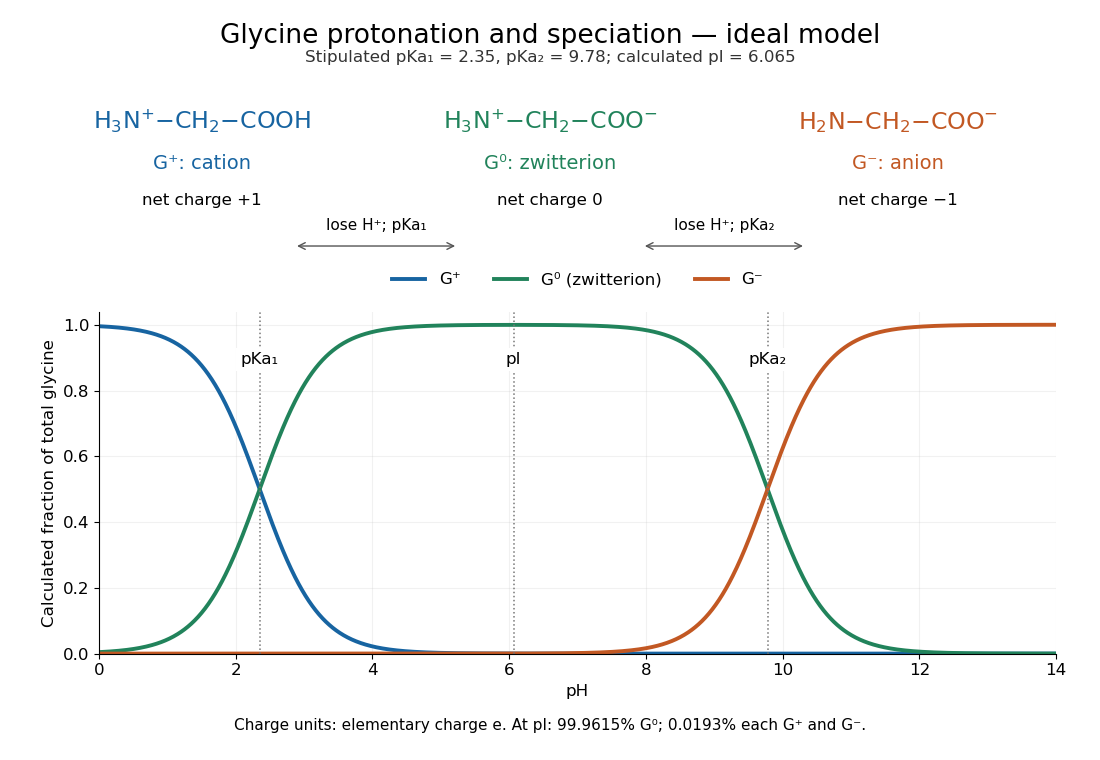

In an ideal aqueous chemical solution, set , with , and approximate activity coefficients by one. Put and for the stipulated dimensionless acid dissociation constants. The Henderson-Hasselbalch equation gives the adjacent-state ratiosWith analytical concentration , normalization gives the three fractions and mean electric charge in units of the elementary charge:All three fractions are nonnegative and sum to one. At pH , the model gives about zwitterion, cation and anion; . Predominantly zwitterionic therefore need not mean exactly at the isoelectric point.
Setting requires . Taking the logarithm yieldsAt this model isoelectric point, and : about of each charged form remains. At either pKa, the relevant adjacent fractions are equal, but the third fraction is not mathematically zero. This three-state model neglects the minor uncharged form ; macroscopic pKa values alone do not determine its fraction separately from the zwitterion.
Adding sodium hydroxide to acidified glycine successively removes its two titratable protons. Two broad buffer solution regions appear around the two pKa values, separated by a steep pH rise near the isoelectric point. This is useful evidence for two separated acid-base chemistry steps even though the changing chemical species are invisible. In the approximation that added hydroxide only changes glycine protonation, is the added base amount of substance per initial amount of substance of glycine. Then , and correspond to , and ; endpoints are not exactly pure chemical species. [ref]
Organic Chemistry by John McMurry. §26.2, Figure 26.2: calculated two-leg titration and half-equivalent interpretation
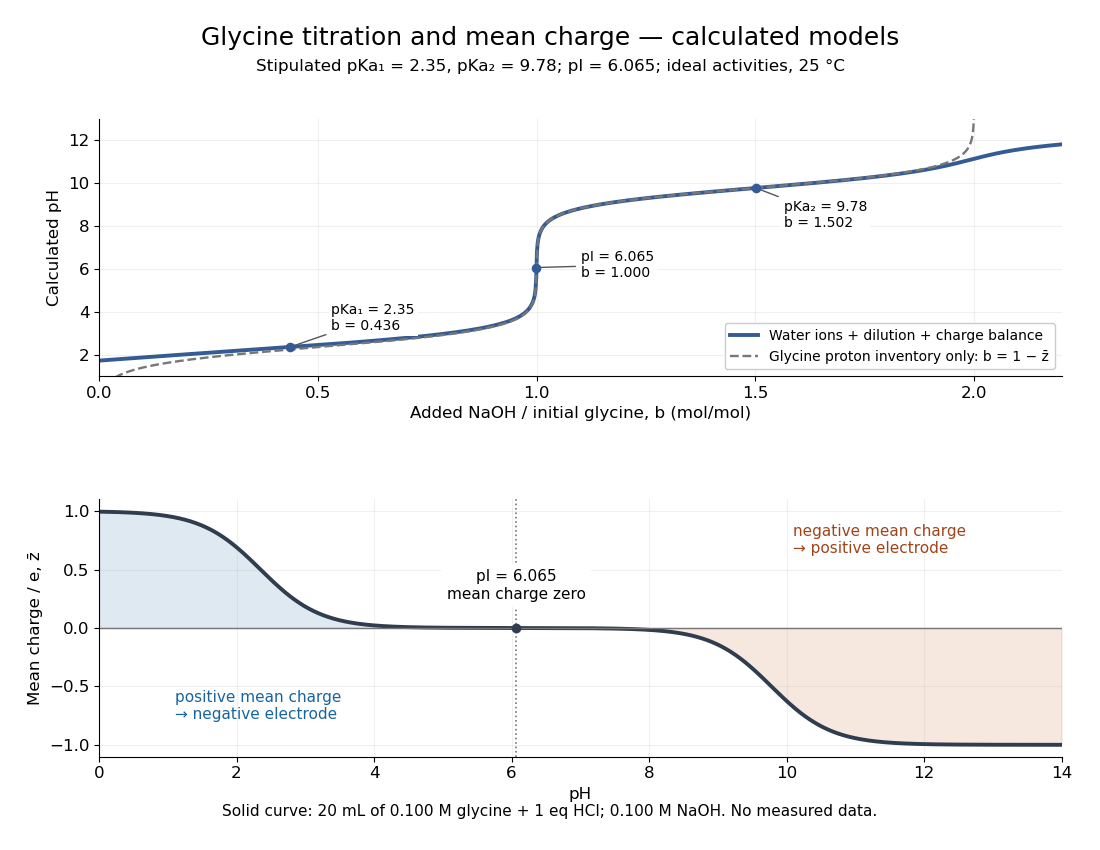

For the solid-curve model, start with of glycine in and exactly of fully dissociated hydrochloric acid; this fixes the chloride inventory, but does not force every glycine molecule to remain . Let the sodium hydroxide concentration be and . Assume volume is additive and no other ions are present; stipulate for self-ionization of water at a temperature of . ThenBalancing all positive and negative electric charges requiresSolving this equation gives the solid curve. It remains finite at and beyond , where ignoring free hydronium and hydroxide would fail. At the first pKa, the full model gives , rather than : appreciable free hydronium makes that half-equivalent shortcut inaccurate. At the second pKa, . Known acid inventory, dilution, and thermodynamic activity assumptions are therefore part of any quantitative interpretation, not optional corrections inferred from the curve's shape.
The Amrita Virtual Lab procedure uses glycine, hydrochloric acid and sodium hydroxide, two burettes, a pH meter, beaker and stirrer. A pipette transfers of glycine into a beaker. Calibrate the meter with standard buffer solutions at pH , and , then record the starting pH. Add hydrochloric acid in increments, recording pH after each addition until . Rinse the electrode in distilled water, take a separate fresh portion, and add sodium hydroxide in increments until pH . Its observed readout is paired added volume and pH, plotted as an acid-base titration curve; it does not measure each glycine form directly. [ref]
These are two titrations from the starting glycine chemical solution, rather than the single acidified-sample protocol assumed by the solid curve in glycine titration. Retain each portion's initial volume and the signed added acid/base amount of substance; do not concatenate raw burette readings and assume the result begins at . For this procedure's of glycine, each addition supplies of acid or base, a increment relative to the glycine inventory. This calculated resolution is not a reported measurement.
Useful additional controls are a fresh repeat portion, independently checked acid/base concentrations, a water blank, and a calibration-check buffer solution after the run. Stir without striking the glass electrode, keep its sensing region immersed and wait for stable readings; record temperature and background salts. Reduce addition size near a steep pH change. These are suggested controls for testing the model, beyond the published steps. A water blank can reveal contamination but must not be subtracted directly from pH, which is a logarithm.
The standards at pH , and do not bracket either endpoint of this protocol. Extreme readings therefore require independently checked instrument performance, and alkaline samples are sensitive to atmospheric carbon dioxide uptake. Electrode drift, incomplete mixing, volume error, dilution and changing ionic strength can shift apparent pKa values. A titration constrains the acid/base model; it cannot establish chirality or separate every microscopic protonation form. The two original diagrams show calculated predictions to compare with measured points, not reconstructed experimental data.
Leucine is an amino acid with a branched hydrophobic side chain. In proteins, that side chain often participates in packing away from water, while the amino-acid backbone forms peptide bonds.
Leucine is also a metabolic signal. Direct leucine sensing by Sestrin2 connects amino-acid availability with the mTORC1 pathway; the original study used binding and signalling measurements to distinguish sensing from mere correlation.[ref]
Sestrin2 is a leucine sensor for the mTORC1 pathway by Rachel L. Wolfson and others. Leucine binding and regulation of the Sestrin2-GATOR2 interaction
Glutamic acid is an amino acid with a second carboxylic acid group in its side chain. Near physiological pH, this side chain is mostly deprotonated, giving glutamate.
Transamination connects the glutamate carbon skeleton with 2-Oxoglutarate. This allows amino groups to be transferred between carbon skeletons, making glutamate central to nitrogen metabolism as well as a constituent of proteins.
Glutamate is an anionic form of glutamic acid, with one fewer proton. The acid and anion are different chemical species.
Citric acid is a six-carbon hydroxytricarboxylic acid, . Its three carboxyl groups can lose protons successively, producing differently protonated forms of citrate.[ref]
This acid-base speciation matters when interpreting citrate-containing buffers or metal complexes. A total citric-acid inventory does not specify one unique charge state in every solution.
Citrate denotes an ion derived from citric acid. The commonly specified form has electric charge equal to that of three electrons and chemical formula ; it results from removing three hydrogen ions from citric acid. Forms with additional hydrogen ions attached through protonation also occur. [ref]
https://www.ebi.ac.uk/chebi/CHEBI:16947. ChEBI, citrate(3−)
Phosphoenolpyruvic acid is the acid form of phosphoenolpyruvate, a phosphorylated enol derivative of pyruvic acid. Its phosphate group is attached through oxygen to the enol system.
In glycolysis, transfer of that phosphate group to ADP forms ATP and pyruvate. Conversion of the initial enol product into the more stable keto form helps favour the overall reaction, connecting molecular rearrangement with energy transfer.
Phosphoenolpyruvate supplies a phosphate group to ADP in the final glycolysis step catalyzed by pyruvate kinase. The free ionic form used in the worked balance has charge .
Lactic acid is 2-hydroxypropanoic acid, . Its central carbon is a stereogenic centre, and its conjugate base is lactate.
In lactic acid fermentation, reduction of pyruvate to lactate regenerates NAD+ from NADH. That regeneration allows glycolysis to continue when the pathway cannot rely on sufficiently rapid respiratory oxidation of NADH.
Lactate is the conjugate base of lactic acid. Lactate dehydrogenase couples its interconversion with pyruvate to the NAD+/NADH redox pair.
Trichloroacetic acid is a chlorinated carboxylic acid, used for protein precipitation in the Nirenberg and Matthaei experiment.
Malic acid is a four-carbon dicarboxylic acid with one hydroxyl group. Its deprotonated form, malate, is an intermediate of the citric acid cycle.
Oxidation of malate to oxaloacetate couples a change in the carbon skeleton's functional groups to reduction of NAD+. The reaction illustrates why protonation state and oxidation state are separate aspects of a metabolite's identity.[ref]
The citric acid cycle by Hans Adolf Krebs. Table 1, malic and oxaloacetic acids
Malate is the anion obtained by removing both carboxyl protons from malic acid. Its protonation state distinguishes it from the acid.
L-malate is the malate enantiomer with configuration at its hydroxyl-bearing carbon. In the dianionic form specified here, its formula is . The stereochemical label and the charge state answer separate questions: one specifies the spatial arrangement around a stereogenic carbon, while the other specifies loss of the two carboxyl protons.[ref]
The connectivity can be written schematically asbut that flat condensed structural formula does not by itself distinguish the two enantiomers. An opposite configuration has the same elemental formula and charge. Likewise, changing protonation of a carboxyl group is not the same operation as reversing the stereochemical arrangement at the carbon bearing OH.
A metabolic transformation makes this distinction useful. The NAD-dependent oxaloacetate-forming reaction EC1.1.1.37 oxidizes L-malate to oxaloacetate while reducing NAD+ to NADH. Conversion of the hydroxyl-bearing carbon to a carbonyl removes that stereogenic center in the oxaloacetate framework. This is a covalent oxidation, rather than simply another protonation state of malate.[ref]
Enzyme Nomenclature by the IUBMB. EC1.1.1.37, accepted name, Reaction and Comments: NAD-dependent oxaloacetate formation
Articles by others on the same topic
There are currently no matching articles.