Memory thrashing is repeated costly cycling of memory pages out of and back into computer memory, leaving little useful computation between page faults. Active demand can exceed the available page frames, especially when multiprogramming admits too many operating-system processes. A high page fault rate during initial loading alone does not establish memory thrashing. [ref]
Beyond Physical Memory: Policies. Arpaci-Dusseau and Arpaci-Dusseau, OSTEP chapter 22, section 22.11: Thrashing
Consider one operating-system process making the 20 memory references : five repetitions of four memory pages. Start with an empty resident set, use demand paging and exact LRU replacement, and assume no prefetching or competing operating-system processes. A hit finds the requested memory page resident; a miss requires a nonresident page fault. With three page frames, references 1–3 load pages 1–3. Reference 4 evicts page 1, reference 5 reloads page 1 and evicts page 2, and the cycle continues: every return finds its memory page evicted. With four page frames, only the first four references miss; all four memory pages then remain resident.
| Available page frames | Misses in all 20 memory references | Overall page fault rate | Misses in references 5–20 | Page fault rate in references 5–20 | 3 | 20 | 100% | 16 | 100% | 4 | 4 | 20% | 0 | 0% |
|---|
The four initial misses with four page frames are compulsory first-use misses from the empty resident set. They are startup work; the three-page frame case keeps faulting after startup. This makes the difference between memory thrashing and loading a new working set visible. For the three-page frame trace, each reused memory page has three distinct intervening memory pages, so LRU replacement has already evicted it before its next use.
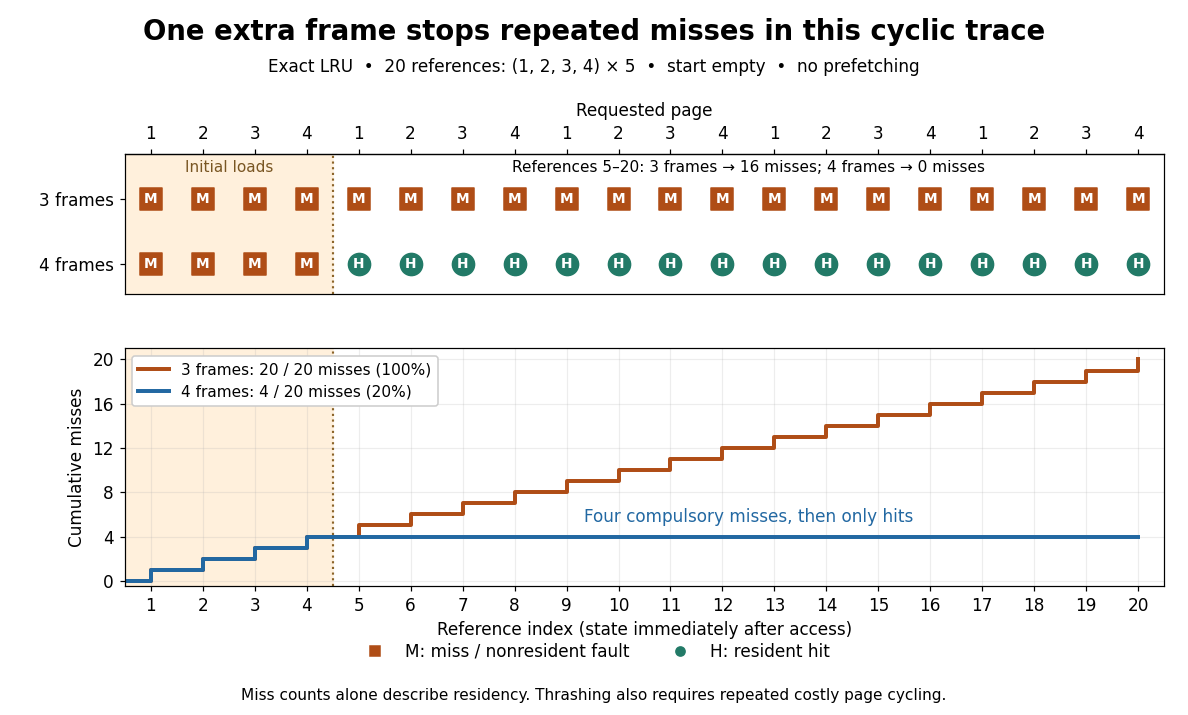
The same 20 memory references under LRU replacement: three page frames miss every time, four miss only during startup
. Details. 
To quantify the cost, assume each hit takes 100 nanoseconds and each miss incurs an additional 1 millisecond of page fault service, followed by the same 100-nanosecond memory access. These are toy latencies, not measurements. With miss probability , the expected value of access time isThe service cost is additional: it does not include the final 100 nanoseconds. Thus gives and gives , approximately a fivefold ratio over the complete trace. Over references 5–20, the corresponding ratio is : repeated page faults dominate the useful accesses. The expected value model follows the additive miss-penalty convention of OSTEP chapter 22, section 22.1. [ref]
Beyond Physical Memory: Policies. Arpaci-Dusseau and Arpaci-Dusseau, OSTEP chapter 22, equation 22.1: average memory access time
Not every page fault performs disk input-output: demand paging can allocate zero-filled memory pages, and copy-on-write can copy an existing page frame. The toy service cost models expensive misses; the miss trace alone establishes residency behavior, while memory thrashing additionally concerns repeated costly cycling. [ref]
https://pages.cs.wisc.edu/~remzi/OSTEP/vm-complete.pdf. Arpaci-Dusseau and Arpaci-Dusseau, OSTEP chapter 23, section 23.1, Other Neat Tricks: demand zeroing and copy-on-write
Possible remedies are more resident page frames, less multiprogramming, or reorganizing accesses to improve temporal locality. For this toy sequence, one extra page frame suffices under LRU replacement; that is not a universal threshold or policy. Page replacement alone cannot make every simultaneously needed memory page fit.
// Target: computer-science.bigb
Articles by others on the same topic
There are currently no matching articles.