A transformation monoid is a collection of self-maps of a fixed set that contains the identity function and is closed under function composition. The associative property comes from function composition. A monoid action describes transformations of a set that obey a monoid's multiplication and identity laws.
The full transformation monoid consists of every self-map of , with function composition as its binary operation. For , there are four functions: the identity function , the swap , and the constant functions . Their composition order matters: , whereas . Thus associativity does not imply commutativity.
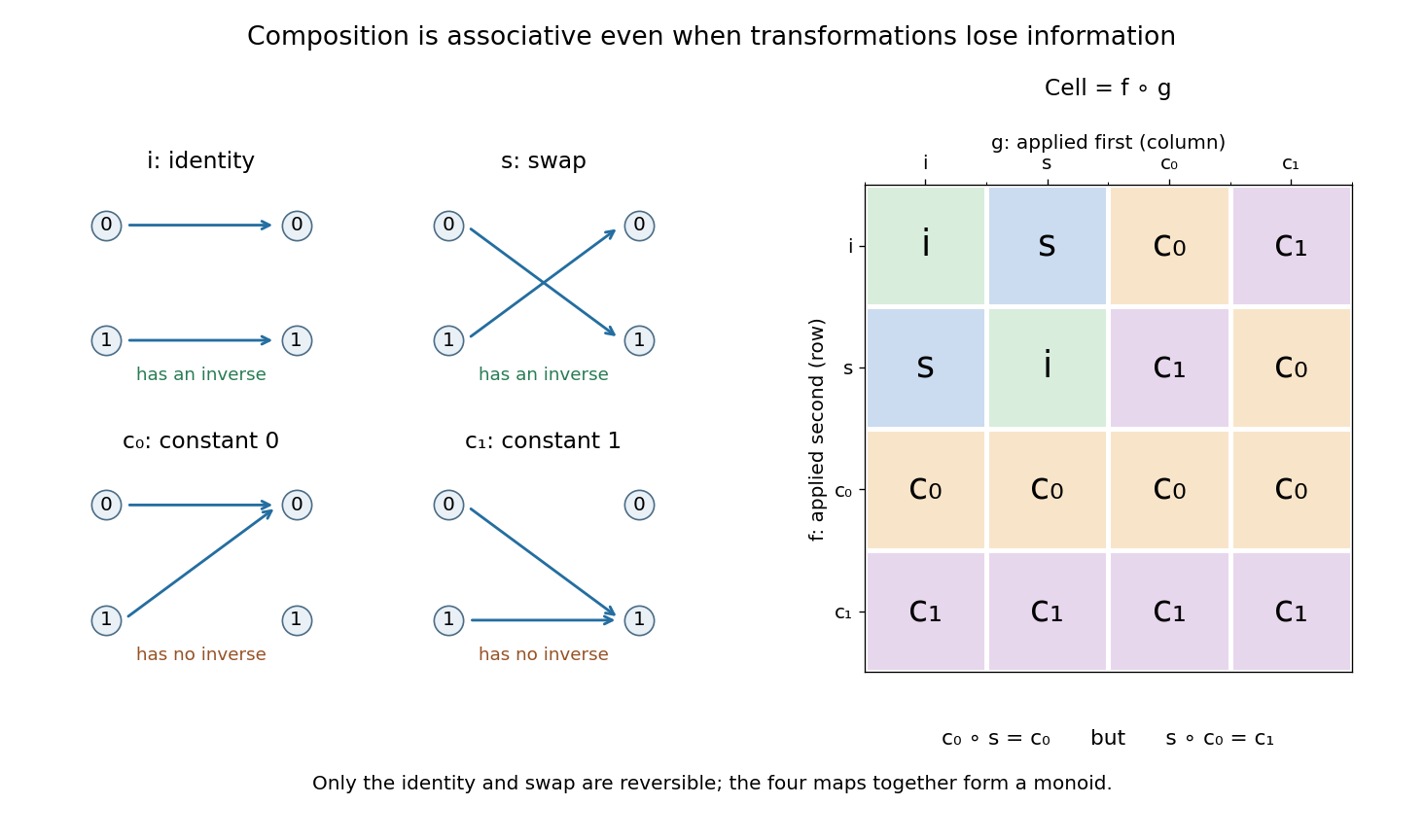

Only and are bijections, and their inverse elements are themselves. They form a two-element group within this monoid. The constant functions instead satisfy and , so they are idempotent elements of a semigroup. Such irreversible transformations explain why the monoid setting is useful even when a group would be too restrictive.
Articles by others on the same topic
There are currently no matching articles.