Ugo Piomelli researches computational models of turbulence, including large eddy simulation. Queen's University's institutional account describes work aimed at predicting complicated flows with tractable computational cost and identifies his former Canada Research Chair in turbulence simulation and modeling.[ref]
Ugo Piomelli research profile by Queen’s University. Research description and former chair designation
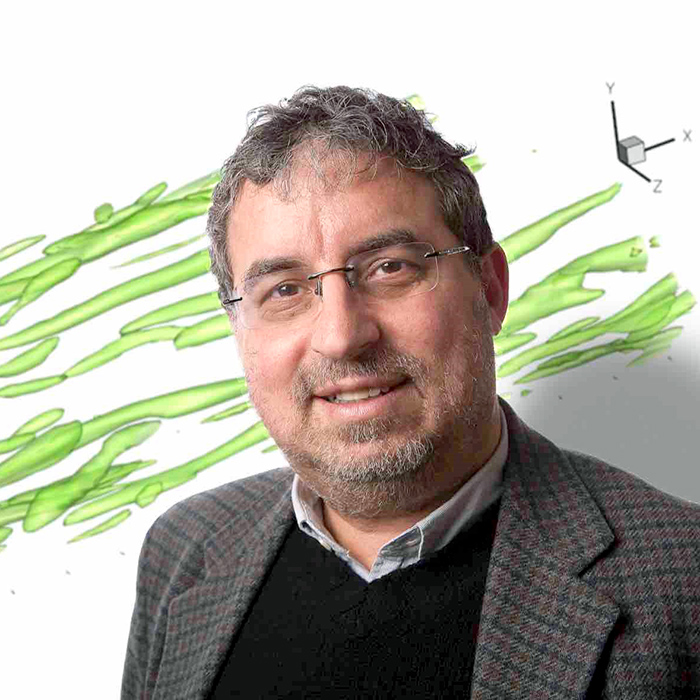
Ugo Piomelli
. Identified portrait from Ugo Piomelli research profile by Queen’s University.Piomelli coauthored the dynamic subgrid-scale model work with Massimo Germano, Parviz Moin and William H. Cabot.[ref] In a retrospective with Moin, he describes incorporating the proposed model into a channel-flow code. An initially delayed transition proved to reflect an incorrectly entered perturbation amplitude; correcting it changed the comparison with reference data.[ref]
Thirty years of Dynamic Modeling by Ugo Piomelli and Parviz Moin. Page3, implementation and initial-condition error
The episode makes a methodological point: a discrepancy can test the closure, the numerical implementation or the specified physical problem. If one simulation starts with a disturbance one hundred times smaller than intended, equal times no longer represent equal stages of its growth. Checking initial conditions therefore precedes attributing every difference to the subgrid-scale model. The numerical factor in this illustration is hypothetical; the retrospective does not quantify the mistyped factor.
Articles by others on the same topic
There are currently no matching articles.