Use a freely rotating chain: fixed bond length , fixed angle between forward bond vectors, and independently random torsion angles. Then , giving the orientational persistence length of a freely rotating chainThe equivalent long-chain Kuhn length divided by two, , is nearly equal here but is a distinct discrete-chain convention. A chemical internal bond angle is supplementary to the forward-vector angle used above.
Synthetic examples are relatively stiff poly(p-phenylene terephthalamide) and flexible polydimethylsiloxane. Light scattering and viscometry established rodlike solution conformations for the former; single-chain mechanical measurements support the latter's flexibility. Persistence is solvent- and model-dependent, so no universal numerical value is inferred for either example.[ref]
Properties of some rodlike polymers in solution by C.-P. Wong and others. publisher abstract, dilute-solution light scattering and viscometry
[ref]Understanding the Extraordinary Flexibility of Polydimethylsiloxane through Single-Molecule Mechanics by Song Lu and others. abstract, single-chain atomic-force measurements and flexibility
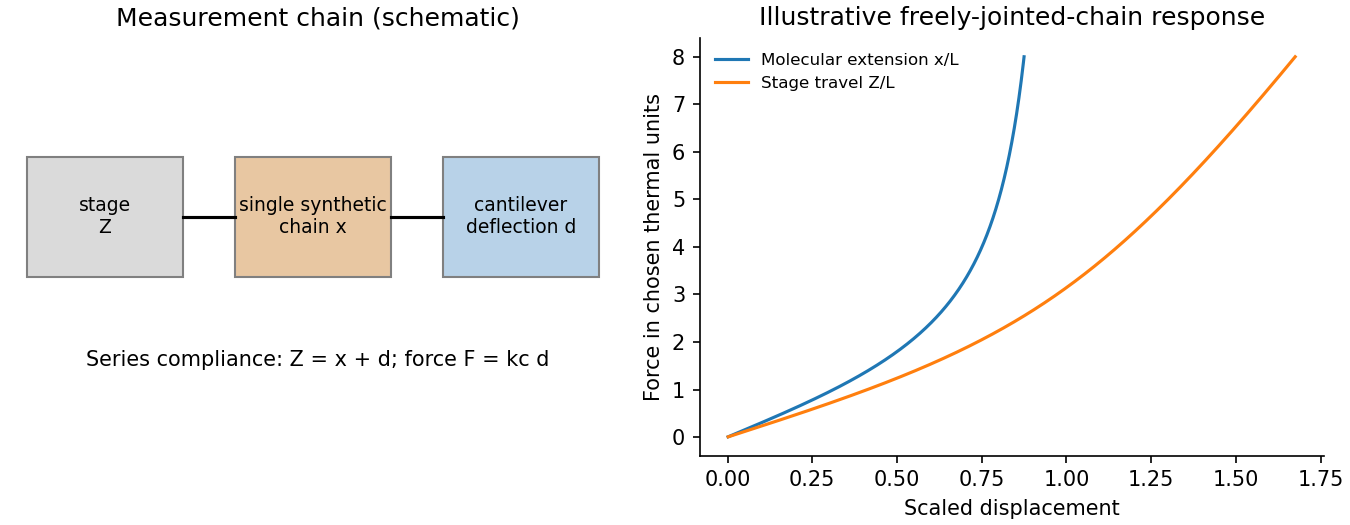
single-molecule force spectroscopy measures force and extension of an individual tether while controlling position or load. In an atomic-force arrangement, a synthetic chain connects a cantilever probe to a translated substrate. For the cantilever compliance correction, a deflection sensor gives , a calibrated spring constant gives , and substrate displacement gives chain extension after geometric offsets are removed. Additional linkers and instrument compliance must be included if appreciable. Thermal deflection calibration uses only after isolating the cantilever's calibrated thermal contribution.
An optical-tweezers implementation detects a tethered bead's displacement from a calibrated trap centre, with in the harmonic regime. Detector calibration, drag and trap linearity determine the usable force and frequency range. These instruments measure individual force–extension curves and distributions; averaging many curves can hide multiple tether populations.
For a synthetic freely jointed chain with Kuhn length ,A strongly stretched worm-like chain instead has before backbone stretching becomes important. Fits can estimate contour and persistence lengths only in their appropriate regimes. Hysteresis and pulling-rate dependence test whether an apparent mechanical transition is quasistatic or activated.
Control single versus multiple attachments, subtract nonspecific adhesion, vary pulling speed, calibrate temperature and stiffness, and correct drift. A rupture peak is not a universal bond strength independent of loading history. A primary nonbiological example measured individual polydimethylsiloxane chains by atomic-force methods; its flexibility interpretation combines those measurements with molecular calculations.[ref]