Stipulate a distant circular source of uniform angular brightness, full angular diameter in radians, and narrow optical bandwidth around wavelength . Distinct source patches emit independently. Assume each collector is small enough not to resolve the disk individually. For a sky offset from the disk centre, the baseline-dependent phase difference is , up to channel-sign convention. Summing independent patch contributions makes the equal-delay first-order optical coherence the normalized Fourier transform of angular brightness:Choose the horizontal coordinate along , put , and integrate along vertical chords of the disk:The imaginary part cancels between opposite chords. Here is the order-one Bessel function of the first kind. One way to obtain the last equality is to integrate the exponential's power series term by term on the finite disk. Equivalently the result is specified by the convergent seriesAt take the continuous limit ; starts as . This is why very short interferometric baselines give little leverage on angular diameter. Larger disks lose spatial optical coherence at shorter baselines.
The first positive zero of is , soThis is a full diameter convention. The angle must be converted before substitution: one arcsecond is radians, and one milliarcsecond, abbreviated mas, is arcseconds. For the stipulated and , and . At , the model gives and .
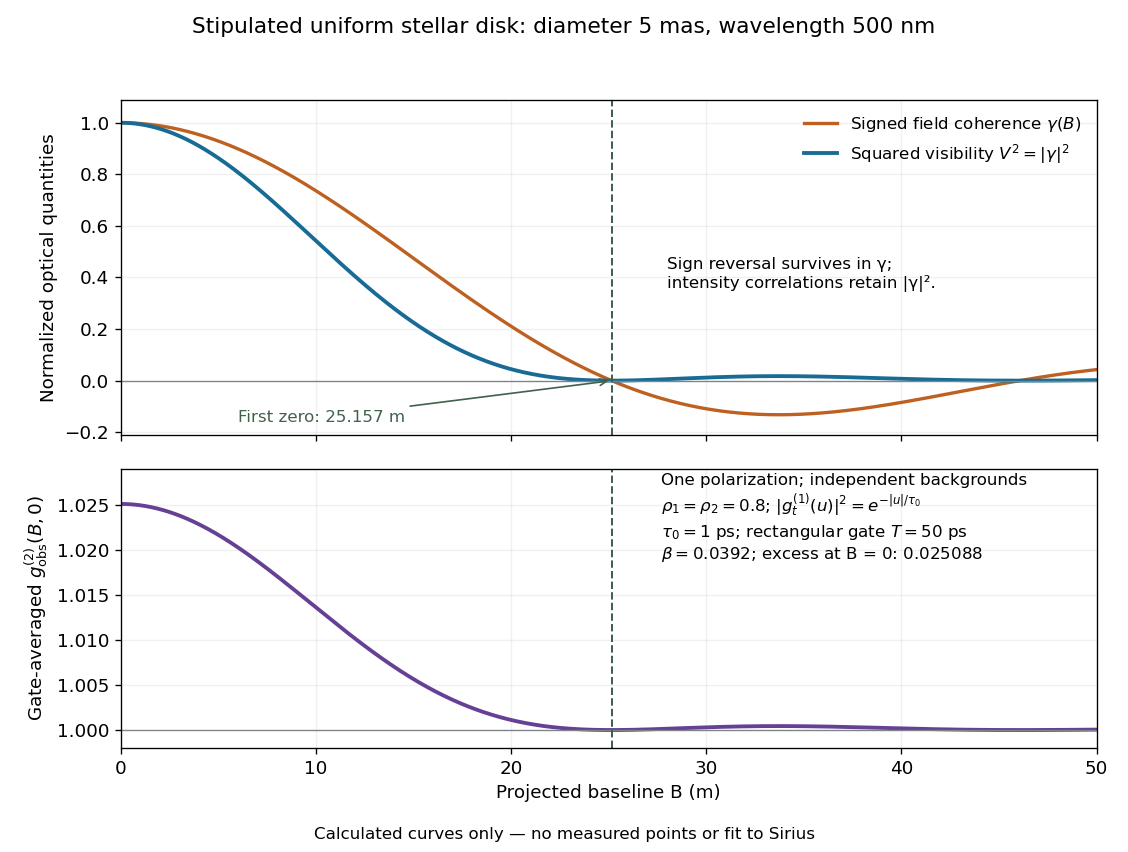
Stipulated uniform-disk model: signed field coherence, squared visibility and finite-gate intensity correlation versus interferometric baseline
. Original calculated curves for a 5-mas disk at 500 nm, with no measured points. The lower panel uses one polarization, independent signal fractions 0.8 in each channel, and the explicitly specified exponential temporal correlation and 50-ps gate below. It is not a fit to Sirius. Details.
Beyond , changes sign but stays nonnegative and develops weak further lobes. A single measured squared visibility can therefore match several angular diameters; sampling several interferometric baselines constrains the fit. Limb darkening, spectral averaging, or resolved collector apertures change the uniform-disk prediction. A uniform-disk diameter is a parameter of that brightness model; converting it to a physical stellar radius also requires distance and an appropriate brightness profile.
Articles by others on the same topic
There are currently no matching articles.