Use a linear shear flow to see why straight pathlines can still carry local spin. Faster layers pull past slower ones, and a small symmetric paddle can turn clockwise while its center travels straight ahead.
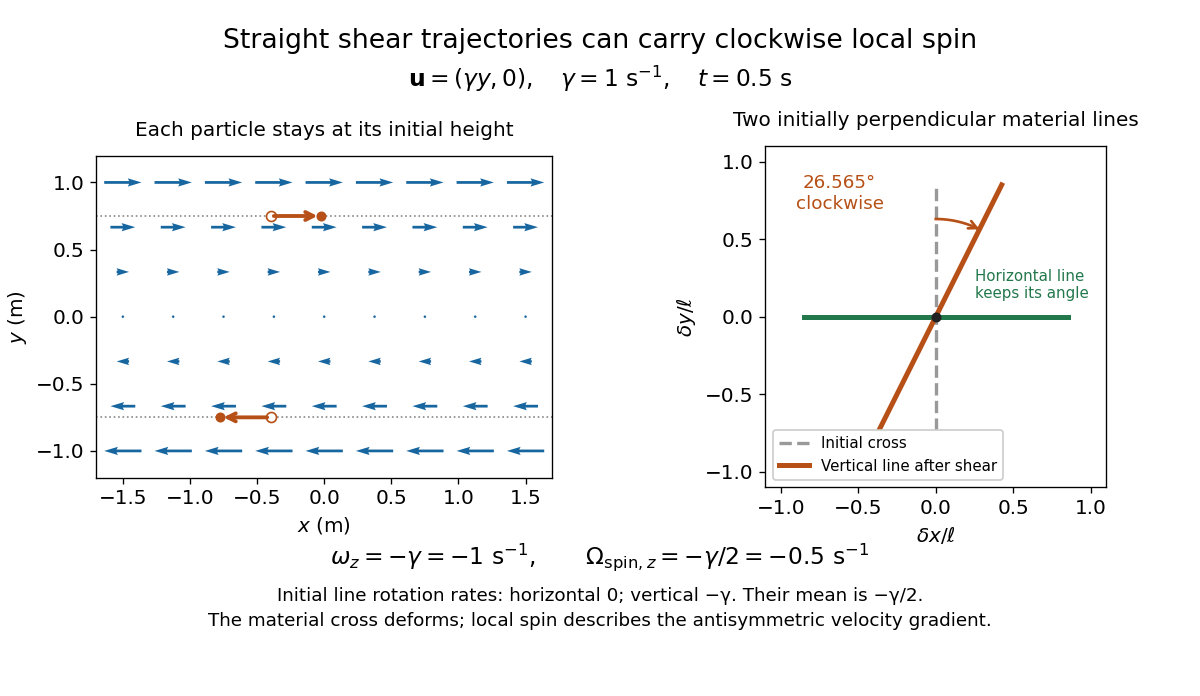
Straight particle paths in linear shear coexist with clockwise local spin and material-line deformation
. Details. 
For the planar simple shear flow with constant signed shear rate , direct differentiation givesWith , these are and : both signs indicate clockwise orientation under the right-hand rule. Yet a particle initially at follows the straight pathline , . The curl measures differences of velocity between neighboring particles, rather than bending of one particle's pathline.
The velocity gradient has as its only nonzero entry. Its spin tensor supplies clockwise rotation, while its rate-of-strain tensor supplies simultaneous deformation. For a material line making angle to the horizontal, the equation gives . Initially horizontal and vertical material lines therefore have angular velocities and ; their mean is . At with , an initially vertical displacement becomes times its original length and has angle , a clockwise change of . The plotted cross deforms; an actual paddle's response also depends on its shape and interaction with the fluid. The exact local spin statement concerns the spin tensor, rather than every tracer's orientation.
Articles by others on the same topic
There are currently no matching articles.