Walter Gilbert helped turn questions about gene regulation and DNA sequence into experimentally accessible molecular measurements. He moved from physics toward molecular biology at Harvard; the Cold Spring Harbor Laboratory archive records that transition and preserves his research collection.[ref]
Walter Gilbert in the Cold Spring Harbor Laboratory archives. Institutional biography and Scope and Content
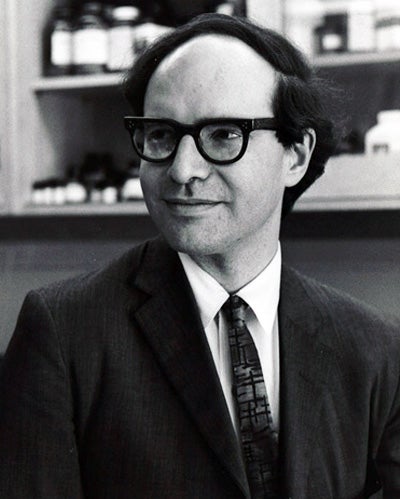
Walter Gilbert, portrait identified by Cold Spring Harbor Laboratory and credited to Harvard News Service
. Source. With Benno Müller-Hill, Gilbert reported isolation of the lac repressor in 1966. Their assay detected binding to an inducing small molecule using equilibrium dialysis, providing a biochemical handle on a genetically inferred control protein.[ref]
Isolation of the lac repressor by Walter Gilbert and Benno Müller-Hill. printed p. 1891, assay description
The distinction between a measurable binding activity and a fully established regulatory mechanism remains important: the assay did not assume that every detail of operator recognition was already known.With Allan M. Maxam, he later developed the chemical DNA sequencing method now called Maxam-Gilbert sequencing. Their 1977 paper described partial cleavage at selected bases in terminally labeled DNA, followed by polyacrylamide gel electrophoresis to resolve fragment lengths.[ref]
A new method for sequencing DNA by Allan M. Maxam and Walter Gilbert. PNAS 74, pp. 560–564, Abstract
A ladder of labeled fragment lengths converts chemical specificity into information about positions along a strand.An original schematic inference illustrates the readout. Suppose calibrated fragment-length patterns assign A to positions 1 and 6, G to positions 2 and 5, C to positions 3 and 7, and T to positions 4 and 8. Combining the position sets gives AGCTGACT in the stated reading direction. A G-selective measurement alone would leave six positions unresolved; the different chemical channels supply complementary information.
The example abstracts away migration calibration, cleavage-site offsets and band overlap. Real interpretation requires identifying the labeled end and relating each band to the appropriate base position. This sequencing approach interrogates a pre-existing labeled strand through cleavage, so its measurement logic is different from inferring sequence from terminated synthesis products. Gilbert's work exemplifies how designing a recoverable physical signal can transform an otherwise indirect molecular question.
Articles by others on the same topic

Walter Gilbert is an American biochemist and molecular biologist renowned for his significant contributions to the field of genetics. Born on March 21, 1928, he played a crucial role in the development of techniques for DNA sequencing, which have been foundational for modern genetic research. In 1980, he was awarded the Nobel Prize in Chemistry, along with Fred Sanger, for their work on the sequencing of proteins and nucleic acids.