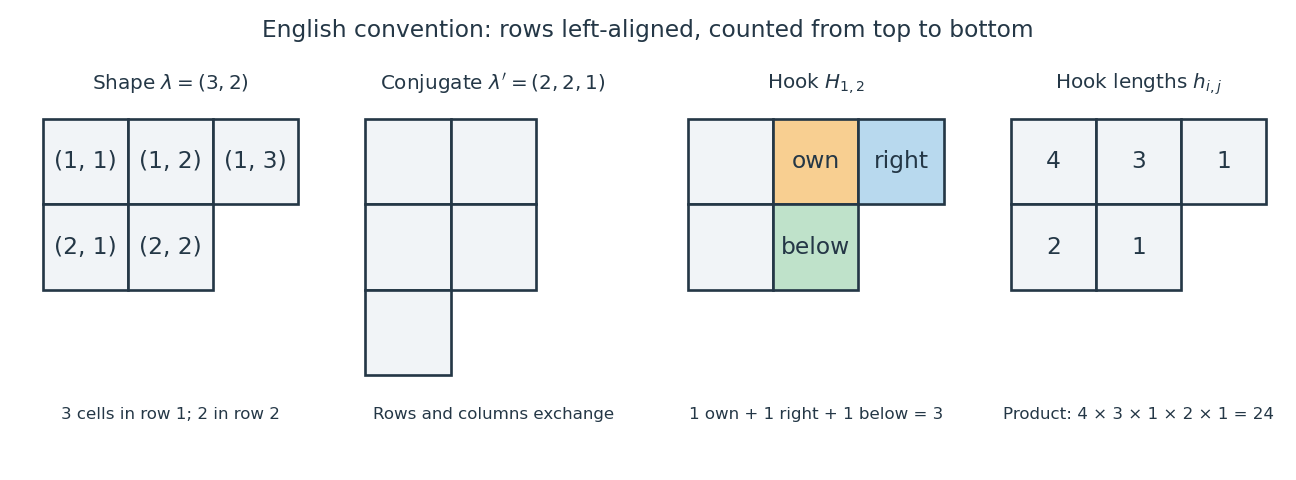

The Young diagram of a partition of an integer consists of one unit square, or cell, for each pairThroughout this article we use the English convention: rows are left-aligned, row is at the top, row indices increase downwards, and column indices increase to the right. The row lengths weakly decrease from top to bottom. Thus has cells , with three cells above two. In the French convention the longest row is drawn at the bottom; the underlying partition of an integer is unchanged, but directions in descriptions of hooks of a Young diagram and standard Young tableaux must be interpreted consistently. See Grinberg's hook-length-formula teaching slides, §§1.1–1.2, for diagrams with the same orientation.
The number of cells is , and reading the row lengths recovers the partition of an integer. Reading the column lengths instead gives its conjugate partition. This turns numerical inequalities into visible geometry: Young diagrams satisfywith missing parts treated as zero. For example, . This inclusion is the order in Young's lattice; it differs from dominance order on partitions, which compares sums of initial parts of partitions of an integer of the same size. The partition of an integer dominates because their successive sums are , , and , but neither Young diagram contains the other: one has cell , the other .
The beauty of a Young diagram is that its shape simultaneously records a partition of an integer, indexes a Specht module, and supports local quantities such as hook lengths that determine a global dimension. Filling its cells leads to Young tableaux; adding one cell at a time leads to the Young branching graph.
For diagram inclusion , the skew Young diagram consists of the cells of outside . Diagram inclusion is not the dominance order on partitions. Edge adjacency defines its connected components, and a connected skew diagram without a square is a rim hook.
A standard skew Young tableau fills the cells of a skew Young diagram bijectively with , increasing along each row and column. Equivalently it is a linear extension of a partially ordered set formed from the row and column inequalities. Interchanging consecutive labels preserves standardness exactly when their cells are incomparable in that partial order.
Here , with zero entries for negative factorial arguments. Extract the squarefree monomial from the skew Jacobi–Trudi identity. A product contributes because its distinct labels are assigned to the factors in that many ways. Summing determinant signs proves the formula, since a squarefree semistandard Young tableau is a standard skew Young tableau.
A horizontal strip is a skew Young diagram containing at most one cell in each column. Equivalently, is a horizontal strip when for all . The multiplicity of the trivial representation in the associated skew representation of a symmetric group is one for horizontal strips and zero otherwise. A column with two cells supplies a cyclic tableau vector on which an adjacent transposition acts by , excluding invariants.
Under edge adjacency, a skew Young diagram is totally disconnected when every component has one cell. This means that no two cells share an edge. It is stronger than being a horizontal strip, which excludes repeated columns but permits adjacent cells in one row. The trivial-constituent criterion for a skew representation of a symmetric group concerns horizontal strips, not total disconnection in this sense.
A hook partition has shape , . Equivalently its Young diagram has no cell , so its only cell of content zero is . Its standard Young tableaux are counted by : choose the entries below the initial , then the column and remaining row orders are forced.
An addable node is a cell outside a Young diagram whose insertion leaves a Young diagram. Its left and upper predecessors, when present in the positive-coordinate grid, must already belong to the diagram. Different addable nodes have distinct Young-diagram cell contents.
A removable node is a cell whose deletion leaves a Young diagram. The set consists of the distinct partitions obtained by deleting one removable node from .
The conjugate partition exchanges rows and columns in a Young diagram: the cell becomes . Equivalently,For , the three column lengths are , so , as shown in Young diagram. Conjugating twice returns the original partition of an integer, and the number of cells stays five. Transposition also preserves hook lengths, with ; consequently the hook-length formula gives equal dimensions for the two Specht modules over the complex numbers. This row-column symmetry is already used in §1 of [ref]
https://doi.org/10.4153/CJM-1954-030-1. Frame, Robinson and Thrall's 1954 paper
.In the English convention of Young diagram, the hook at a cell consists of that cell itself, all cells to its right in the same row, and all cells below it in the same column:Here is the conjugate partition. The cells to the right form the arm of a Young-diagram cell, and those below form the leg of a Young-diagram cell. Both extend all the way to the edge of the Young diagram, rather than containing just the immediate neighbors. The three pieces are disjoint, so their total cardinality is one plus the two lengths.
For , the highlighted Young-diagram hook is , of hook length three. The hook at is , of hook length four: the southeast cell is excluded because it is in neither the anchor's row nor its column. These local shapes are useful because their hook lengths give the denominator of the hook-length formula. The hook terminology and its use to calculate representation degrees appear explicitly in §1 of [ref]
https://doi.org/10.4153/CJM-1954-030-1. Frame, Robinson and Thrall's original paper
.The arm consists of the cells strictly to the right of in its row of the Young diagram; its length is . It excludes the anchor cell. At in the arm contains only , so its length is one. Together with the leg of a Young-diagram cell and the anchor, it forms the hook of a Young diagram.
The leg consists of the cells strictly below in its column of the Young diagram; its length is , where is the conjugate partition. It excludes the anchor cell. At in the leg contains only , so its length is one. Transposing the Young diagram exchanges the leg and the arm of a Young-diagram cell.
The hook length of cell in the Young diagram of a partition of an integer is the number of cells in its Young-diagram hook:Here is the conjugate partition. There is one hook length for every cell, so the multiset of hook lengths has cardinality .
For and , compute and . Continuing cell by cell gives the hook graph of a partitionor the row array . Its hook product is . A cell has hook length one exactly when it is a Removable node of a Young diagram: it has no cell to its right or below. Here these are and . Transposing the Young diagram gives the array with the same hook product; this explains geometrically why conjugate shapes have equal counts in the hook-length formula.
The hook graph is the Young diagram with the hook length written in each box. It displays the hook product and thus the hook-length formula for the corresponding Specht module. This use of the name is recorded in Frame, Robinson and Thrall's original hook-graph paper; it refers to a labeled array, not a directed hook-walk graph.
The product of all hook lengths in a Young diagram is the denominator in the hook-length formula, and the scalar in the quasi-idempotence identity for its Young symmetrizer.
For , the integers from one through split as the disjoint unionTracing the southeast boundary of the hook records the first set at horizontal steps and the second at vertical steps.
If a partition has a hook of length , it has a hook of length . In a beta set, the first hook is a bead-gap pair at distance ; along the arithmetic progression with step , some consecutive pair changes from a bead to a gap.
A rim hook, or border strip, is a connected skew Young diagram containing no square. Its leg length is one less than its number of occupied rows.
For a type , each successive difference is a rim hook of size ; zero parts give empty differences of height zero. Label its cells by . Such fillings are weakly increasing along rows and columns, and the height is the sum of the occupied strips' numbers of rows minus one. Empty parts are omitted from the associated product of positive power sums; the finite-variable degree-zero power sum is not inserted.
The content of the cell is . Transposing the diagram negates every content and preserves every hook length.
The principal hook lengths are along the main diagonal. They are strictly decreasing positive integers, and their sum is the size of the partition.
Articles by others on the same topic
There are currently no matching articles.