
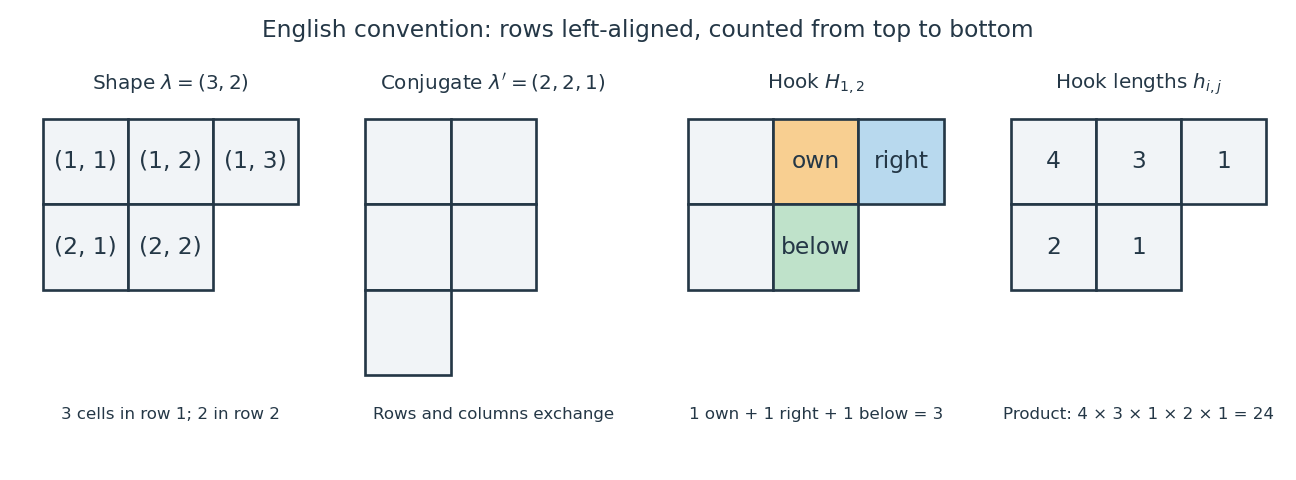

The Young diagram of a partition of an integer consists of one unit square, or cell, for each pairThroughout this article we use the English convention: rows are left-aligned, row is at the top, row indices increase downwards, and column indices increase to the right. The row lengths weakly decrease from top to bottom. Thus has cells , with three cells above two. In the French convention the longest row is drawn at the bottom; the underlying partition of an integer is unchanged, but directions in descriptions of hooks of a Young diagram and standard Young tableaux must be interpreted consistently. See Grinberg's hook-length-formula teaching slides, §§1.1–1.2, for diagrams with the same orientation.
The number of cells is , and reading the row lengths recovers the partition of an integer. Reading the column lengths instead gives its conjugate partition. This turns numerical inequalities into visible geometry: Young diagrams satisfywith missing parts treated as zero. For example, . This inclusion is the order in Young's lattice; it differs from dominance order on partitions, which compares sums of initial parts of partitions of an integer of the same size. The partition of an integer dominates because their successive sums are , , and , but neither Young diagram contains the other: one has cell , the other .
The beauty of a Young diagram is that its shape simultaneously records a partition of an integer, indexes a Specht module, and supports local quantities such as hook lengths that determine a global dimension. Filling its cells leads to Young tableaux; adding one cell at a time leads to the Young branching graph.
New to topics? Read the docs here!