In Qiskit at: qiskit/hello.py.
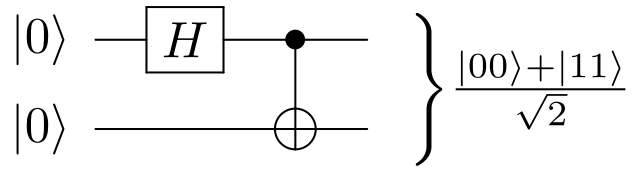
Quantum circuit that generates the Bell state
. Source. 
E.g. with our qiskit/hello.py, we obtain the Bell state circuit:
OPENQASM 2.0;
include "qelib1.inc";
qreg q[2];
creg c[2];
h q[0];
cx q[0],q[1];
measure q[0] -> c[0];
measure q[1] -> c[1];One would hope that they are not Turing complete, this way they may serve as a way to pass on data in such a way that the receiver knows they will only be doing so much computation in advance to unpack the circuit. So it would be like JSON is for JavaScript.
These appear to be benchmarks that don't involve running anything concretely, just compiling and likely then counting gates:
The Busy Beaver Competition: a historical survey by Pascal Michel by  Ciro Santilli 40 Updated 2025-07-16
We ust use the if mod notation definition as mentioned at: math.stackexchange.com/questions/4305972/what-exactly-is-a-collatz-like-problem/4773230#4773230
Course plan:
- Section "Programmer's model of quantum computers"
- look at a Qiskit hello world
- e.g. ours: qiskit/hello.py
- learn about quantum circuits.
- tensor product in quantum computing
- First we learn some quantum logic gates. This shows an alternative, and extremely important view of a quantum computer besides a matrix multiplication: as a circuit. Fundamental subsections:
- quantum algorithms
But what is quantum computing? by 3Blue1Brown
. Source. Ubuntu 23.04 install:
sudo apt install rbaseHello world:
R -e 'print("hello world")'As mentioned in True Genius: The Life and Science of John Bardeen page 224, the idea of symmetry breaking was a major motivation in Josephson's study of the Josephson effect.
Ciro Santilli invented this term, it refers to mechanisms in which you put an animal in a virtual world that the animal can control, and where you can measure the animal's outputs.
- MouseGoggles www.researchsquare.com/article/rs-3301474/v1 | twitter.com/hongyu_chang/status/1704910865583993236
- Fruit fly setup from Penn State: scitechdaily.com/secrets-of-fly-vision-for-rapid-flight-control-and-staggeringly-fast-reaction-speed/
So we see that the classification is quite simple, much like the classification of finite fields, and in strict opposition to the classification of finite simple groups (not to mention the 2023 lack of classification for non simple finite groups!)
There are unlisted articles, also show them or only show them.