See sections: "Example 1 - N even", "Example 2 - N odd" and "Representation in terms of sines and cosines" of www.statlect.com/matrix-algebra/discrete-Fourier-transform-of-a-real-signal
The transform still has complex numbers.
Summary:Therefore, we only need about half of to represent the signal, as the other half can be derived by conjugation.
- is real
"Representation in terms of sines and cosines" from www.statlect.com/matrix-algebra/discrete-Fourier-transform-of-a-real-signal then gives explicit formulas in terms of .
NumPy for example has "Real FFTs" for this: numpy.org/doc/1.24/reference/routines.fft.html#real-ffts
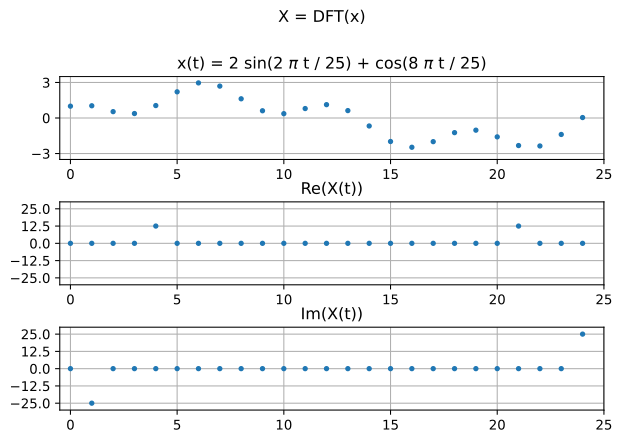
DFT of with 25 points
. Source at: numpy/fft_plot.py. This plot illustrates how the DFT of a real signal is symmetric around the middle point, and so only half of the transform points are needed to reconstruct the original signal. We also see how the phase of the sinusoids determines if their DFT components are real or imaginary.Published as: arxiv.org/pdf/2304.03442.pdf Generative Agents: Interactive Simulacra of Human Behavior by Park et al.


Atomic and laser Physics subdepartment of the University of Oxford by  Ciro Santilli 40 Updated 2025-07-16
 Symmetry in Condensed Matter Physics course of the University of Oxford by Ciro Santilli 40 Updated 2025-07-16
Ciro Santilli 40 Updated 2025-07-16www2.physics.ox.ac.uk/students/course-materials/symmetry-in-condensed-matter-physics# Archive: web.archive.org/web/20230804204137/https://www2.physics.ox.ac.uk/students/course-materials/symmetry-in-condensed-matter-physics Lecture notes from 2019.
Professor: Radu Coldea
Group of students that represent students academic views about the courses.
Subdepartment of the Department of Physics of the University of Oxford by Ciro Santilli 40 Updated 2025-07-16
Ciro Santilli 40 Updated 2025-07-16It is said that you leave Oxford with either
Things actually have gotten more and more closed, e.g. of stuff getting paywalled with time:
It appears that things got really bad starting in 2017, possibly when WebLearn was introduced. When things migrated to Canvas, they were closed by default, apparently with any mechanism to publish publicly.
Therefore, they managed to make things more closed than when teachers would just upload to good old
ox.ac.uk/~name static websites!!Ciro Santilli has also heard that some people in the Mathematical Institute of the University of Oxford opposed to moving away from their Moodle instance precisely because the new options did not support open publishing, so kudos to those people. But most teachers likely don't care and just do whatever is the best internally supported default.
Their "open" video material: podcasts.ox.ac.uk/ A somewhat small part is Creative Commons, but most proprietary. Despite the name "podcasts", they do contain video, it is just a relic.
podcasts.ox.ac.uk/open contains actual Creative Commons only it seems.
It does however appear that professors own their lecture notes, so there some hope maybe: governance.admin.ox.ac.uk/legislation/statute-xvi-property-contracts-and-trusts#collapse1383636
Talks: talks.ox.ac.uk/. Mathematical, Physical and Life Sciences (MPLS) subset: talks.ox.ac.uk/talks/department/id/oxpoints:23232639
University of Oxford documentary by the British Council (1941)
Source. There are unlisted articles, also show them or only show them.