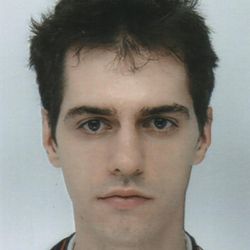
He testified against Ross: arstechnica.com/tech-policy/2015/01/friend-who-helped-ulbricht-build-silk-road-testifies-against-him/
youtu.be/HBTYVVUBAGs?t=178 claims to contain a photo of him without source. He has no easy to find online profiles.
Variety Jones: IRL, is there anyone with a clue at all? A girlfriend, boyfriend, buddy you talk to, etc?myself: Unfortunately yes, there are two but they think I sold the site and got out, and they're quite convinced of it.
When they disabled this from Chromium, it was one of the things that prompted Ciro Santilli to switch to Proton Pass.
Ross Ulbricht told her about Silk Road, but then later said he had sold the website to someone else, without really doing that.
- LinkedIn profile: www.linkedin.com/in/julia-vie-35296959/
- Twitter profile: twitter.com/destenyrangel

Full name Carl Mark Force IV, the fourth! As mentioned at www.vice.com/en/article/vv7dgj/great-moments-in-shaun-bridges-a-corrupt-silk-road-investigator (this made Ciro Santilli laugh quite hard:
Carl Mark Force IV - the other corrupt cop charged alongside Bridges - is pretty hard to beat, just name-wise.

Someone should package this better for end user "just works after Conda install" image generation, it is currently much more of a library setup.
Tested on Amazon EC2 on a g5.xlarge machine, which has an Nvidia A10G, using the AWS Deep Learning Base GPU AMI (Ubuntu 20.04) image.
First install Conda as per Section "Install Conda on Ubuntu", and then just follow the instructions from the README, notably the Reference sampling script section.This took about 2 minutes and generated 6 images under
git clone https://github.com/runwayml/stable-diffusion
cd stable-diffusion/
git checkout 08ab4d326c96854026c4eb3454cd3b02109ee982
conda env create -f environment.yaml
conda activate ldm
mkdir -p models/ldm/stable-diffusion-v1/
wget -O models/ldm/stable-diffusion-v1/model.ckpt https://huggingface.co/CompVis/stable-diffusion-v-1-4-original/resolve/main/sd-v1-4.ckpt
python scripts/txt2img.py --prompt "a photograph of an astronaut riding a horse" --plmsoutputs/txt2img-samples/samples, includining an image outputs/txt2img-samples/grid-0000.png which is a grid montage containing all the six images in one: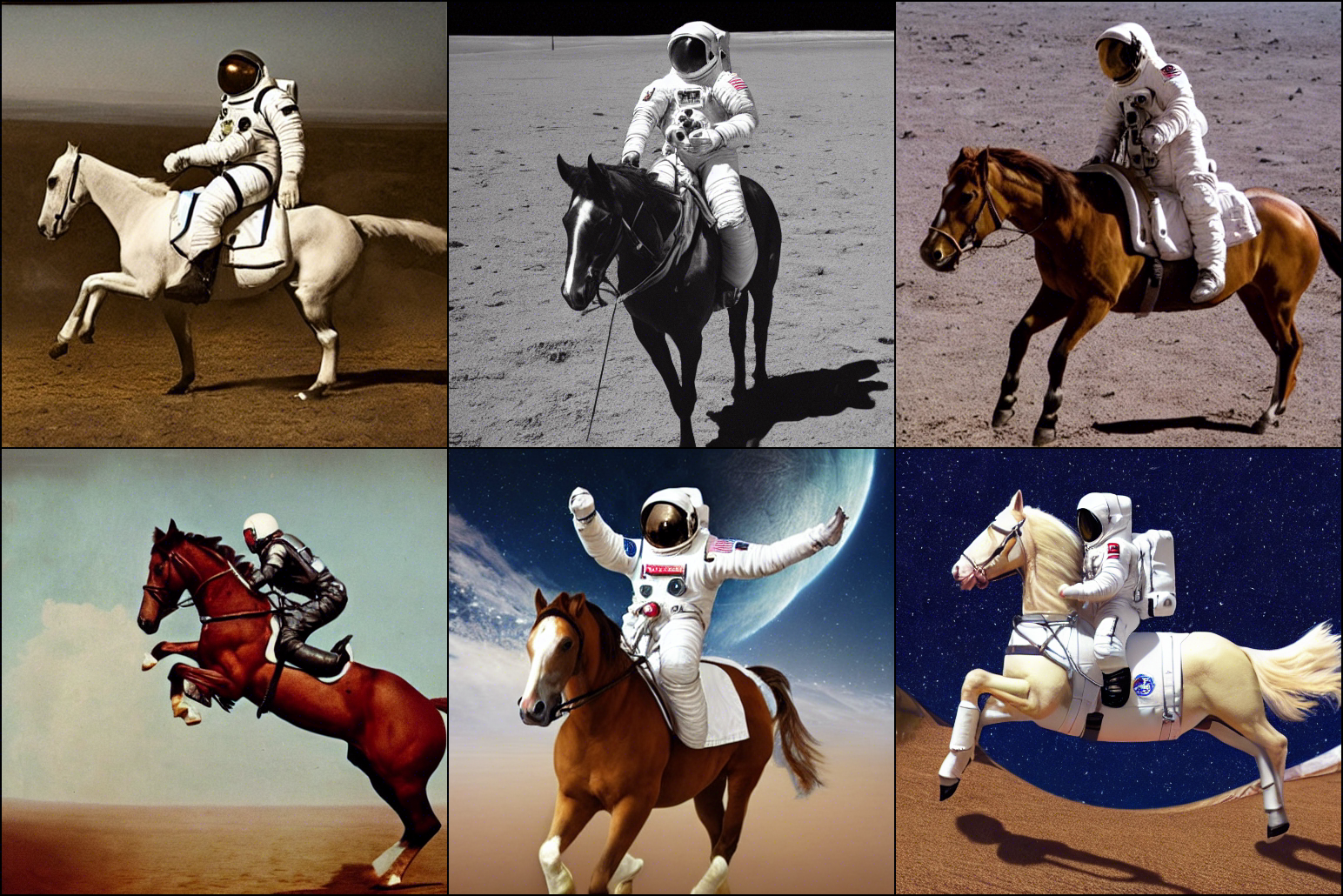
A quick attempt at removing their useless safety features (watermark and NSFW text filter) is:but that produced 4 black images and only two unfiltered ones. Also likely the lack of sexual training data makes its porn suck, and not in the good way.
diff --git a/scripts/txt2img.py b/scripts/txt2img.py
index 59c16a1..0b8ef25 100644
--- a/scripts/txt2img.py
+++ b/scripts/txt2img.py
@@ -87,10 +87,10 @@ def load_replacement(x):
 def check_safety(x_image):
     safety_checker_input = safety_feature_extractor(numpy_to_pil(x_image), return_tensors="pt")
     x_checked_image, has_nsfw_concept = safety_checker(images=x_image, clip_input=safety_checker_input.pixel_values)
-    assert x_checked_image.shape[0] == len(has_nsfw_concept)
-    for i in range(len(has_nsfw_concept)):
-        if has_nsfw_concept[i]:
-            x_checked_image[i] = load_replacement(x_checked_image[i])
+    #assert x_checked_image.shape[0] == len(has_nsfw_concept)
+    #for i in range(len(has_nsfw_concept)):
+    #    if has_nsfw_concept[i]:
+    #        x_checked_image[i] = load_replacement(x_checked_image[i])
     return x_checked_image, has_nsfw_concept


@@ -314,7 +314,7 @@ def main():
                             for x_sample in x_checked_image_torch:
                                 x_sample = 255. * rearrange(x_sample.cpu().numpy(), 'c h w -> h w c')
                                 img = Image.fromarray(x_sample.astype(np.uint8))
-                                img = put_watermark(img, wm_encoder)
+                                # img = put_watermark(img, wm_encoder)
                                 img.save(os.path.join(sample_path, f"{base_count:05}.png"))
base_count += 1You get an error like this if you forget to call Related: quantumcomputing.stackexchange.com/questions/34396/aererror-unknown-instruction-c-unitary-while-using-control-unitary-operator/35132#35132
qiskit.transpile():qiskit_aer.aererror.AerError: 'unknown instruction: QFT'Had this happen on P14s on Ubuntu 23.10 while causally using Chromium. The screen went blank for a few seconds, but it apparently managed to reboot itself, and things started working again, except that and most windows were killed:It appears to be a bug in the AMDGPU open source driver.
[drm:gfx_v11_0_priv_reg_irq [amdgpu]] *ERROR* Illegal register access in command stream
[drm:amdgpu_job_timedout [amdgpu]] *ERROR* ring gfx_0.0.0 timeout, signaled seq=5774109, emitted seq=5774111
[drm:amdgpu_job_timedout [amdgpu]] *ERROR* Process information: process chrome pid 14023 thread chrome:cs0 pid 14087
amdgpu 0000:64:00.0: amdgpu: GPU reset begin!
[drm:mes_v11_0_submit_pkt_and_poll_completion.constprop.0 [amdgpu]] *ERROR* MES failed to response msg=3
[drm:amdgpu_mes_unmap_legacy_queue [amdgpu]] *ERROR* failed to unmap legacy queue
[drm:mes_v11_0_submit_pkt_and_poll_completion.constprop.0 [amdgpu]] *ERROR* MES failed to response msg=3
[drm:amdgpu_mes_unmap_legacy_queue [amdgpu]] *ERROR* failed to unmap legacy queue
[drm:mes_v11_0_submit_pkt_and_poll_completion.constprop.0 [amdgpu]] *ERROR* MES failed to response msg=3
[drm:amdgpu_mes_unmap_legacy_queue [amdgpu]] *ERROR* failed to unmap legacy queue
[drm:mes_v11_0_submit_pkt_and_poll_completion.constprop.0 [amdgpu]] *ERROR* MES failed to response msg=3
[drm:amdgpu_mes_unmap_legacy_queue [amdgpu]] *ERROR* failed to unmap legacy queue
[drm:mes_v11_0_submit_pkt_and_poll_completion.constprop.0 [amdgpu]] *ERROR* MES failed to response msg=3
[drm:amdgpu_mes_unmap_legacy_queue [amdgpu]] *ERROR* failed to unmap legacy queue
[drm:mes_v11_0_submit_pkt_and_poll_completion.constprop.0 [amdgpu]] *ERROR* MES failed to response msg=3
[drm:amdgpu_mes_unmap_legacy_queue [amdgpu]] *ERROR* failed to unmap legacy queue
[drm:mes_v11_0_submit_pkt_and_poll_completion.constprop.0 [amdgpu]] *ERROR* MES failed to response msg=3
[drm:amdgpu_mes_unmap_legacy_queue [amdgpu]] *ERROR* failed to unmap legacy queue
[drm:mes_v11_0_submit_pkt_and_poll_completion.constprop.0 [amdgpu]] *ERROR* MES failed to response msg=3
[drm:amdgpu_mes_unmap_legacy_queue [amdgpu]] *ERROR* failed to unmap legacy queue
[drm:mes_v11_0_submit_pkt_and_poll_completion.constprop.0 [amdgpu]] *ERROR* MES failed to response msg=3
[drm:amdgpu_mes_unmap_legacy_queue [amdgpu]] *ERROR* failed to unmap legacy queue
[drm:gfx_v11_0_cp_gfx_enable.isra.0 [amdgpu]] *ERROR* failed to halt cp gfx
Dec 27 15:03:38 ciro-p14s kernel: amdgpu 0000:64:00.0: amdgpu: MODE2 reset
Dec 27 15:03:38 ciro-p14s kernel: amdgpu 0000:64:00.0: amdgpu: GPU reset succeeded, trying to resume
Dec 27 15:03:38 ciro-p14s kernel: [drm] PCIE GART of 512M enabled (table at 0x0000008000900Related reports:
I think this was on Wayland. Possibly relatd but on X Window System, crashed the UI, showed message "oh no! Something has gone wrong."
2024-01-13_21-55-07@ciro@ciro-p14s$ cat /var/log/apport.log
ERROR: apport (pid 975172) 2024-01-13 21:41:02,087: host pid 3528 crashed in a separate mount namespace, ignoring
INFO: apport (pid 975227) 2024-01-13 21:41:02,398: called for pid 2728, signal 5, core limit 0, dump mode 1
INFO: apport (pid 975227) 2024-01-13 21:41:02,401: executable: /usr/bin/gnome-shell (command line "/usr/bin/gnome-shell")
INFO: apport (pid 975227) 2024-01-13 21:41:12,667: wrote report /var/crash/_usr_bin_gnome-shell.1000.crashThese come with pre-installed drivers, so e.g. nvidia-smi just works on them out of the box, tested on g5.xlarge which has an Nvidia A10G GPU. Good choice as a starting point for deep learning experiments.
Unlisted articles are being shown, click here to show only listed articles.