The Champernowne constant is a decimal number that is constructed by concatenating the positive integers in sequence. It is defined as follows: \[ C_{10} = 0.123456789101112131415161718192021...
Articles by others on the same topic

Form Champernowne constant by using concatenation to join the decimal representations of the positive integers after the decimal point. Champernowne proved in 1933 that this particular real number is a normal number in base ten. The construction is striking because its rule is completely explicit, while all finite words have the prescribed limiting digit block frequencies. [ref]
https://doi.org/10.1112/jlms/s1-8.4.254. D. G. Champernowne, The Construction of Decimals Normal in the Scale of Ten, Journal of the London Mathematical Society 8, 254–260, 1933
Copeland and Erdős explicitly recall this result at the start of their own paper. [ref]https://users.renyi.hu/~p_erdos/1946-01.pdf. Copeland and Erdős, Note on Normal Numbers, 1946, first paragraph
The first digits of Champernowne constant have the following exact counts, in digit order :For the adjacent pairs fully inside that prefix, the words occur times respectively. Thus, for example, , which is about , rather than . The prefix ends partway through the decimal representation of ; the many leading ones in earlier positive integers help explain the visible imbalance.
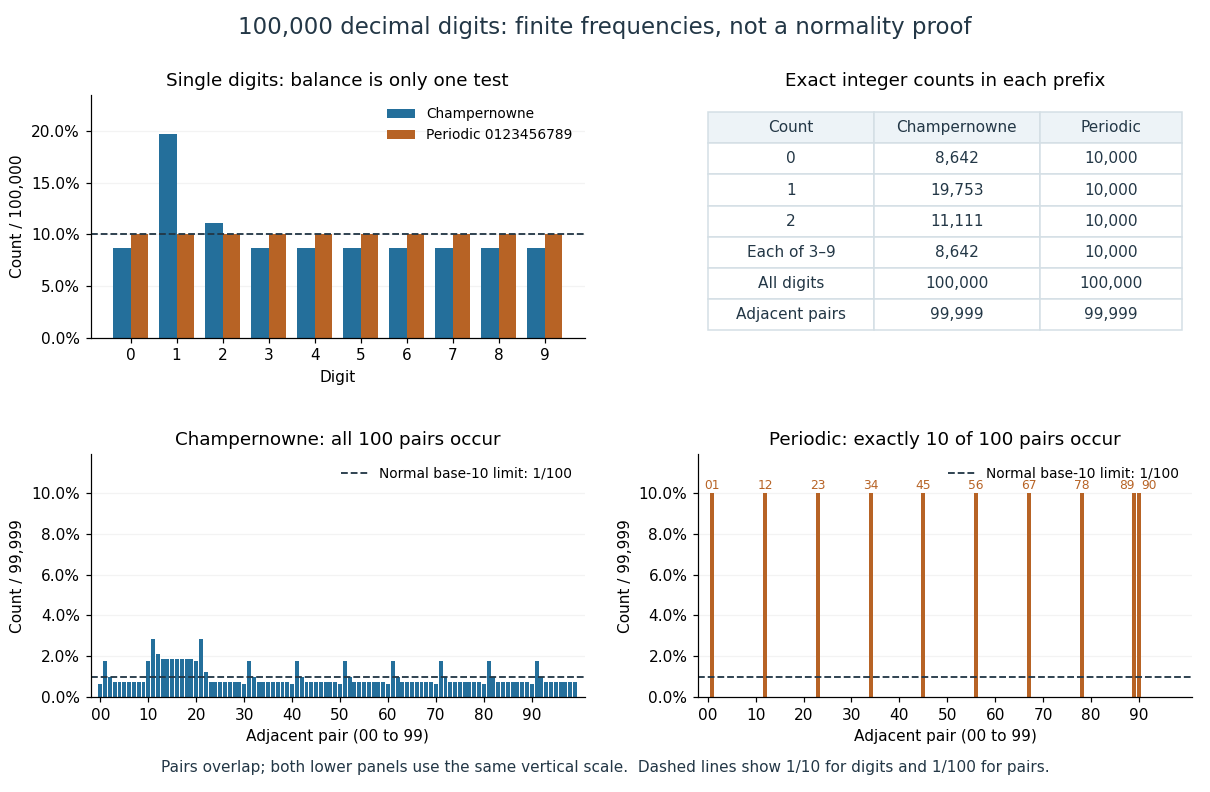

These are finite counts, not a proof of the normal number theorem: a finite prefix can be followed by an all-zero tail. The theorem for Champernowne constant concerns the infinite limit, and establishes base-ten normality, rather than absolute normality. Nor do computations prove normality for familiar constants: the normality of Pi and Euler's number remains unproved, as discussed by Bailey and Borwein. [ref]
https://www.davidhbailey.com/dhbpapers/normal-pseudo.pdf. David H. Bailey and Jonathan M. Borwein, Normal Numbers and Pseudorandom Generators, author manuscript, 2011, introduction