Chromatic aberration is a type of optical distortion that occurs in camera lenses, telescopes, and other optical systems due to the different wavelengths of light being focused at different points. This phenomenon happens because lenses are made of materials that refract (bend) light differently based on its color (wavelength).
Articles by others on the same topic

An optical camera can focus a white object sharply in one colour while leaving coloured fringes around its edges in another. Chromatic aberration is the dependence of image position or image scale on wavelength, caused by optical dispersion in the optical lens materials. Axial chromatic aberration separates the optical foci along the optical axis; lateral chromatic aberration changes the transverse magnification with wavelength. Moving the receiving plane can favour one colour without bringing all colours into focus. [ref]
https://farside.ph.utexas.edu/teaching/302l/lectures/node142.html. Richard Fitzpatrick, University of Texas at Austin, Chromatic aberration
; [ref]https://imaging.nikon.com/sport-optics/guide/fieldscopes/choosing/choosing_03/. Nikon, Comparison of ED glass and ordinary lens
.For ordinary optical glass in the visible range, the blue refractive index exceeds the red refractive index. For a fixed positive thin lens in air, the lensmaker's equation then givesHere is wavelength, is refractive index, is optical power, is focal length, and are the signed surface radius of curvature values in the lensmaker's equation. The blue light rays therefore bend more strongly and meet sooner. This ordering is a statement about ordinary visible optical dispersion, not a universal rule for every material and every spectral range. [ref]
https://farside.ph.utexas.edu/teaching/302l/lectures/node142.html. Fitzpatrick, Chromatic aberration, colour-dependent focusing
.For a worked example, take a single positive thin lens with reference optical power and Abbe number , hence reference focal length . Its F–C optical power difference is , by the achromatic doublet power balance relation below. This difference alone does not locate the reference optical power within the F–C interval. To draw a transparent example, introduce a synthetic colour coordinate , a dimensionless quantity, with red , reference , and blue , and choose the toy optical dispersion modelThe diagram's red and blue endpoints represent the C and F endpoints of this toy model. Its reference point is placed symmetrically in optical power by construction; is not a measured wavelength scale, and the model is not measured optical glass data. The endpoint focal lengths areThus the axial chromatic aberration in this example separates the endpoint optical foci by about . A single receiving plane cannot coincide with both optical foci.
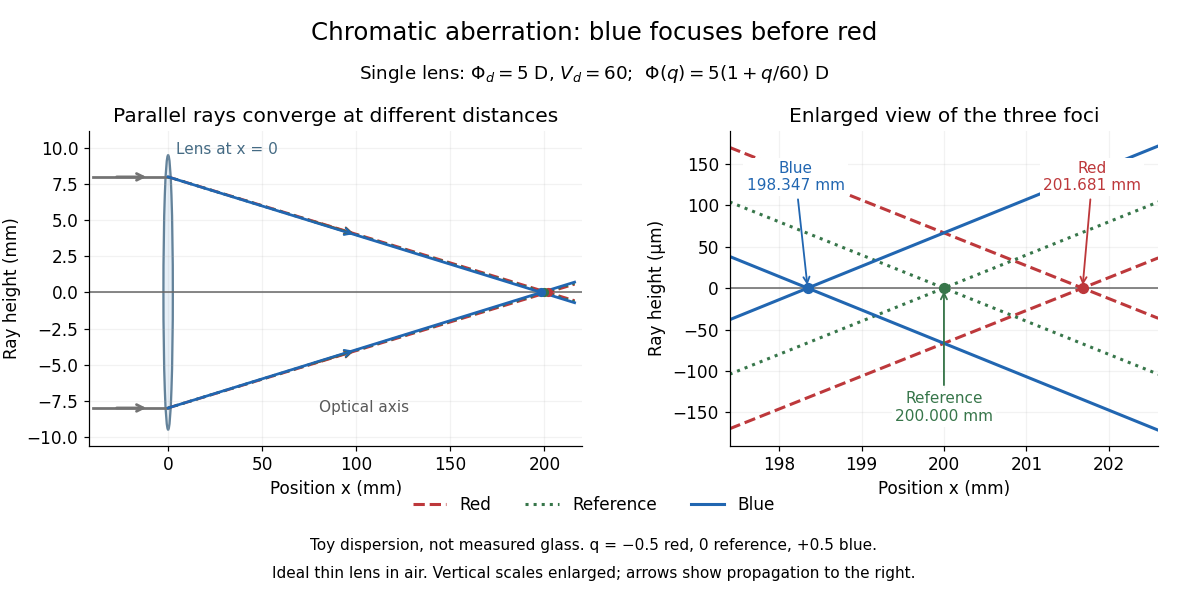
Chromatic aberration: the blue optical focus precedes the red optical focus in a toy single thin lens
. Parallel incoming light rays meet an ideal positive thin lens at . The right panel enlarges the neighbourhood of the three optical foci; the reference focal length is . The synthetic model uses , , and . This is toy optical dispersion, not measured optical glass; the vertical scales are enlarged. Details.
The useful design idea is to cancel changes of optical power while retaining a positive total optical power. An achromatic lens does this with materials having different Abbe numbers. It greatly reduces chromatic aberration, but correcting two chosen wavelengths still leaves the possibility of a secondary spectrum.