An integer is a whole number that can be positive, negative, or zero. Integers do not include fractions, decimals, or any non-whole numeric values. The set of integers is typically represented by the symbol **ℤ** and includes numbers such as: - Positive integers: 1, 2, 3, ... - Zero: 0 - Negative integers: -1, -2, -3, ...
Articles by others on the same topic

An integer is a whole number, positive, negative, or zero. The set of all integers isThe positive integers are ; the negative integers are their opposites . Zero is neither positive nor negative. The nonnegative integers include zero and all the positive integers. On a number line, consecutive integers are one unit apart, negative integers lie to the left of zero, and positive integers lie to its right. [ref]
3.1 Introduction to Integers. Prealgebra 2e, §3.1: Locate Positive and Negative Numbers on the Number Line; Opposite Notation; Integers
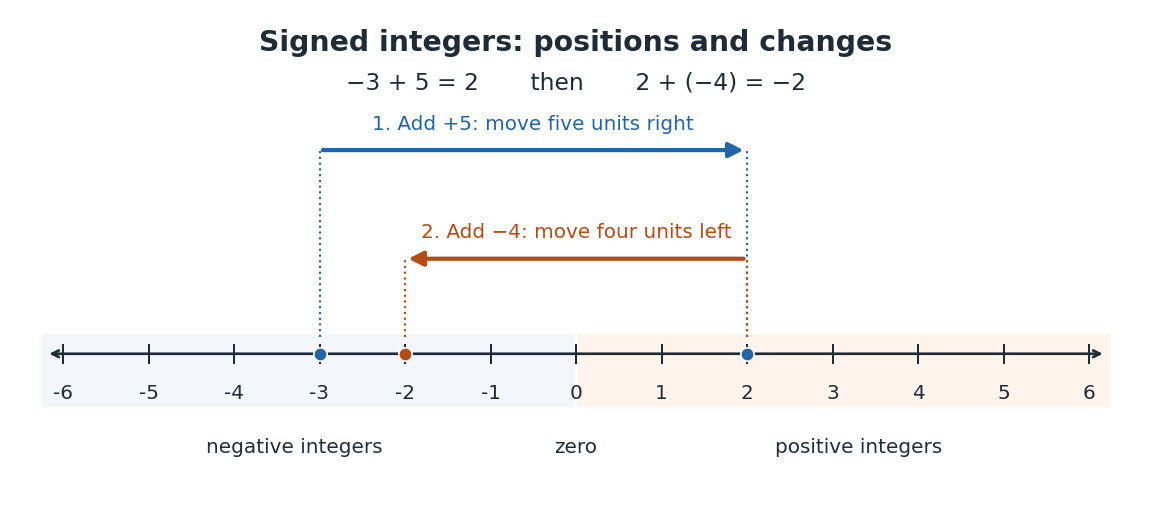
The integers let counting describe changes in both directions. If a counter starts at and increases by five, it reaches : . Decreasing that result by four gives . In addition on the number line, the sign of the added integer chooses the direction and its absolute value gives the distance. The additive inverse reverses the change made by .
The integers have closure under a binary operation for addition, subtraction and multiplication: whenever , the results , and are still integers. Together these operations give the integers their ring structure.[ref]
A Computational Introduction to Number Theory and Algebra by Victor Shoup. §7.1, p. 166, Definition 7.1; p. 167, Example 7.1: the integers with their usual addition and multiplication
For instance, , , and . General division has no such closure: is a rational number but not an integer. Some divisions are exact, such as ; division by zero is undefined. Euclidean division instead produces an integer quotient and a remainder, so retains the information that ordinary division puts into the fraction .An integer is the value, whereas its written numeral is an encoding. The decimal representation and the binary representation name the same integer. Changing positional notation changes how that value is displayed and how calculations are organized; it does not change the value itself.

