Articles by others on the same topic

Row of Pascal's triangle consists of the binomial coefficients , beginning with row . Boundary entries are one, and Pascal's identity says each interior entry is the sum of the two entries above it. The hockey-stick identity evaluates sums along its diagonals.
The highlighted entry in the binomial coefficient illustration is . Split two-person teams according to whether they contain the fifth person: six choose both members from the other four, and four contain the fifth person together with one of those four. Thus . All entries can be generated by the same local rule, so a large table of counts needs no repeated enumeration of its subsets.
Reading row seven. Label the entries in each row from on the left through on the right. Rows zero through seven are shown below. The highlighted entry comes from and . Starting with row zero , the edges remain one and Pascal's rule determines every interior entry, so mathematical induction uniquely determines the whole array.
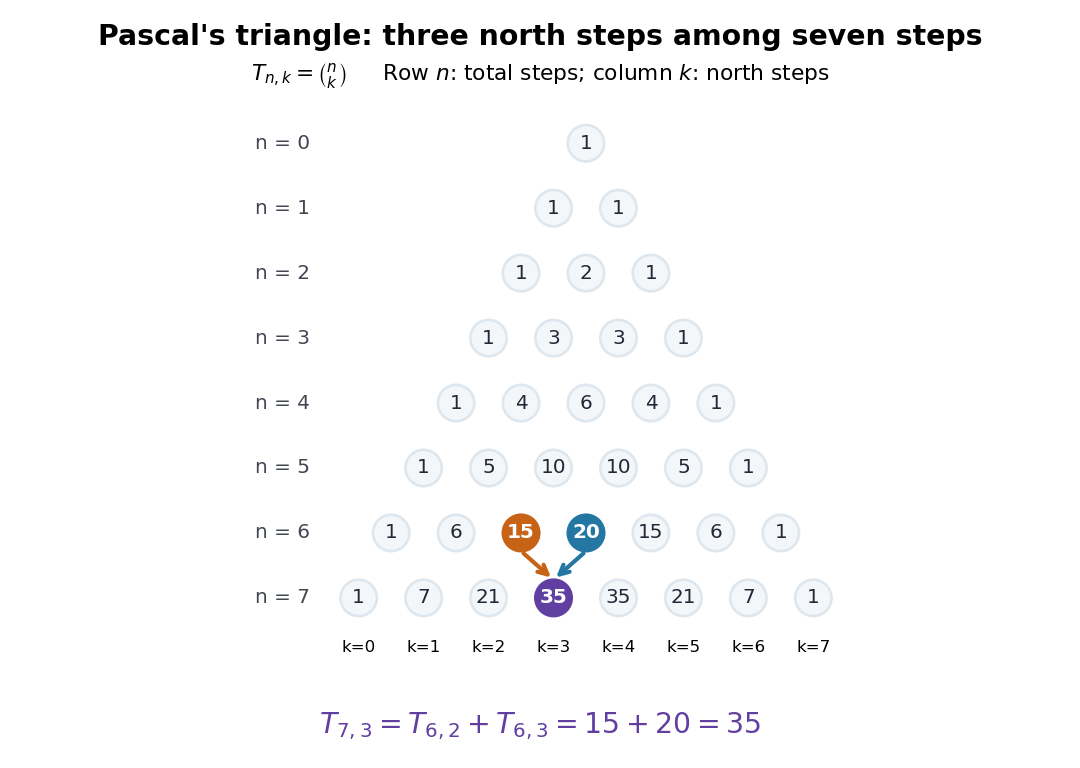
Rows zero through seven of Pascal's triangle, with
. The index increases from left to right in each row; it counts north steps in the north-east lattice path interpretation. Each row index counts all steps. Details.
The triangular and rectangular layouts describe the same entries. For a north-east lattice path ending at , set and , so . The predecessor has indices , while has indices . Thus the grid's west and south arrivals are exactly the triangle's two parents. This change of indices explains why the north-east lattice path recurrence and Pascal's rule agree.
There is also a global check on the local construction: row sums to . Every subset of an -element set appears exactly once among the classes of sizes , and each element has two inclusion choices by the rule of product. In row seven, . Replacing every subset by its complement reverses the row, explaining . The binomial theorem packages the whole row as the coefficients of .
Blaise Pascal's Traité du triangle arithmétique, published in 1665, presents an arithmetic array and connects it to combinations, games of chance, and powers of binomial expressions. This makes the connection between a counting table and several applications visible in the original work. [ref]
https://archive.org/details/bub_gb_UqgUAAAAQAAJ. Pascal, Traité du triangle arithmétique, 1665 edition
The University of Cambridge's account of the treatise explains its 1654 composition and the organization of these applications. [ref]https://api.repository.cam.ac.uk/server/api/core/bitstreams/9bfbc9c8-fa56-4694-b96d-fc18db0f562f/content. Cambridge University Library, account of Pascal's treatise