A north-east lattice path is a lattice path whose allowed steps are and . From to , with nonnegative integers , it has east steps and north steps. The number isThere is one zero-step north-east lattice path when .[ref]
Discrete Mathematics: An Open Introduction (3rd edition) by Oscar Levin. §1.2, Lattice Paths and Binomial Coefficients: encoding paths by step positions
Seven positions, thirty-five paths. To reach , choose the three positions occupied by north steps in a seven-symbol word. For example, the subset of gives
ENENEEN: putting exactly in those positions and elsewhere reconstructs the north-east lattice path. Reading the north-step positions recovers the subset, so these two operations give a bijection. HenceThe numerator counts ordered choices of three different positions; each subset occurs in orders. Dividing by this factorial counts each north-east lattice path once. A binary string recording as and as gives the same example as 0101001.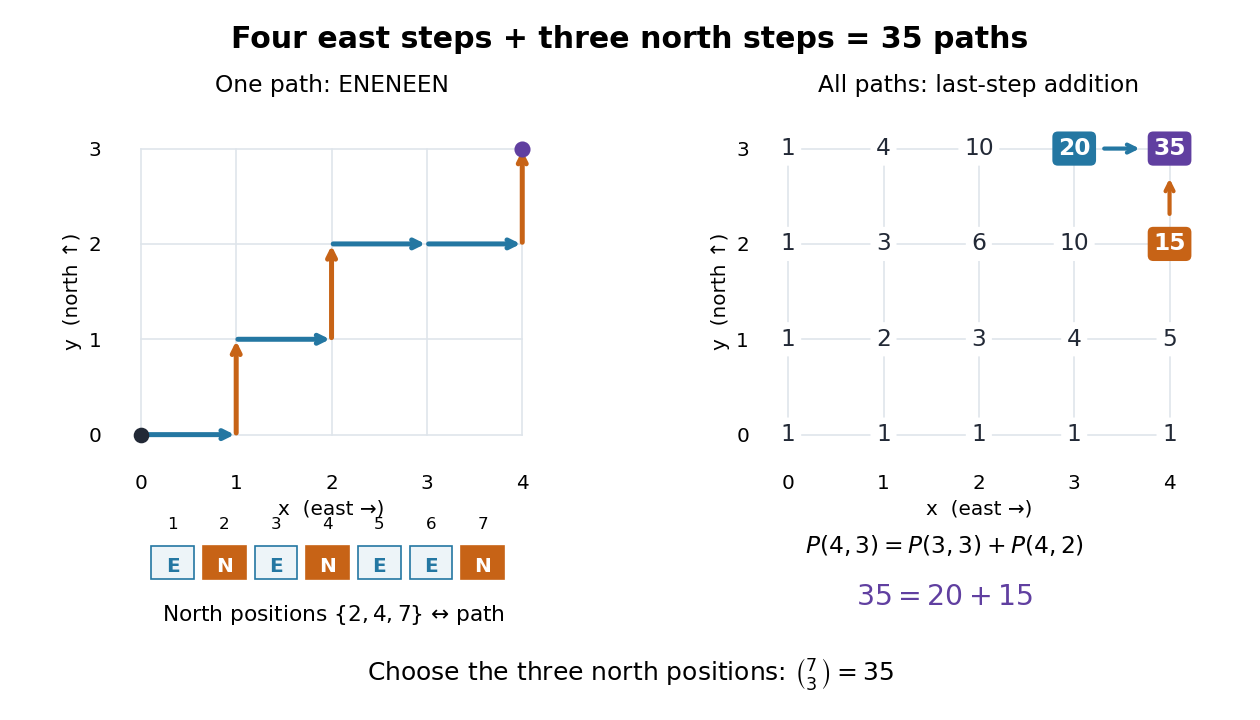
ENENEEN reaches . Both panels use east to the right and north upwards. The right panel counts all such north-east lattice paths, rather than just the displayed one: twenty arrive with a final east step and fifteen with a final north step. Details.
This interpretation is useful when arrangements have fixed totals but flexible order: a subset, a binary string, and a north-east lattice path become different views of one selection. It also separates endpoint restrictions from restrictions along the journey. Requiring the lattice path to avoid specified points changes the count; the unrestricted binomial coefficient no longer suffices, but the local north-east lattice path recurrence still suggests how to count allowed arrivals.
For positive integers , the north-east lattice path recurrence isThe boundaries have only straight north-east lattice paths. The origin counts the zero-step north-east lattice path once.[ref]
Discrete Mathematics: An Open Introduction (3rd edition) by Oscar Levin. §1.2, Lattice Paths: split by the final horizontal or vertical step
Proof outline. A north-east lattice path ending at has a final step either from or from . Deleting that step gives a shorter north-east lattice path; appending it reverses the operation. The two classes are disjoint and exhaust all possibilities, so the rule of sum adds their counts. At , the arrivals from contribute , while those from contribute : altogether .
Set if either integer coordinate is negative. Then the same recurrence relation applies on the nonnegative axes away from : one predecessor contributes one, and the other contributes zero. Initialize separately; applying the recurrence relation there would incorrectly give zero.
Computing the grid once in increasing order of is dynamic programming: every entry uses two earlier entries. If a specified point is forbidden, set its count to zero, then continue the same recurrence relation at allowed points. This counts north-east lattice paths avoiding the forbidden points, provided the origin and endpoint are allowed. The last-step argument remains valid because appending a step to an allowed endpoint cannot visit any new intermediate integer lattice point.
Articles by others on the same topic
There are currently no matching articles.