Scott Kirkpatrick is known for his work in the field of computer science, particularly in optimization and artificial intelligence. He is credited with the development of simulated annealing, a probabilistic technique that is used for approximating the global optimum of a given function. Simulated annealing mimics the process of annealing in metallurgy, where controlled cooling helps to minimize defects. Kirkpatrick introduced this algorithm in a landmark paper co-authored with Chilean physicist Jorge A.
Articles by others on the same topic

Scott Kirkpatrick is a computer scientist whose work connects statistical physics with computational complexity theory and optimization. With Charles Daniel Gelatt Jr. and Mario P. Vecchi, he developed simulated annealing as a method for combinatorial optimization.[ref]
Optimization by Simulated Annealing by Scott Kirkpatrick and others. 1983, introduction and pages 672–673
The method borrows a rule from the Metropolis algorithm: a proposed increase in cost can be accepted with probability , where is an adjustable control parameter in the same units as the cost. Allowing occasional uphill changes can escape a local minimum; reducing progressively makes them less likely. The original work applied this physical analogy to electronic component placement and wiring.[ref]
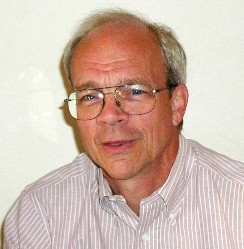
Portrait of Scott Kirkpatrick
. Photograph from Hebrew University of Jerusalem's official researcher profile. Source.