Topics (271k) Articles (279k) Users (351) Discussions (237) Comments (383) Files (5k) New article
Education has become an expensive bureaucratic exercise, completely dissociated from reality and usefulness.
It completely rejects what the individual wants to achieve, and instead attempts to mass homogenize and test people through endless hours of boredom.
And the only goals it achieves are testing student's resilience to stress, and facilitating the finding of sexual partners. True learning is completely absent.
Teachers only teach because they have to do it to get paid, not for passion. Their only true incentive is co-authoring papers.
Education is meant to help us, the students, achieve our goals through passionate learning.
And, we, the students, are individuals, with different goals and capabilities.
The way we protest is to publish the knowledge from University for free, on the Internet, so that anyone can access it.
And we do this is a law-abiding way, without copyright infringement, so that no one can legally take it down.
We come to our courses just for the useless roll calls. But we already know all the subject better than the "teacher" on the very first day.
And we are already more famous than the "teacher" online, and through the Internet have already taught more way way more people than they ever will.
The effect of this is to demoralize the entire school system at all levels, until only one conclusion is possible: implosion.
And from the ashes of the old system, we will build a new one, which does only what matters with absolute efficiency: help the individual students achieve their goals.
A system in which the only reason why university exist will be to allow the most knowledgeable students to access million dollar laboratory equipment, and to pay the most prolific content creators so they can continue content creating.
No more useless courses. No more useless tests. Only passion, usefulness and focus.
OurBigBook.com Why it is hard to make money from this website by  Ciro Santilli 40 Updated 2025-07-16
Ciro Santilli 40 Updated 2025-07-16There is basically only one scalable business model in education as of the 2020's: helping teenagers pass university entry exams. And nothing else. Everything else is a "waste" of time.
Perhaps there is a little bit of publicity incentive to helping them win knowledge olympiads as well, but it is tiny in comparison, and almost certainly not a scalable investment. This may also depend on whether universities consider anything but exams, which varies by country.
That marked is completely saturated, and Ciro Santilli refuses to participate in it for moral reasons.
Beyond that, there is no scalable investment. Other non-scalable investments that could allow one to make a lifestyle business are:
- extra-curricular initiatives to get younger children interested in science. These may have some money stream coming from the parents of the children. This happens because for young children, the parents are more in control, and the parents, unlike the students, have some money to spend. An example: www.littlehouseofscience.com/This business model is possible because experiments for young children may be cheap to realize, unlike any experiment that would matter to a teenager or adult.
- creating a private university, for profit or not. Of course, at this point, you would be either:
- competing against the reputation and funding of century old universities
- or be offering more boring, lower tech or techless courses, to (God forbid the phrasing) "worse students", i.e. at a "worse university"
Teenagers and young adults:
- don't have money to give you if you want to "help them learn for real"
- are somewhat forced to obtain their "reputable university" reputation to kickstart their careers
It is this perfect storm that places this specific section of education in such a bad shape that it is today.
This project is likely to fail. It could become the TempleOS of wikis. The project' autism score is quite high. It might be an impossible attempt at a lifestyle business. But Ciro is beyond caring now. It must be done. Other things that come to mind:
- www.youtube.com/playlist?list=PLibNZv5Zd0dzvoxXrjA9xNHLpdgLhTkZz "Obsessed" playlist by Wired. Helps Ciro feel better about himself.
- Don Quixote
- pipe dream
- Video "Don't Try - The Philosophy of Charles Bukowski by Pursuit of Wonder (2019)"
Dangerous combination:and for any crazy person who might wish to join: Men Wanted for Hazardous Journey.
In some ways, Ciro was reminded of OurBigBook.com by this documentary. Ken built his ultimate audio system without regard to money and time, to enjoy until he dies. Ciro is doing something similar. There is one fundamental difference however: everyone can enjoy a website all over the world.
A bit ominous though that the whole thing was eventually sold off for a fraction of the building cost: www.washingtonpost.com/style/interactive/2024/ken-fritz-greatest-stereo-auction-cost/.
Once the ball starts rolling, these are people who should be contacted.
Basically anything under educational charitable organization counts.
It is also worth having a look under the Wikipedia page for open educational resources: en.wikipedia.org/wiki/Open_educational_resources
Start with consulting for universities to get some cash flowing.
Help teachers create perfect courses.
Choose a domain of knowledge, generate perfect courses for it, and find all teachers of the domain in the world who are teaching that and help them out.
Then expand out to other domains.
TODO: which domain of knowledge should we go for? The more precise the better.
- maths is perfect because it "never" changes. But does not make money.
- computer science might be good, e.g. machine learning.
Teachers have the incentive of making open source to get more students.
Students pay when they want help to learn something.
Maybe focus on job ads like Stack Overflow.
Not a fun of giving up control for such a low-maintenance cost venture... but keeping a list just in case...
It would be really cool to have a PageRank-link algorithm that answers the key questions:However, Ciro has decided to leave this for phase two action plan, because it is impossible to tune such an algorithm if you have no users or test data.
- what is the best content for subject X.For example, if you are reading
cirosantilli/riemann-integraland it is crap, you would be able to click the buttonwhich leads you to the URL: ourbigbook.com/subject/mathematics. This URL then contains a list of all pages people have written about the subjectVersions by other authors
mathematics, sorted by some algorithm, containing for example: - who knows the most about subject X. This can be found by visiting: ourbigbook.com/users/mathematics "Top Mathematics users", which would contain the list of users sorted by the algorithm:
Perhaps it is also worth looking into ExpertRank, they appear to do some kind of "expert in this area", but with clustering (unlike us, where the clustering would be more explicit).
Other dump of things worth looking into:
- you don't get any/sufficient recognition for your contributions. The closest they have to upvotes and reputation is the incredibly obscure "thank" feature which is only visible to the receiver itself: en.wikipedia.org/wiki/Help:Notifications/Thanks
- deletionism is a tremendous problem on Wikipedia, for two main causes:The stuff you wrote can be deleted anytime by some random admin/opposing editor, examples at: Section "Deletionism on Wikipedia".
- tutorial-like subjectivity
- notability
- Scope too limited, and politics defined. Everything has to sound encyclopedic and be notable enough. This basically excludes completely good tutorials.
- Insane impossible to use markup language-base talk pages instead of issue trackers?! Ridiculous!!! That change alone could make Wikipedia so much more amazing. Wikipedia could become a Stack Exchange killer by doing that alone + some basic reputation system. Some work on that is being done at: www.mediawiki.org/wiki/Extension:DiscussionTools, already in Beta as of 2022.
- Edit wars
Stack Exchange solves to a good extent the use cases:
points of view. It is a big open question if we can actually substantially improve it.
Major shortcoming are mentioned at idiotic Stack Overflow policies:
- Scope restrictions can lead to a lot of content deletion: closing questions as off-topicThis greatly discourages new users, who might still have added value to the project.On our website, anyone can post anything that is legal in a given country. No one can ever delete your content if it is legal, no matter their reputation.
- Although you can answer your own question, there's no way to write an organized multi-page book with Stack Exchange due to shortcomings such as no table of contents, 30k max chars on answer, huge risk of deletion due to "too broad"
- Absolutely no algorithmic attempt to overcome the fastest gun in the West problem (early answers have huge advantage over newer ones): meta.stackoverflow.com/questions/404535/closing-an-old-upvoted-question-as-duplicate-of-new-unvoted-questions/404567#404567
- Native reputation system:
- if the living ultimate God of
C++upvotes you, you get10reputation - if the first-day newb of
Javaupvotes you, you also get10reputation
- if the living ultimate God of
- Randomly split between sites like Stack Overflow vs Super User, with separate user reputations, but huge overlaps, and many questions that appears as dupes on both and never get merged.
- Possible edit wars, just like Wikipedia, but these are much less common since content ownership is much clearer than in Wikipedia however
Where blog is taken in a wide sense, including e.g. Medium, WordPress, Facebook, Twitter, etc., etc.
The main shortcoming of blogs is the lack of topic convergence across blogs. Each blog is a moderated castle. So who is the best user for a given topic, or the best content for a given tag, across the entire website?
The only reasonable free material we have for advanced subjects nowadays are university lecture notes.
While some of those are awesome, when writing a large content, no one can keep quality high across all sections, there will always be knowledge that you don't have which is enlightening. And Googlers are more often than not interested only in specific sections of your content.
Our website aims to make smaller subjects vertically curated across horizontal single author tutorials.
MIT calculus course             UCLA calculus course

* Calculus                <---> * Calculus
  * Limit                 <--->   * Limit
    * Limit of a function
    * Limit of a series   <--->     * Limit of a series
  * Derivative            <--->   * Derivative
                                    * L'Hôpital's rule
  * Integral              <--->   * Integral
Some more links:
- prose.sh/ multiblog, the only feature is easy of publishing from CLI
Basically everything that applies to the blogs section also applies here, but university lecture notes are so important to us that they deserve a bit more talk.
It is arguable that this is currently the best way to learn any university subject, and that it can already be used to learn any subject.
We basically just want to make the process more efficient and enjoyable, by making it easier:
One major problem with lecture notes is that, as the name suggests, they are merely a complement to the lecture, and don't contain enough detail for you to really learn solely from them without watching the lecture.
The only texts that generally teach in enough depth are actual books, which are almost always commercial.
So in a sense, this project can be seen as a path to upgrade free lecture notes into full blown free books, from which you can learn from scratch without any external material.
And a major way in which we believe this can be done is through the reuse of sections of lecture notes by from other universities, which greatly reduces the useless effort of writing things from scratch.
The intended mental picture is clear: the topics feature docs.ourbigbook.com/#ourbigbook-web-topics will is intended to act as the missing horizontal topic integration across lecture notes of specific universities, e.g:
MIT calculus course             UCLA calculus course

* Calculus                <---> * Calculus
  * Limit                 <--->   * Limit
    * Limit of a function
    * Limit of a series   <--->     * Limit of a series
  * Derivative            <--->   * Derivative
                                    * L'Hôpital's rule
  * Integral              <--->   * Integral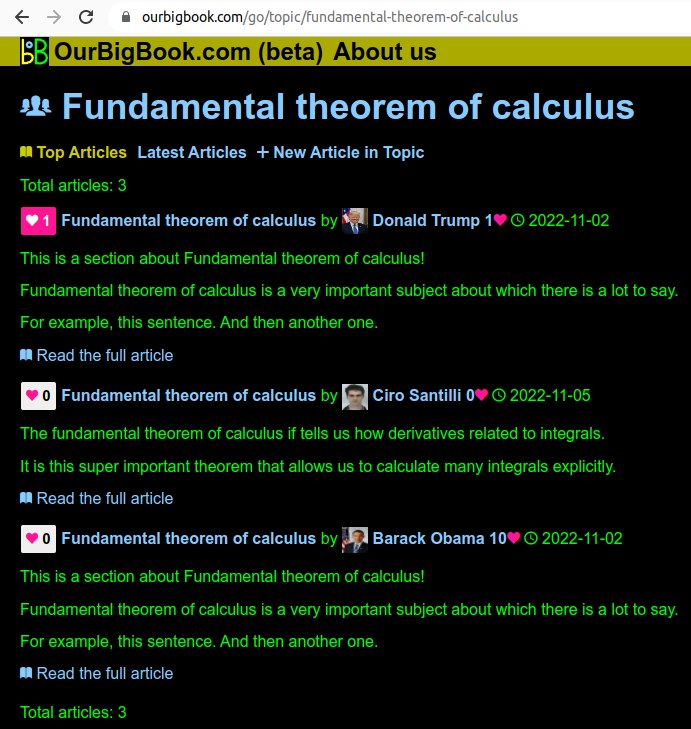
Example topics page of OurBigBook.com
. One important advantage of lecture notes is that since they are written by the teacher, they should match exactly what "students are supposed to learn to get good grades", which unfortunately is a major motivation for student's learning weather we want it or not.
One big open question for this project is to what extent notes written for lectures at one university will be relevant to the lectures at another university?
Is it possible to write notes in a way that they are naturally reusable?
It is our gut feeling that this is possible. But it almost certainly requires an small intentional effort on the part of authors.
The question then becomes whether the "become famous by getting your content viewed in other universities" factor is strong enough to attract users.
And we believe that it might, it just might be.
Some possible/not possible sources that could be used to manually bootstrap content:
- LibreTexts. Good project. "Teacher-only-content" unfortunately as usual. But besides that fundamental flaw, they do exactly what we want to do in a sense.
- OpenStax: CC BY. This could be a great entry point, as they already have some university integration going on, and might be interested in this project.
- physics.stackexchange.com/questions/6157/list-of-freely-available-physics-books "List of freely available physics books" explicitly asks for:but the thread was locked, and basically none of the sources in the answers have free licenses, nor do they note it. It just seems that the physicists don't know what a free license is.
a list of physics books with open-source licenses, like Creative Commons, GPL
- MIT OpenCourseWare: CC BY-NC-SA, so not really usable
- github.com/certik/theoretical-physics: MIT License. Workable but wonky.
- subwiki.org/: wiki with some upper graduate math subjects presumably by this Indian dude: www.linkedin.com/in/vipul-naik-0ab1898/. Description on his homepage: vipulnaik.com/subwiki/. He's also got other interesting but not so relevant projects:He's also into Stack Overflow, Quora and Wikipedia editing. That's a cool dude. He's into in LessWrong it seems.
- pro freer immigration laws: vipulnaik.com/openborders/
- vipulnaik.com/cognito-mentoring/ free mentoring project for interested students
- massive mathematics books
- Infinite Napkin.CC BY-SA mathematics infinite book: github.com/vEnhance/napkin/issues/77. Very similar type of content to what we want in this project!
- Stacks Project
Existing lecture notes by students:
- github.com/mb2g17/NotesNetworkArchive Google Docs-based: docs.google.com/document/d/1OIcQ8dJ_FAhdkirU94M29-ZbNZ4oQs1LbWF3Nz-mq_U/edit#heading=h.vehxib58w1iw. An actual student uploading tons of lecture notes in one coherent system. CC BY-NC-SA unfortunately.
- academia.stackexchange.com/questions/148261/do-you-keep-your-study-notes-publicly-available mentions:Related: academia.stackexchange.com/questions/40381/how-common-is-it-that-professors-have-their-students-write-textbooks
- Cambridge Mathematics Lecture Notes by Dexter Chua (2014-2018)Comments:
Lecture note upload website:
- nexusnotes.com likely illegal reuploads of PDFs from teachers
- www.studocu.com/en-gb Paywall. PDF uploads. Unclear if simple teacher reuploads or actual novel notes.
- www.studydrive.net/
- Chinese GitHub repos. Some of these are very advanced in terms of content quantity and organizational quality! The Chinese are miles ahead in this area:
- github.com/PKUanonym/REKCARC-TSC-UHT Guidance for courses in Department of Computer Science and Technology, Tsinghua University. Chinese. Appears to try and store all past exams.
- github.com/lib-pku/libpku
- github.com/openwhu/OpenWHU: Wuhan University
- github.com/USTC-Resource/USTC-Course: USTC
- github.com/Zeal-L/UNSW: UNSW from Australia, but by a Chinese dude
- github.com/apachecn/mit-18.06-linalg-notes: translation of MIT course to Chinese
- github.com/chenyang1999/MyComputerCollegeCourses: TODO which univeresity
- github.com/elder-frog/OpenCourseCatalog: nothing to do with this project, but since I'm making a list, this dude is copying YouTube videos to Bilibili. And he's edgy anti-CCP on Twitter, what a legend.
- github.com/TheBloodthirster/BUAA_Course_Sharing: en.wikipedia.org/wiki/Beihang_University
- github.com/1051727403/SHU-CS-Source-Share: ShangHai University CS course source code
- github.com/Willie169/tw-gifted-k12-notes: Taiwanese high school notes
Exams uploads:
- questions.tripos.org/part-ib/all/ University of Cambridge Mathematics past examinations
A list of reviews of such systems is maintained at:
This is the class of existing software the perhaps comes the closest to OurBigBook, in particular systems such as:
- Roam Research and its open source clone Foam
- Forester
While we believe that OurBigBook can hold its own against most of them as a personal knowledge base, there is one feature which we believe truly distinguishes OurBigBook from all others in a big way: trustless mind meld with the OurBigBook topic feature, which no other system seems to have.
Many such systems are also no publishing focused enough, and are more focused only in maintaining people's private knowledge bases. Some of them don't even have publishing at all, or its complicated. While publishing is optional in OurBigBook, it is a crucial feature and extremely well supported.
This website basically aims to be a learning management system, allowing in particular a teacher to focus his help on students that he is legally obliged to help due to their job. But it will have the following unusual characteristics in current LMS solutions:
- public first, to allow reuse across universities, rather than paywalled as is the case for most top universities
- students can create material just like teachers, both are on equal footing. Students/teachers will see an indicator "this is your teacher"/"this is your student for this/past semester", but that is the only difference between their interfaces.
If Ciro Santilli were to write a book about quantum mechanics as of 2020 (before OurBigBook.com went live), he would upload an OurBigBook Markup website to GitHub Pages.
But there is one major problem with that: the entry barrier for new contributors is very large.
If they submit a pull request, Ciro has to review it, otherwise, no one will ever see it.
Our amazing website would allow the reader to add his own example of, say, The uncertainty principle, whenever they wants, under the appropriate section.
- HyperCard: we are kind of a "multiuser" version of HyperCard, trying to tie up cards made by different users. It is worth noting that HyperCard was one of the inspirations for WikiWikiWeb, which then inspired Wikipedia
- Semantic Web
- NLab
- physicstravelguide.com/ Nice manifesto: physicstravelguide.com/about by Jakob Schwichtenberg.
- OpenStax
- www.ft.com/content/5515ec3e-0040-4d90-85a9-df19d6e3ebd2 (archive) Twilio’s Jeff Lawson: an evangelist for software developersYou can never be first. But you can have the correct business model. That company's website must have gone into IP Purgatory, and could never be released as an open source website.As a student at the University of Michigan, he started a company that made lecture notes available free online, drawing a large audience of Midwestern college students and, soon enough, advertisers. At the height of the dotcom bubble, he dropped out of college, raised $10m from the venture firm Venrock and moved the company to Silicon Valley.His start-up drew interest from an acquirer that was planning to go public early in 2000. They closed the acquisition but missed their IPO window as the market plunged, and by August the company had filed for bankruptcy. Stock that Lawson and investors in his start-up received from the sale became worthless.He might actually be interested in donating to OurBigBook.com if it move forward now that he's a billionaire.
- Knol: basically the exact same thing by Google but 14 years earlier and declared a failure. Quite ominous:
- leanpub: similar goals, markdown-based, but the usual "you own your book copyright and you are trying to sell your book" approach
- nature Scitable
OK, just going random now:
This one is not generally seen by software, which mostly operates starting from OSI layer 2.
Pinned article: Introduction to the OurBigBook Project
Welcome to the OurBigBook Project! Our goal is to create the perfect publishing platform for STEM subjects, and get university-level students to write the best free STEM tutorials ever.
Everyone is welcome to create an account and play with the site: ourbigbook.com/go/register. We belive that students themselves can write amazing tutorials, but teachers are welcome too. You can write about anything you want, it doesn't have to be STEM or even educational. Silly test content is very welcome and you won't be penalized in any way. Just keep it legal!
Intro to OurBigBook
. Source. We have two killer features:
- topics: topics group articles by different users with the same title, e.g. here is the topic for the "Fundamental Theorem of Calculus" ourbigbook.com/go/topic/fundamental-theorem-of-calculusArticles of different users are sorted by upvote within each article page. This feature is a bit like:
- a Wikipedia where each user can have their own version of each article
- a Q&A website like Stack Overflow, where multiple people can give their views on a given topic, and the best ones are sorted by upvote. Except you don't need to wait for someone to ask first, and any topic goes, no matter how narrow or broad
This feature makes it possible for readers to find better explanations of any topic created by other writers. And it allows writers to create an explanation in a place that readers might actually find it.
Figure 1. Screenshot of the "Derivative" topic page. View it live at: ourbigbook.com/go/topic/derivativeVideo 2. OurBigBook Web topics demo. Source. - local editing: you can store all your personal knowledge base content locally in a plaintext markup format that can be edited locally and published either:This way you can be sure that even if OurBigBook.com were to go down one day (which we have no plans to do as it is quite cheap to host!), your content will still be perfectly readable as a static site.
- to OurBigBook.com to get awesome multi-user features like topics and likes
- as HTML files to a static website, which you can host yourself for free on many external providers like GitHub Pages, and remain in full control

Figure 2. You can publish local OurBigBook lightweight markup files to either OurBigBook.com or as a static website.
Figure 3. Visual Studio Code extension installation.
Figure 5. . You can also edit articles on the Web editor without installing anything locally. Video 3. Edit locally and publish demo. Source. This shows editing OurBigBook Markup and publishing it using the Visual Studio Code extension. 
- Infinitely deep tables of contents:


All our software is open source and hosted at: github.com/ourbigbook/ourbigbook
Further documentation can be found at: docs.ourbigbook.com
Feel free to reach our to us for any help or suggestions: docs.ourbigbook.com/#contact