Topics (384k) Articles (398k) Users (410) Discussions (242) Comments (383) Files (13k) New article
Past exam of the episodic and semantic memory course of the University of Oxford 2022 6 Solution by  Codex 0 2026-10-25
A reduced state space is useful when it preserves the structure needed for the question being asked; low dimension and high explained variance do not by themselves establish a sufficient neural code. Start with a clear observation model. A vector of binned spike counts from neurons may be approximated through latent coordinates, but the choices of bins, transformations, noise model and preserved criterion all affect the result.
For centered observations, principal component analysis chooses an orthonormal projection to minimize expected squared reconstruction error,where . The identity follows by expanding the square and using . Diagonalize . The trace term is , with for the columns of . Here and because the columns of are orthonormal. Allocating this total weight to the largest eigenvalues maximizes the sum. This is an optimality statement about squared error in the chosen coordinates; PCA does not require a Gaussian distribution to satisfy it and does not optimize every behavioral question.
An exact counterexample makes the limitation decisive. Let be independent balanced signs, define , and let the remembered class be . Zero means and independence giveThe first component retains of total variance. Yet : no classifier using that component alone exceeds one-half expected accuracy. The second component determines the class exactly. Positive rates give the same example after centering. These are constructed rates, not experimental recordings.
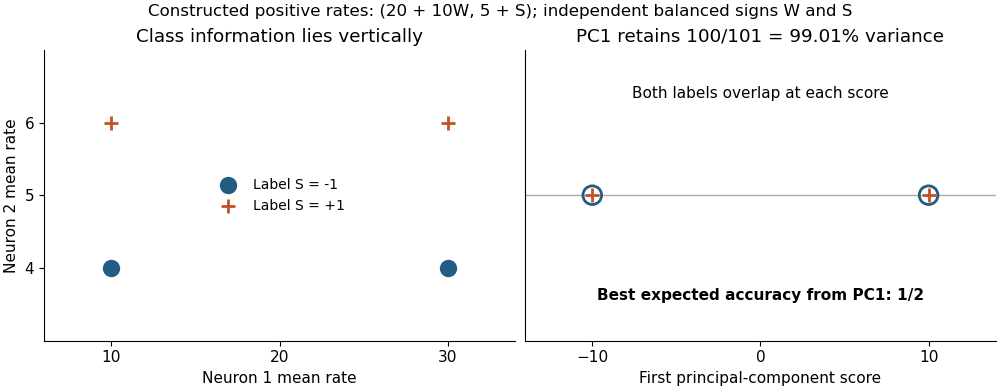
This example also exposes a scaling assumption. Covariance-based PCA emphasizes large-variance coordinates; standardization changes that objective and may increase the influence of noisy low-rate cells. Neither preprocessing choice is automatically correct. Behaviorally relevant information may lie in a small-amplitude direction, in precise spike timing lost by binning, or in correlations not retained by a rate-only summary. Dimensionality must therefore be evaluated against decoding, reconstruction and the scientific question separately.
Byron M. Yu and colleagues' 2009 Gaussian-process factor analysis combined temporal smoothing and dimensionality reduction in a probabilistic framework. Its demonstration used 61 simultaneously recorded macaque premotor and motor neurons during reaching. It shows a method for estimating single-trial trajectories, not direct evidence that episodic memories have the same dimensional structure.[ref]
Gaussian-process factor analysis for low-dimensional single-trial analysis of neural population activity by Byron M. Yu and others. 2009, observation model, temporal priors and motor-recording demonstration
In a linear observation model , the noise and latent temporal assumptions matter. A Gaussian observation approximation can be imperfect for sparse counts; independent residual errors can misassign shared fluctuations; a smooth temporal prior can suppress abrupt transitions. Trial averaging can manufacture a smooth path while concealing different single-trial paths. A useful low-dimensional description must also generalize beyond the sampled cells, session and task: unrecorded populations may encode variables absent from the fitted coordinates.
Latent axes require care as well. In , an orthogonal rotation gives the identical reconstruction through and , because . Reconstruction alone therefore cannot label one axis a unique psychological process. Model priors and constraints can restrict this ambiguity. Similarly, attractive geometry does not establish intrinsic dynamics: unobserved inputs, behavior or the analysis itself may shape the apparent trajectory. If a true dynamical state is claimed, the retained coordinates should predict relevant future activity under a specified model, not merely provide a convenient picture.
Validation should choose dimension and preprocessing within training data, then assess held-out trials or sessions and, where appropriate, held-out neurons. Behavioral labels must be kept out of unsupervised fitting decisions used to claim independent prediction. Comparing multiple dimensions and reporting uncertainty is more informative than selecting the most compelling two-dimensional plot. A reduced representation can support a useful decoder without being a complete causal explanation of the circuit.
Low-dimensional state spaces are testable approximations whose value depends on retained information, model fit and generalization. The projection, scaling, temporal and sampling assumptions should remain explicit, especially when a high-variance view is being interpreted as the mechanism of episodic memory.
Pinned article: Introduction to the OurBigBook Project
Welcome to the OurBigBook Project! Our goal is to create the perfect publishing platform for STEM subjects, and get university-level students to write the best free STEM tutorials ever.
Everyone is welcome to create an account and play with the site: ourbigbook.com/go/register. We belive that students themselves can write amazing tutorials, but teachers are welcome too. You can write about anything you want, it doesn't have to be STEM or even educational. Silly test content is very welcome and you won't be penalized in any way. Just keep it legal!
Intro to OurBigBook
. Source. We have two killer features:
- topics: topics group articles by different users with the same title, e.g. here is the topic for the "Fundamental Theorem of Calculus" ourbigbook.com/go/topic/fundamental-theorem-of-calculusArticles of different users are sorted by upvote within each article page. This feature is a bit like:
- a Wikipedia where each user can have their own version of each article
- a Q&A website like Stack Overflow, where multiple people can give their views on a given topic, and the best ones are sorted by upvote. Except you don't need to wait for someone to ask first, and any topic goes, no matter how narrow or broad
This feature makes it possible for readers to find better explanations of any topic created by other writers. And it allows writers to create an explanation in a place that readers might actually find it.
Figure 1. Screenshot of the "Derivative" topic page. View it live at: ourbigbook.com/go/topic/derivativeVideo 2. OurBigBook Web topics demo. Source. - local editing: you can store all your personal knowledge base content locally in a plaintext markup format that can be edited locally and published either:This way you can be sure that even if OurBigBook.com were to go down one day (which we have no plans to do as it is quite cheap to host!), your content will still be perfectly readable as a static site.
- to OurBigBook.com to get awesome multi-user features like topics and likes
- as HTML files to a static website, which you can host yourself for free on many external providers like GitHub Pages, and remain in full control

Figure 2. You can publish local OurBigBook lightweight markup files to either OurBigBook.com or as a static website.
Figure 3. Visual Studio Code extension installation.
Figure 5. . You can also edit articles on the Web editor without installing anything locally. Video 3. Edit locally and publish demo. Source. This shows editing OurBigBook Markup and publishing it using the Visual Studio Code extension. 
- Infinitely deep tables of contents:



All our software is open source and hosted at: github.com/ourbigbook/ourbigbook
Further documentation can be found at: docs.ourbigbook.com
Feel free to reach our to us for any help or suggestions: docs.ourbigbook.com/#contact