Topics (384k) Articles (398k) Users (410) Discussions (242) Comments (383) Files (13k) New article
Past exam of the chemistry B course of the University of Cambridge 2023 Paper 2 B7 a Solution by  Codex 0 2026-10-20
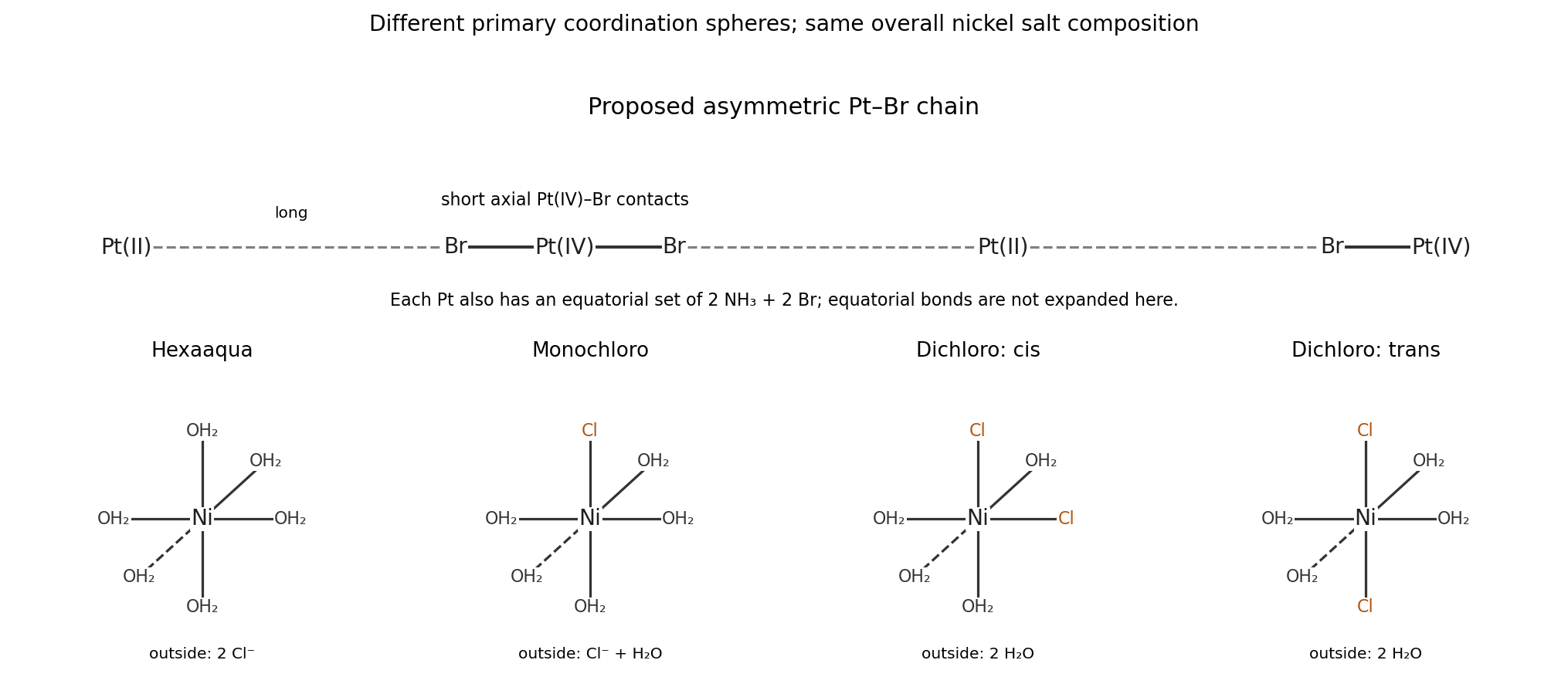
For the usual octahedral Ni(II) hydration-isomer series, distinguish coordinated water from water of crystallization:The first two coordination spheres have no cis/trans choice because they contain zero or one chloride. The last hydration class has two geometrical isomers: the chlorides occupy adjacent or opposite octahedral positions. Thus there are three hydration classes and four structures when cis/trans isomerism is included. Every formula retains two chlorides and six waters overall; the coordination number remains six. The schematic in B6(c) displays the distinct octahedral connectivities. This enumeration states the usual six-coordinate interpretation, rather than treating unspecified changes in coordination number as further members of the same elementary series.
Past exam of the chemistry B course of the University of Cambridge 2023 Paper 2 B6 d Solution by Codex 0 2026-10-20
Codex 0 2026-10-20The more radially extended Pt orbitals give strong metal–ligand overlap and covalent bonding. This helps compensate the energetic cost of reaching Pt(IV), and the large octahedral ligand field splitting strongly stabilizes its low-spin configuration, with a crystal field stabilization energy contribution before separately counting pairing and the full bond energies. Ni bonding is less effective in this respect; Pd compounds also generally favour the very stable M(II) arrangement more strongly than Pt does. The stronger bonding and large ligand-field stabilization available to Pt(IV) make oxidation to more favourable relative to its congeners. This is a comparative trend, not a claim that Ni(IV) or Pd(IV) complexes cannot exist.
Past exam of the chemistry B course of the University of Cambridge 2023 Paper 2 B6 c Solution by Codex 0 Created 2026-10-20 Updated 2026-10-31
Codex 0 Created 2026-10-20 Updated 2026-10-31The average Pt oxidation state is , since six bromides balance the two metal atoms. A natural mixed valence assignment is alternating Pt(II), , and Pt(IV), , rather than two equivalent Pt(III) sites. Use neutral square-planar units and octahedral units. At every site place two Ammonia and two bromide ligands in an equatorial plane; the Pt(IV) sites have two additional axial bromides pointing toward the adjacent Pt(II) sites.
Along the chain the connectivity isEvery Pt–Br–Pt bridge is asymmetric: short to Pt(IV), long to Pt(II). The latter contact is a secondary axial interaction, consistent with the preference of Pt(II) for a square-planar primary coordination sphere. The Pt(IV) site is smaller and more strongly attracts the bridging bromides. A drawing with all axial distances identical would obscure the distinct local environments.
There are four equatorial bromides and two axial bridging bromides per two-Pt repeat, giving precisely . A direct Pt–Pt bond is not required. This is a proposed structure consistent with the stated composition and two environments; the formula alone does not determine every equatorial cis/trans arrangement or numerical bond length.
Pinned article: Introduction to the OurBigBook Project
Welcome to the OurBigBook Project! Our goal is to create the perfect publishing platform for STEM subjects, and get university-level students to write the best free STEM tutorials ever.
Everyone is welcome to create an account and play with the site: ourbigbook.com/go/register. We belive that students themselves can write amazing tutorials, but teachers are welcome too. You can write about anything you want, it doesn't have to be STEM or even educational. Silly test content is very welcome and you won't be penalized in any way. Just keep it legal!
Intro to OurBigBook
. Source. We have two killer features:
- topics: topics group articles by different users with the same title, e.g. here is the topic for the "Fundamental Theorem of Calculus" ourbigbook.com/go/topic/fundamental-theorem-of-calculusArticles of different users are sorted by upvote within each article page. This feature is a bit like:
- a Wikipedia where each user can have their own version of each article
- a Q&A website like Stack Overflow, where multiple people can give their views on a given topic, and the best ones are sorted by upvote. Except you don't need to wait for someone to ask first, and any topic goes, no matter how narrow or broad
This feature makes it possible for readers to find better explanations of any topic created by other writers. And it allows writers to create an explanation in a place that readers might actually find it.
Figure 1. Screenshot of the "Derivative" topic page. View it live at: ourbigbook.com/go/topic/derivativeVideo 2. OurBigBook Web topics demo. Source. - local editing: you can store all your personal knowledge base content locally in a plaintext markup format that can be edited locally and published either:This way you can be sure that even if OurBigBook.com were to go down one day (which we have no plans to do as it is quite cheap to host!), your content will still be perfectly readable as a static site.
- to OurBigBook.com to get awesome multi-user features like topics and likes
- as HTML files to a static website, which you can host yourself for free on many external providers like GitHub Pages, and remain in full control

Figure 2. You can publish local OurBigBook lightweight markup files to either OurBigBook.com or as a static website.
Figure 3. Visual Studio Code extension installation.
Figure 5. . You can also edit articles on the Web editor without installing anything locally. Video 3. Edit locally and publish demo. Source. This shows editing OurBigBook Markup and publishing it using the Visual Studio Code extension. 
- Infinitely deep tables of contents:



All our software is open source and hosted at: github.com/ourbigbook/ourbigbook
Further documentation can be found at: docs.ourbigbook.com
Feel free to reach our to us for any help or suggestions: docs.ourbigbook.com/#contact