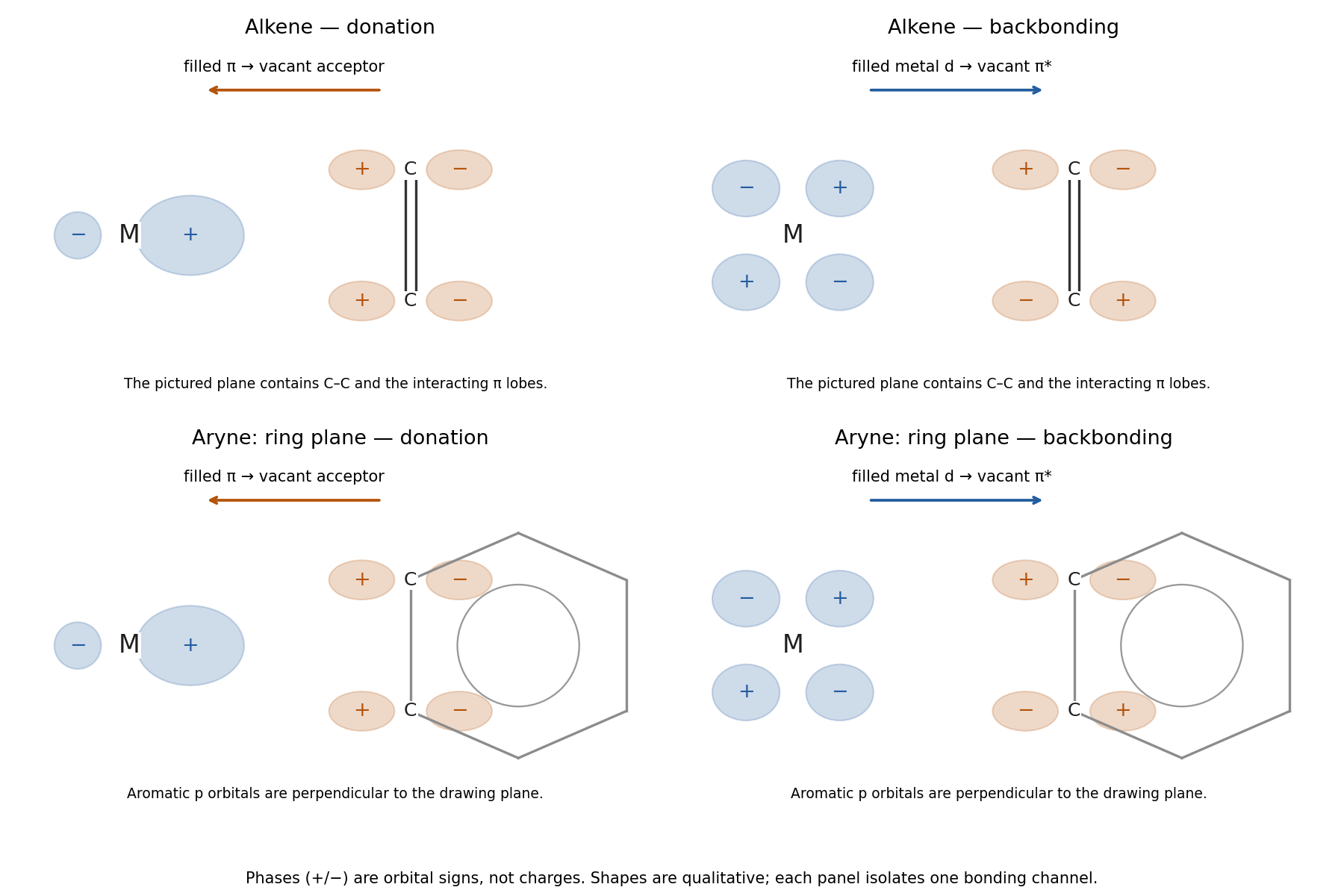
The Dewar-Chatt-Duncanson model has two complementary interactions. The filled alkene orbital donates to an empty metal orbital, and an occupied metal orbital back-donates into the empty alkene orbital. The metal acceptor has the symmetry of the sum of the two ligand lobes facing it; the back-donor has opposite phases at the two carbon positions and matches the antisymmetric combination.Both channels strengthen metal–alkene attachment. Donation removes some electron density from the internal bonding orbital, while back-donation populates its antibonding partner, so coordination generally reduces C–C bond order. The schematic shows orbital phase signs, not positive and negative electric charges.

Articles by others on the same topic
There are currently no matching articles.