Topics (384k) Articles (398k) Users (410) Discussions (242) Comments (383) Files (13k) New article

Original literate WEB program for TeX82. Header records copyright 1982 and release history through version 3.141592653 (January 2021). Named code sections and identifiers provide stable locators: penalty_node, badness, try_break, fit_class, adj_demerits, glue_set. Official distribution directory: ctan.org/tex-archive/systems/knuth/dist/tex .
RFC9110,June2022,STD97. Primary protocol standard:§7.1Determining the Target Resource explicitly excludes the fragment component from the target URI; fragment processing remains client-side. Used for request semantics only.
RFC3986,January2005,STD66. Primary standard:§2.1percent-encoding,§3components,§3.4query,§3.5fragment,§5.2relative-reference resolution. Generic URI model distinguished from WHATWG algorithms; no publication-status claim inferred from WHATWG goals.
By Ashish Vaswani.
2017 paper; inspected arXiv version 7, 2 August 2023. Sections 5.4.2 and 6.2, Table 3: label smoothing and Transformer component variations on newstest2013. Base epsilon_ls=0.1: wordpiece perplexity 4.92 and BLEU 25.8; epsilon_ls=0.0: 4.67 and 25.3. Model-variation runs use no checkpoint averaging. Byline and contribution note identify Ashish Vaswani; other authors retain the published byline.
Proceedings of the 34th International Conference on Machine Learning, PMLR 70, 1321–1330 (2017). Primary paper PDF proceedings.mlr.press/v70/guo17a/guo17a.pdf . Section 2 defines top-label confidence calibration and reliability diagrams; Figure 1 compares error and confidence, section 4 presents temperature scaling. First three authors share equal-contribution credit, not solely first author.
Institutional primary profile identifies Sepp Hochreiter and machine-learning,LSTM research. Explicitly labeled portrait links www.jku.at/fileadmin/_processed_/a/4/csm_Sepp_Hochreiter_9f3c8a11bf.jpg . Binary cache miss recorded; no current job date or personal biographical dates inferred.
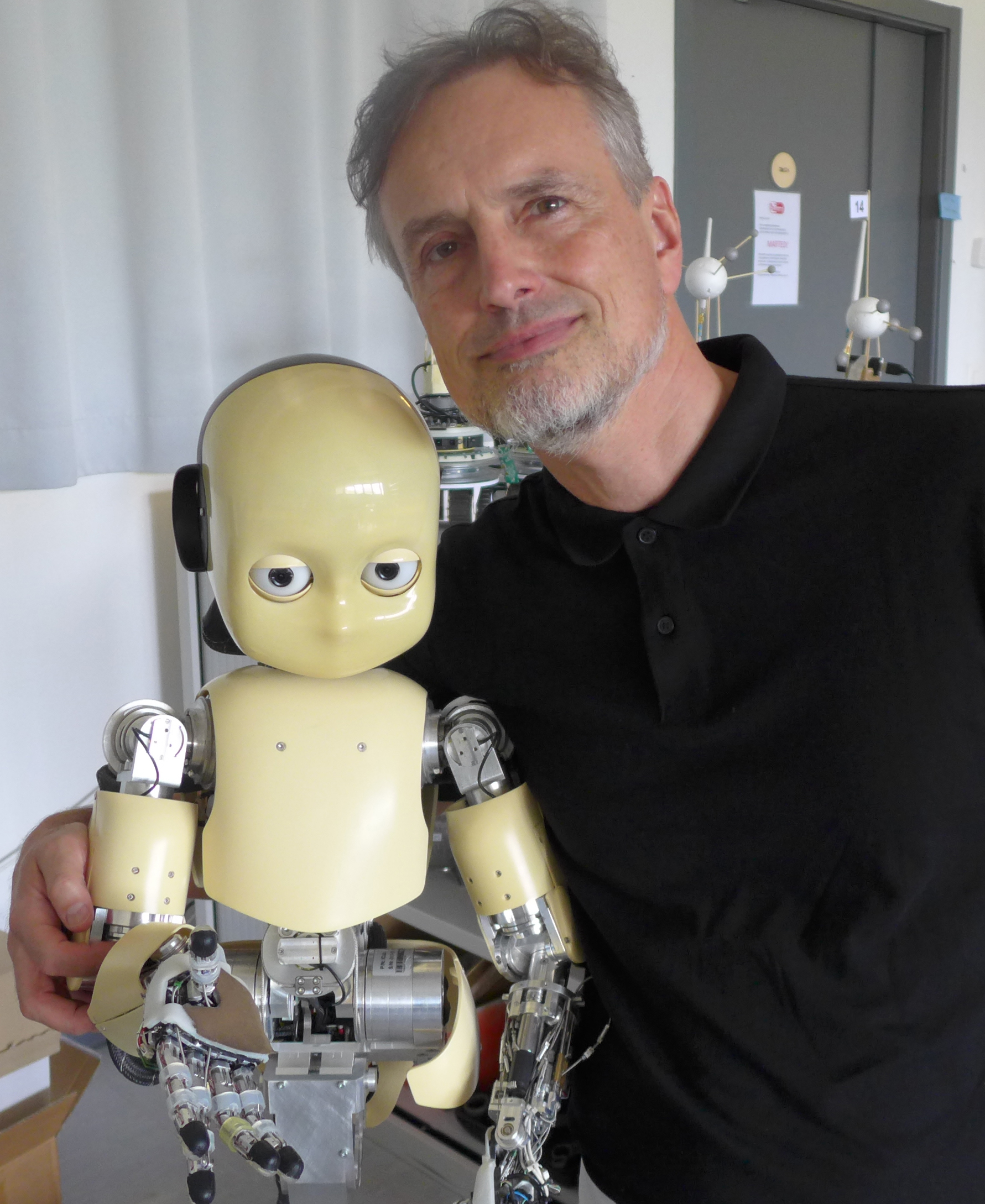
Author homepage identifies Jürgen Schmidhuber and neural-network research. Its Photos list links people.idsia.ch/~juergen/juergen2017icub.jpg . Used for identity/portrait only, not unverified priority claims or universal AI performance claims.
Primary2019event speaker profile identifies Fred Cummins,UCD and empirical study of joint speech; date-specific affiliation only. Portrait under named speaker heading links archives.battleofideas.org.uk/2019/wp-content/uploads/2019/09/Fred.jpeg . Direct image retrieval cache miss. Author publication list pworldrworld.com/fred/?page_id=14 confirms both2003speech paper and2000Learning to Forget coauthorship.
Journal of Phonetics31(2003),139–148; DOI10.1016/S0095-4470(02)00082-7. Primary byline Fred Cummins; abstract and Methods:27self-selected pairs, prepared-text synchronous readings, practice and visibility comparisons, typical lag about40ms, reciprocal timing adjustment. Author manuscript cspeech.ucd.ie/Fred/docs/jPhon02.pdf indexed original title page checked; direct fetch timed out.
Institutional primary profile identifies Felix Gers, neural-network and NLP research, IDSIA collaboration; labeled profile portrait foundationmodels.bht-berlin.de/assets/uploads/2026/04/Felix-Gers.jpg . Primary2000MIT Press byline separately verifies Felix A.Gers. Image binary retrieval cache miss; identity verified by profile caption.
Author homepage identifies Klaus Greff as machine-learning researcher and labels linked portrait Klaus Greff. Portrait URL qwlouse.github.io/images/portrait.jpg identified from primary page; direct web image retrieval cache miss, no claim of visual inspection.
Official user guide, section 1.16: calibrated probabilities, reliability diagrams, predicted-versus-observed frequencies and calibration data. Used for the distinction between a classifier confidence score and an empirically calibrated probability; no latest library release claim needed.
Living Standard. Goals; section 4 URL representation, parsing, serialization and equivalence; section 6.1 URL class. Prepared component, relative-resolution and default-port examples were checked with Node URL before this level; no duplicate browsing needed for those facts.
Official editor draft, inspected heading ECMAScript 2027 Language Specification; not asserted to be a published 2027 edition. Overview, Hosts and Implementations; Array.prototype.map; Addition Operator and string concatenation semantics. Used for stable language examples and distinction from host-provided DOM facilities.
Software: Practice and Experience 11(11),1119–1184 (1981); DOI10.1002/spe.4380111102. The primary abstract describes paragraph-wide optimization using boxes, glue and penalties, with dynamic programming. Original paper copy: gwern.net/doc/design/typography/tex/1981-knuth.pdf .
Living Standard. Nodes, node trees, Document, Element and Text interfaces; createElement and appendChild algorithms. Provides the document model and mutation operations used in the article example, independently of exact HTML source serialization.
Pinned article: Introduction to the OurBigBook Project
Welcome to the OurBigBook Project! Our goal is to create the perfect publishing platform for STEM subjects, and get university-level students to write the best free STEM tutorials ever.
Everyone is welcome to create an account and play with the site: ourbigbook.com/go/register. We belive that students themselves can write amazing tutorials, but teachers are welcome too. You can write about anything you want, it doesn't have to be STEM or even educational. Silly test content is very welcome and you won't be penalized in any way. Just keep it legal!
Intro to OurBigBook
. Source. We have two killer features:
- topics: topics group articles by different users with the same title, e.g. here is the topic for the "Fundamental Theorem of Calculus" ourbigbook.com/go/topic/fundamental-theorem-of-calculusArticles of different users are sorted by upvote within each article page. This feature is a bit like:
- a Wikipedia where each user can have their own version of each article
- a Q&A website like Stack Overflow, where multiple people can give their views on a given topic, and the best ones are sorted by upvote. Except you don't need to wait for someone to ask first, and any topic goes, no matter how narrow or broad
This feature makes it possible for readers to find better explanations of any topic created by other writers. And it allows writers to create an explanation in a place that readers might actually find it.
Figure 1. Screenshot of the "Derivative" topic page. View it live at: ourbigbook.com/go/topic/derivativeVideo 2. OurBigBook Web topics demo. Source. - local editing: you can store all your personal knowledge base content locally in a plaintext markup format that can be edited locally and published either:This way you can be sure that even if OurBigBook.com were to go down one day (which we have no plans to do as it is quite cheap to host!), your content will still be perfectly readable as a static site.
- to OurBigBook.com to get awesome multi-user features like topics and likes
- as HTML files to a static website, which you can host yourself for free on many external providers like GitHub Pages, and remain in full control

Figure 2. You can publish local OurBigBook lightweight markup files to either OurBigBook.com or as a static website.
Figure 3. Visual Studio Code extension installation.
Figure 5. . You can also edit articles on the Web editor without installing anything locally. Video 3. Edit locally and publish demo. Source. This shows editing OurBigBook Markup and publishing it using the Visual Studio Code extension. 
- Infinitely deep tables of contents:





All our software is open source and hosted at: github.com/ourbigbook/ourbigbook
Further documentation can be found at: docs.ourbigbook.com
Feel free to reach our to us for any help or suggestions: docs.ourbigbook.com/#contact