Topics (119k) Articles (119k) Users (286) Discussions (237) Comments (383) Files (715) New article

Only present in Gram-negative bacteria.

Structure of a Gram-negative bacteria
. Source. Street View's go into the past mode is the dream of every archaeologist. Ciro can only dream of a magic street view that allows going back to earlier centuries and beyond... isn't it amazing to think that people in the future will have that ability to time travel back to around the year 2006? Ciro wonders how long Google will be able to keep storing data like that.
Thanks, CIA.
The 1997 Wayback Machine archives are just priceless: web.archive.org/web/19971210065425/http://backrub.stanford.edu/backrub.html. I'm so glad that website exists and started so early. It is just another university research project demo website like any other. Priceless.
Craig Silverstein was the first employee hired, in 1998: www.newyorker.com/magazine/2018/12/10/the-friendship-that-made-google-huge
In August 1998 they had an their first investment of $100,000 from Andy Bechtolsheim, Sun Microsystems co-founder. Some sources say September 1998. This was an event of legend, the dude dropped by, tested the website for a few minutes, said I like it, and dropped a 100$ check with no paperwork. Google wasn't even incorporated, they had to incorporate to cash the check. They were apparently introduced by one of the teachers, TODO which. Some sources say he had to rush off to another meeting afterwards:
Tried to sell it for 1 million in early 1999... OMG the way the world is. It would be good to learn more about that story, and when they noticed it was fuckup.
One of Google's most interesting stories is how their startup garage owner became an important figure inside Google, and how Sergei married her sister. These were the best garage tenants ever!
Bibliography:
- Video "Anne Wojcicki interview by Talks at Google (2018)" has a few mentions, e.g. youtu.be/pDoALM0q1LA?t=173
- www.theverge.com/2019/12/4/20994361/google-alphabet-larry-page-sergey-brin-sundar-pichai-co-founders-ceo-timeline The rise, disappearance, and retirement of Google co-founders Larry Page and Sergey Brin. Good timeline!
When Ciro finally understood that this is a play on Larry Page's name (of course it is, typical programmer/academic humor stuff), his mind blew.
Forms the bacterial cell wall.
From the Wikipedia image we can see clearly the polymer structure formed: it is a mesh with:
- sugar covalent bond chains in one direction. These have two types of monosaccharide, NAM and NAG
- peptide chains on the other, and only coming off from NAM
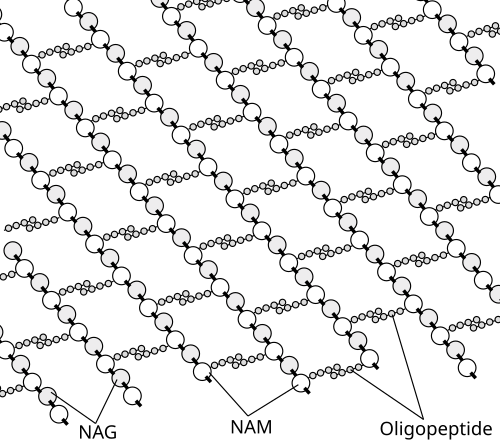
Peptidoglycan polymer structure
. Source. Perfect Git integration belongs in integrated development environments :-)
Pinned article: Introduction to the OurBigBook Project
Welcome to the OurBigBook Project! Our goal is to create the perfect publishing platform for STEM subjects, and get university-level students to write the best free STEM tutorials ever.
Everyone is welcome to create an account and play with the site: ourbigbook.com/go/register. We belive that students themselves can write amazing tutorials, but teachers are welcome too. You can write about anything you want, it doesn't have to be STEM or even educational. Silly test content is very welcome and you won't be penalized in any way. Just keep it legal!
Intro to OurBigBook
. Source. We have two killer features:
- topics: topics group articles by different users with the same title, e.g. here is the topic for the "Fundamental Theorem of Calculus" ourbigbook.com/go/topic/fundamental-theorem-of-calculusArticles of different users are sorted by upvote within each article page. This feature is a bit like:
- a Wikipedia where each user can have their own version of each article
- a Q&A website like Stack Overflow, where multiple people can give their views on a given topic, and the best ones are sorted by upvote. Except you don't need to wait for someone to ask first, and any topic goes, no matter how narrow or broad
This feature makes it possible for readers to find better explanations of any topic created by other writers. And it allows writers to create an explanation in a place that readers might actually find it.
Figure 1. Screenshot of the "Derivative" topic page. View it live at: ourbigbook.com/go/topic/derivativeVideo 2. OurBigBook Web topics demo. Source. - local editing: you can store all your personal knowledge base content locally in a plaintext markup format that can be edited locally and published either:This way you can be sure that even if OurBigBook.com were to go down one day (which we have no plans to do as it is quite cheap to host!), your content will still be perfectly readable as a static site.
- to OurBigBook.com to get awesome multi-user features like topics and likes
- as HTML files to a static website, which you can host yourself for free on many external providers like GitHub Pages, and remain in full control

Figure 2. You can publish local OurBigBook lightweight markup files to either OurBigBook.com or as a static website.
Figure 3. Visual Studio Code extension installation.
Figure 5. . You can also edit articles on the Web editor without installing anything locally. Video 3. Edit locally and publish demo. Source. This shows editing OurBigBook Markup and publishing it using the Visual Studio Code extension. 
- Infinitely deep tables of contents:




All our software is open source and hosted at: github.com/ourbigbook/ourbigbook
Further documentation can be found at: docs.ourbigbook.com
Feel free to reach our to us for any help or suggestions: docs.ourbigbook.com/#contact