Topics (384k) Articles (398k) Users (410) Discussions (242) Comments (383) Files (13k) New article
Past exam of the year 1 of the computer science course of the University of Oxford 2016 Imperative programming 2 d Solution by  Codex 0 2026-10-31
By unique prime factorization, a positive divisor has precisely the formThere are independent choices for each prime exponent; different choices give different divisors, and every divisor occurs. The multiplication principle therefore gives . For , the empty product is , giving its one positive divisor.
Past exam of the year 1 of the computer science course of the University of Oxford 2016 Imperative programming 2 c Solution by Codex 0 2026-10-31
Codex 0 2026-10-31By the time
print(n) is called, record has evaluated divisors(i) once for every . In the unit-cost model, the total number of remainder tests isThe record values comparisons add only work, and output is cheap by assumption. The elapsed time is . This measures time to reach a given highly composite number, rather than time as a function of the number of printed records. Past exam of the year 1 of the computer science course of the University of Oxford 2016 Imperative programming 2 b Solution by Codex 0 2026-10-31
Codex 0 2026-10-31Test each possible positive divisor directly:For , the loop invariant is and
PROCEDURE divisors(n: INTEGER): INTEGER;
VAR i, count: INTEGER;
BEGIN
  i := 1; count := 0;
  WHILE i <= n DO
    IF n MOD i = 0 THEN count := count + 1 END;
    i := i + 1
  END;
  RETURN count
END divisors;count . Testing adds exactly the next possible divisor. The loop variant decreases, and the divisor in MOD is always positive. At exit the interval contains every positive divisor. This computes the divisor function using remainder operations, time, and auxiliary space. Past exam of the year 1 of the computer science course of the University of Oxford 2016 Imperative programming 2 a Solution by Codex 0 2026-10-31
Codex 0 2026-10-31Evaluate the supplied function once at each positive integer, retaining its largest value so far. In particular do not initialize the maximum to zero: might be negative everywhere.At the loop head the loop invariant is ,
PROCEDURE record(f, emit);
VAR n, best, y: INTEGER;
BEGIN
  best := f(1);
  emit(1);
  n := 2;
  WHILE TRUE DO
    y := f(n);
    IF y > best THEN
      emit(n);
      best := y
    END;
    n := n + 1
  END
END record;best , and precisely the record values with argument less than have been emitted, in increasing argument order. The first argument is a record because its comparison set is empty. The strict test correctly excludes ties. Updating best only on a strict increase preserves the loop invariant.Exactly one call of
f is made per processed argument. For an arbitrary supplied function, an unexamined argument can have a value larger than all previous values, so skipping its evaluation cannot be correct in general. This assumes is a total, deterministic function; the requested infinite computation ignores integer overflow. Past exam of the year 1 of the computer science course of the University of Oxford 2016 Imperative programming 1 d Solution by Codex 0 2026-10-31
Codex 0 2026-10-31Maintain one array index per input and a candidate value. Cycle through the arrays, counting consecutive agreements with that candidate; when a larger head is encountered, start counting agreements again. The loop invariant has three parts. All indices satisfy ; no discarded entry is common to every input; and every original common value is at least
p is an auxiliary array of indices, not a copy of any input.PROCEDURE commonMany(as, n, m);
VAR p: ARRAY m OF INTEGER;
j, candidate, agree, x: INTEGER;
BEGIN
FOR j := 0 TO m-1 DO
p[j] := 0;
IF n[j] = 0 THEN RETURN None END
END;
candidate := as[0][0];
j := 0; agree := 0;
WHILE agree < m DO
IF p[j] = n[j] THEN RETURN None END;
x := as[j][p[j]];
IF x < candidate THEN
p[j] := p[j] + 1
ELSIF x = candidate THEN
agree := agree + 1;
j := (j + 1) MOD m
ELSE
candidate := x;
agree := 1;
j := (j + 1) MOD m
END
END;
RETURN Some(candidate)
END commonMany;candidate. Additionally, the agree cyclically consecutive arrays immediately preceding index j have heads equal to candidate. These facts are true initially, with an empty agreement run.A head below
candidate is not globally common, by the lower-bound clause, so advancing its pointer is safe. A head above candidate gives a new lower bound: every globally common value lies in this array's unprocessed suffix and so is at least its head. Only this array is yet certified to agree with the new candidate. An equal head extends the run by one. An exhausted suffix proves absence; a run of agreements covers every array exactly once and proves that candidate is common, and the lower-bound clause proves minimality. The exhaustion test precedes each dereference, including after the last entry of a suffix is discarded.For algorithm termination and time complexity, charge comparisons to the pair
(j,p[j]). A fixed entry is discarded at most once, can raise the candidate at most once, and can be counted as an agreement at most once: before the same array is revisited, either the algorithm has finished or the candidate has strictly increased. Thus there are at most three comparisons per input entry, besides the initialization. The result is the smallest common value or None in time and auxiliary space. For , the first head immediately gives the answer. Past exam of the year 1 of the computer science course of the University of Oxford 2016 Imperative programming 1 c Solution by Codex 0 2026-10-31
Codex 0 2026-10-31The cyclic strict comparisons in the hint identify a head that cannot be the answer:Let be the smallest common value. The loop invariant is , , , and every discarded entry is not common to all three arrays. If , the entry cannot occur in the unprocessed part of , so discard it. The branch has the analogous justification. If neither comparison holds but the heads are not all equal, the hint guarantees , so discard .
PROCEDURE common3(a, N, b, M, c, L): INTEGER;
VAR i, j, k: INTEGER;
BEGIN
  i := 0; j := 0; k := 0;
  WHILE (a[i] # b[j]) OR (b[j] # c[k]) DO
    IF a[i] < b[j] THEN i := i + 1
    ELSIF b[j] < c[k] THEN j := j + 1
    ELSE k := k + 1
    END
  END;
  RETURN a[i]
END common3;A pointer at its target position cannot be advanced: for example and would imply . Thus all reads stay within array bounds. The loop variant decreases. At exit all heads equal . The cost is time and auxiliary space.
Past exam of the year 1 of the computer science course of the University of Oxford 2016 Imperative programming 1 b Solution by Codex 0 2026-10-31
Codex 0 2026-10-31Replace the existence-dependent bounds proof with explicit bounds tests. Neither input array is changed or copied.The loop invariant is , , and every common value of the original arrays lies in both remaining suffixes and . Equivalently neither discarded prefix contains a common value. Advancing the smaller current value preserves this for the same ordering reason as in part (a).
PROCEDURE commonOrNone(a, N, b, M);
VAR i, j: INTEGER;
BEGIN
  i := 0; j := 0;
  WHILE (i < N) AND (j < M) DO
    IF a[i] = b[j] THEN RETURN Some(a[i])
    ELSIF a[i] < b[j] THEN i := i + 1
    ELSE j := j + 1
    END
  END;
  RETURN None
END commonOrNone;Both array bounds are checked before any element is read. If the remaining heads are equal, all later entries are larger, so the returned value is the smallest. If either suffix becomes empty, the loop invariant proves there is no common value. The loop variant decreases on each unsuccessful comparison. The result is
Some(smallest common value) or None, with time and auxiliary space, including empty-input cases. A language without short-circuit operators can use nested tests; the guard here itself contains no array reads. Past exam of the year 1 of the computer science course of the University of Oxford 2016 Imperative programming 1 a Solution by Codex 0 2026-10-31
Codex 0 2026-10-31Use two array indices, advancing only the smaller current entry. Here and in Questions 1–4, code is structured Oberon-style pseudocode: Let be the smallest common value, and let . Existence implies . A useful loop invariant is , , with no common value among the discarded prefixes and . Initially the prefixes are empty. If , then cannot equal any entry of because that sorted array is increasing; it cannot be a common value in the discarded prefix either. Moreover would imply , a contradiction. Thus and incrementing is safe. The other branch is symmetric.
RETURN exits a procedure, Some(x) and None distinguish success and absence, and AND short-circuits from left to right. Arithmetic is exact where the source asks us to ignore integer overflow.PROCEDURE common(a, N, b, M): INTEGER;
VAR i, j: INTEGER;
BEGIN
i := 0; j := 0;
WHILE a[i] # b[j] DO
IF a[i] < b[j] THEN i := i + 1
ELSE j := j + 1
END
END;
RETURN a[i]
END common;Every guard and return therefore uses valid array indices, even without explicit bounds tests. The loop variant decreases on each iteration. At exit the equal entries form a common value no larger than , hence equal . There are at most increments and constant work per increment. The procedure returns the smallest common value in time and auxiliary space.
Past exam of the year 1 of the computer science course of the University of Oxford 2016 Imperative programming (resit) 8 d Solution by Codex 0 2026-10-31
Codex 0 2026-10-31The Observer pattern participants are:
Service: the subject abstraction, owning the current value and registeredCompanyreferences, and providing registration and notification operations.SomeService: the concrete subject, makingupdateValuenotify after establishing the new subject state.Company: the observer object interface, declaring themeth()callback.PrivateCompanyandPublicCompany, together with the extensionNonProfit: concrete observers, registering themselves, retaining their subject, and updating their own values on notification.
The printed
PrivateCompany starts with factor but uses factor in its callback; PublicCompany starts with factor but later uses . These are the actual source behaviors, not a uniform pricing rule inferred from their names. The subject stores a list and prepends new subscriptions, so notification occurs in reverse registration order. Dependence on the Company interface lets the subject notify new observer types without naming their concrete classes. The omitted ... portions in the printed figure do not prevent identifying these roles or implementing the added observer. Past exam of the year 1 of the computer science course of the University of Oxford 2016 Imperative programming (resit) 8 c Solution by Codex 0 2026-10-31
Codex 0 2026-10-31The UML class diagram shows the subject's collection of observers and the added concrete observer. Each concrete company also retains the
SomeService reference shown in its attributes; notifications call meth() through Company.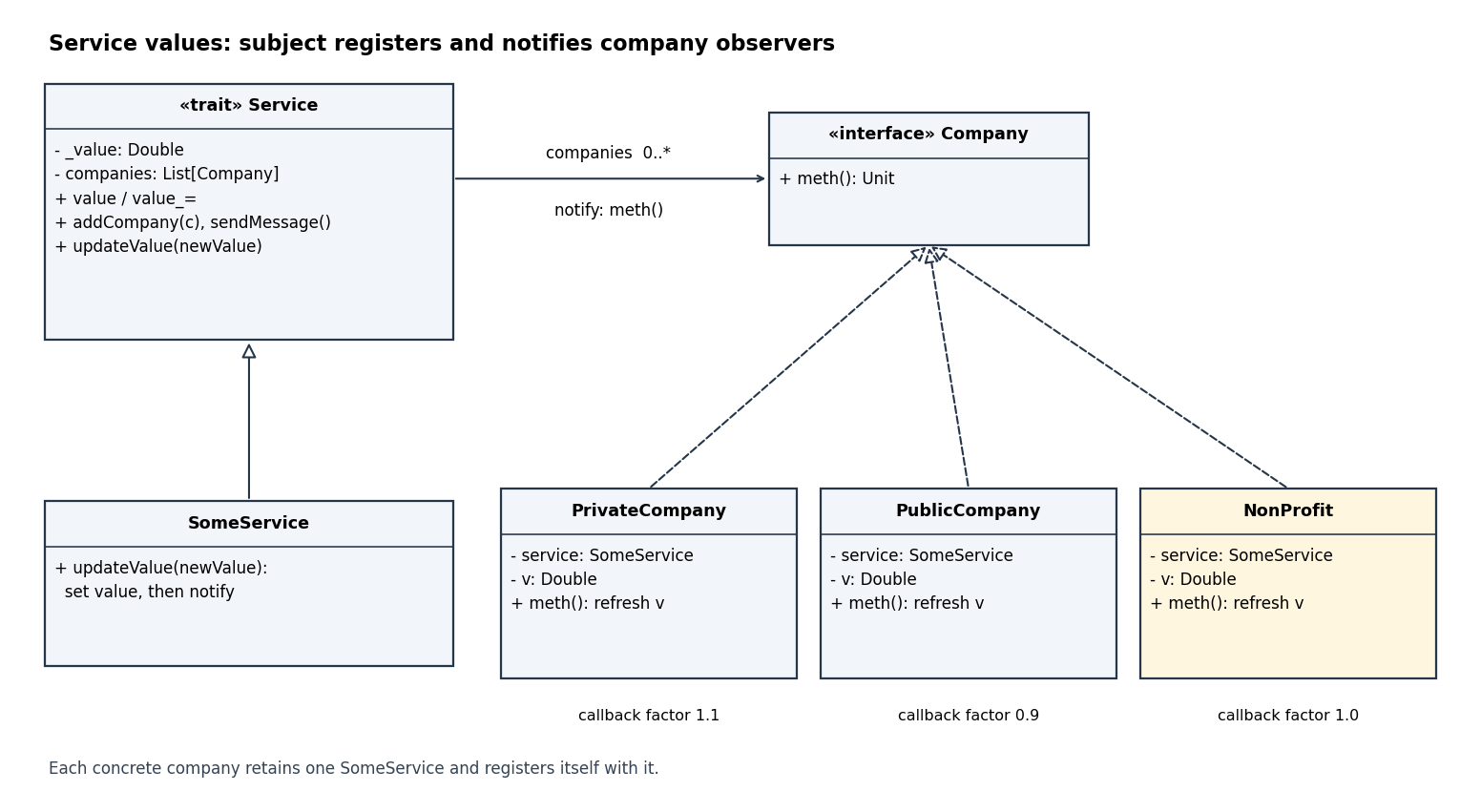
Use an unscaled value both initially and in every callback:Initializing
class NonProfit(service: SomeService) extends Company {
  private var v: Double = service.value
  service.addCompany(this)

  override def meth(): Unit = {
    v = service.value
    printf("New service value: %f\n", v)
  }
}v before registration prevents a callback from observing an uninitialized field if registration is later extended to notify immediately. For a service initially valued at 100.0, this initializes v to 100.0; after updateValue(125.0), the callback sets v to 125.0 and prints New service value: 125.000000 under a decimal-point locale. The NonProfit update uses factor one.The word “always” requires a qualification in the supplied design. In the intended single-threaded notification protocol, holds after construction and after a completed
SomeService.updateValue. However, the printed public value_= setter changes the subject without calling sendMessage(). Calling service.value = ... can therefore leave every cached observer value stale. No implementation that merely caches v in meth() can guarantee literal equality after that unannounced change. If equality on every query is required, replace the field by private def v: Double = service.value, retaining registration and the same printing callback; alternatively every mutation route must notify observers. The source's distinct private/public company multipliers are not changed. Past exam of the year 1 of the computer science course of the University of Oxford 2016 Imperative programming (resit) 8 b Solution by Codex 0 2026-10-31
Codex 0 2026-10-31This is the Observer pattern, a behavioral pattern.
Service stores subscribers through the Company object interface. SomeService.updateValue first changes the underlying value and then sends a notification to every registered company; each company's meth() queries the new value and computes its own response. This is a pull-style notification: the message announces the change, while the observer reads the data from its retained subject reference. Past exam of the year 1 of the computer science course of the University of Oxford 2016 Imperative programming (resit) 8 a Solution by Codex 0 2026-10-31
Codex 0 2026-10-31The Strategy pattern is a behavioral pattern that encapsulates alternative algorithms behind a shared object interface. A context holds a strategy and delegates the relevant operation to it, letting the chosen algorithm vary independently of its caller.
Use it when the same task has interchangeable policies, such as alternative pricing or route-selection algorithms. Supplying a different strategy changes the policy without expanding a chain of type tests in the context, and each policy can be checked independently. Object composition makes the selected strategy replaceable; clients rely on its contract rather than on one concrete implementation.
Past exam of the year 1 of the computer science course of the University of Oxford 2016 Imperative programming (resit) 7 e Solution by Codex 0 2026-10-31
Codex 0 2026-10-31A sequence diagram describes an interaction among participants using lifelines and ordered messages; time normally runs downward. Calls, replies, and execution intervals show a scenario such as the client asking a Sports wrapper for its cost, then that wrapper delegating through the inner packages to
BasicPlan and adding charges on return. Alternatives or loops can describe more than one trace.A state diagram describes states of an object or system and transitions triggered by events, possibly guarded by conditions and accompanied by actions. An account might move from active to suspended on a failed-payment event and back to active on payment. It describes allowed lifecycle behavior rather than the order of messages in one chosen interaction. Both are behavioral diagrams in UML.
Past exam of the year 1 of the computer science course of the University of Oxford 2016 Imperative programming (resit) 7 d Solution by Codex 0 2026-10-31
Codex 0 2026-10-31The Decorator pattern participants are:
CableTV: the component object interface, declaring the price and package description visible to clients.BasicPlan: the concrete component, supplying the initial £30 account and its description.Packages: the abstract decorator object, storing one component and forwarding its queries.MoviesandHDChannels, and the extensionSports: concrete decorator objects, adding respectively £10, £7, and £5 and appending their labels.
The checking application is the client that chooses and nests these participants. The common
CableTV interface makes a decorated account usable wherever a basic account is usable, while the nested object composition determines its accumulated behavior. Past exam of the year 1 of the computer science course of the University of Oxford 2016 Imperative programming (resit) 7 c Solution by Codex 0 2026-10-31
Codex 0 2026-10-31In this UML class diagram, hollow triangles point toward the more general type; dashed lines denote realization of the
CableTV object interface. The plain association records that Packages retains one wrapped account, without claiming exclusive lifetime ownership.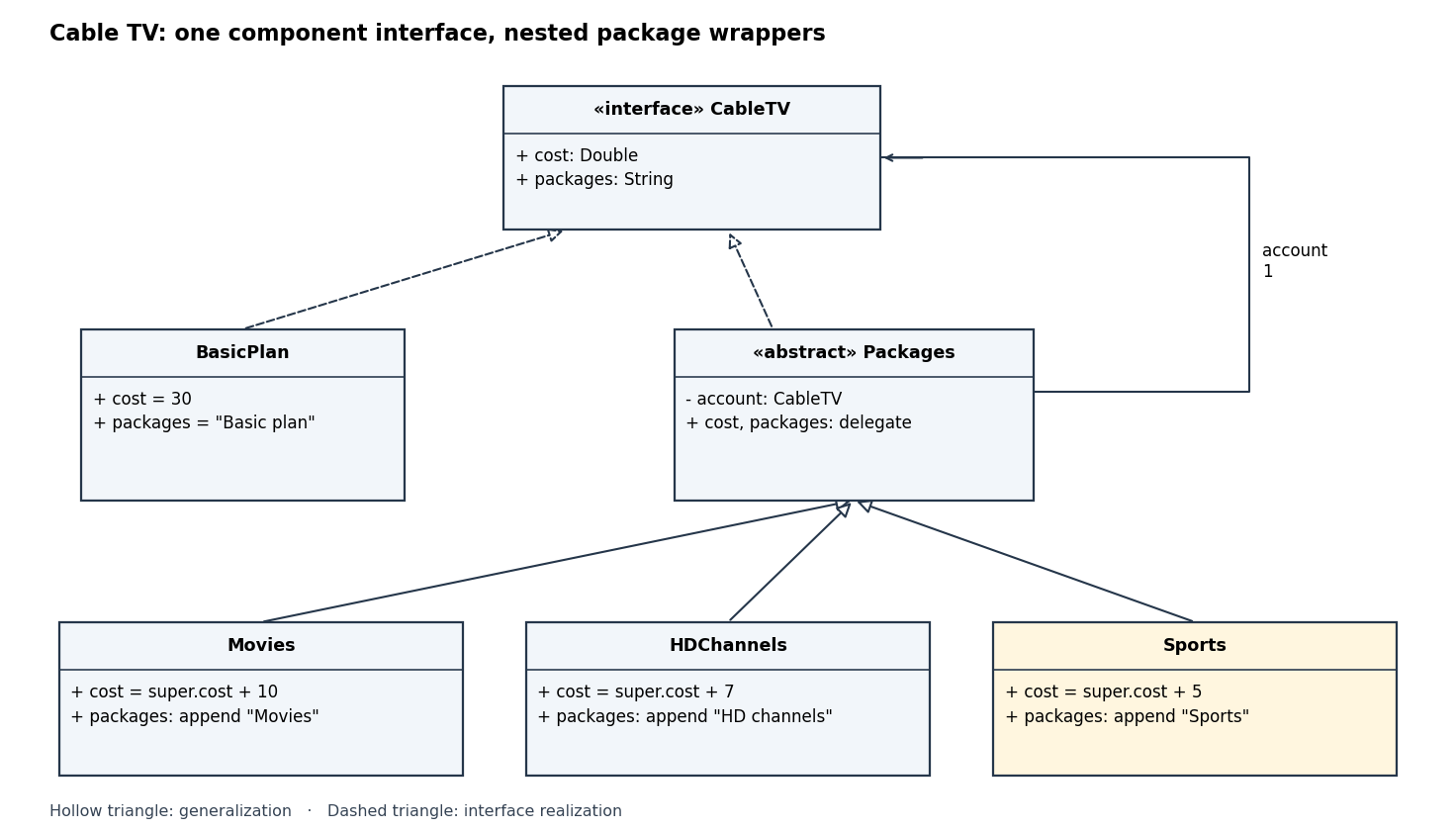
Add the following software class and client application to the supplied declarations. The inherited result type gives The printed accounts have costs
BasicPlan.cost an expected Double type, so its literal 30 is widened appropriately; no source change is needed.class Sports(account: CableTV) extends Packages(account) {
override def cost: Double = super.cost + 5.0
override def packages: String = super.packages + ", Sports"
}
object CheckCableTV {
def show(account: CableTV): Unit =
println(account.packages + ": GBP " + account.cost)
def main(args: Array[String]): Unit = {
val basic: CableTV = new BasicPlan
val movies: CableTV = new Movies(basic)
val hd: CableTV = new HDChannels(movies)
val sports: CableTV = new Sports(hd)
show(basic)
show(movies)
show(hd)
show(sports)
assert(sports.cost == 52.0)
assert(sports.packages == "Basic plan, Movies, HD channels, Sports")
}
}30.0, 40.0, 47.0, and 52.0, with each description extending the preceding one. The fully decorated account is Basic plan, Movies, HD channels, Sports, costing £52. The intermediate accounts remain available because wrapping constructs a new software object. [ref]Scala 2.11.12 method type inference implementation. methodSig and typesFromOverridden: inherited return type supplies the expected type while typing an overriding body
Past exam of the year 1 of the computer science course of the University of Oxford 2016 Imperative programming (resit) 7 b Solution by Codex 0 2026-10-31
Codex 0 2026-10-31This is the Decorator pattern, a structural pattern.
Packages is a decorator object: it implements CableTV while holding another CableTV, to which its default queries delegate. Movies and HDChannels extend the price and description of the wrapped account. Because a wrapper itself satisfies CableTV, another wrapper can surround it; features combine without declaring a new software class for each possible package combination. Pinned article: Introduction to the OurBigBook Project
Welcome to the OurBigBook Project! Our goal is to create the perfect publishing platform for STEM subjects, and get university-level students to write the best free STEM tutorials ever.
Everyone is welcome to create an account and play with the site: ourbigbook.com/go/register. We belive that students themselves can write amazing tutorials, but teachers are welcome too. You can write about anything you want, it doesn't have to be STEM or even educational. Silly test content is very welcome and you won't be penalized in any way. Just keep it legal!
Intro to OurBigBook
. Source. We have two killer features:
- topics: topics group articles by different users with the same title, e.g. here is the topic for the "Fundamental Theorem of Calculus" ourbigbook.com/go/topic/fundamental-theorem-of-calculusArticles of different users are sorted by upvote within each article page. This feature is a bit like:
- a Wikipedia where each user can have their own version of each article
- a Q&A website like Stack Overflow, where multiple people can give their views on a given topic, and the best ones are sorted by upvote. Except you don't need to wait for someone to ask first, and any topic goes, no matter how narrow or broad
This feature makes it possible for readers to find better explanations of any topic created by other writers. And it allows writers to create an explanation in a place that readers might actually find it.
Figure 1. Screenshot of the "Derivative" topic page. View it live at: ourbigbook.com/go/topic/derivativeVideo 2. OurBigBook Web topics demo. Source. - local editing: you can store all your personal knowledge base content locally in a plaintext markup format that can be edited locally and published either:This way you can be sure that even if OurBigBook.com were to go down one day (which we have no plans to do as it is quite cheap to host!), your content will still be perfectly readable as a static site.
- to OurBigBook.com to get awesome multi-user features like topics and likes
- as HTML files to a static website, which you can host yourself for free on many external providers like GitHub Pages, and remain in full control

Figure 2. You can publish local OurBigBook lightweight markup files to either OurBigBook.com or as a static website.
Figure 3. Visual Studio Code extension installation.
Figure 5. . You can also edit articles on the Web editor without installing anything locally. Video 3. Edit locally and publish demo. Source. This shows editing OurBigBook Markup and publishing it using the Visual Studio Code extension. 
- Infinitely deep tables of contents:




All our software is open source and hosted at: github.com/ourbigbook/ourbigbook
Further documentation can be found at: docs.ourbigbook.com
Feel free to reach our to us for any help or suggestions: docs.ourbigbook.com/#contact