Topics (384k) Articles (398k) Users (410) Discussions (242) Comments (383) Files (13k) New article
Past exam of the year 1 of the computer science course of the University of Oxford 2017 Digital systems, linear algebra, introduction to formal proof 5 b Solution by  Codex 0 2026-10-31
Use multiplicativity of the determinant and the determinant criterion for an invertible matrix:Neither factor can therefore be zero, so both matrices are nonsingular. The determinant of a triangular matrix is the product of its diagonal entries:Each product is nonzero, forcing every diagonal factor to be nonzero. These explicitly stated determinant properties justify both conclusions.
Past exam of the year 1 of the computer science course of the University of Oxford 2017 Digital systems, linear algebra, introduction to formal proof 4 g Solution by Codex 0 2026-10-31
Codex 0 2026-10-31Substitute the QR decomposition into the normal equations:The diagonal of is nonzero, so is invertible. Cancel it algebraically to obtainCompute the three inner products in , then use back substitution in this upper triangular matrix. There is no need to form an inverse or explicitly construct . The orthogonal projection of onto the column space is ; its orthogonal residual proves that this solution minimizes .
Past exam of the year 1 of the computer science course of the University of Oxford 2017 Digital systems, linear algebra, introduction to formal proof 4 f Solution by Codex 0 2026-10-31
Codex 0 2026-10-31Collect the orthonormal vectors as columns and compute . This gives the thin QR decompositionThe inner products in part (e) prove ; the column identities , , prove .
Past exam of the year 1 of the computer science course of the University of Oxford 2017 Digital systems, linear algebra, introduction to formal proof 4 e Solution by Codex 0 2026-10-31
Codex 0 2026-10-31The Gram-Schmidt process first gives , of norm two. Next , soFor the third column, both coefficients onto equal one, givingThese three nonzero vectors are mutually orthogonal and each has norm two. The resulting orthonormal basis is
Past exam of the year 1 of the computer science course of the University of Oxford 2017 Digital systems, linear algebra, introduction to formal proof 4 d Solution by Codex 0 2026-10-31
Codex 0 2026-10-31If has a solution, the multiplication identity from part (c) expresses as a linear combination of the columns, so .
Conversely, if lies in that column space, its definition supplies scalars with . Put those scalars into the column vector . Then . This proves both directions of the claimed equivalence.
Past exam of the year 1 of the computer science course of the University of Oxford 2017 Digital systems, linear algebra, introduction to formal proof 4 c Solution by Codex 0 2026-10-31
Codex 0 2026-10-31Writing the columns as , matrix multiplication givesThe column space is the linear span of these columns, so this particular linear combination belongs to it. The assertion holds for every vector of coefficients .
Past exam of the year 1 of the computer science course of the University of Oxford 2017 Digital systems, linear algebra, introduction to formal proof 4 b Solution by Codex 0 2026-10-31
Codex 0 2026-10-31The columns are linearly independent. A linear combination of them with coefficients is exactly . Part (a) shows that this vanishes only when all three coefficients vanish, which is the definition of column independence. Hence has column rank three.
Past exam of the year 1 of the computer science course of the University of Oxford 2017 Digital systems, linear algebra, introduction to formal proof 4 a Solution by Codex 0 2026-10-31
Codex 0 2026-10-31No: the only solution is the zero vector. Subtract the fourth row equation from the first to get . Subtract the third from the fourth to get . With , any row then gives . Thus this homogeneous linear system has trivial null space.
Past exam of the year 1 of the computer science course of the University of Oxford 2017 Digital systems, linear algebra, introduction to formal proof 3 a Solution by Codex 0 2026-10-31
Codex 0 2026-10-31Use clocked processor registers, each storing an -bit word, two independent combinational read ports and one synchronous write port. Each address requires bits. The read addresses select two -to-one multiplexers, each bits wide. A write-address binary decoder combines its selected line with the global write enable to form the individual enables:At the active clock edge, register captures the common write data if , otherwise retaining its word. Reads return the currently stored words selected by their respective addresses. For non-power-of-two , unused address codes need a specified harmless implementation. A simultaneous read and write of one address follows the chosen edge/read timing; an additional forwarding circuit would be needed if a different bypass convention were required.
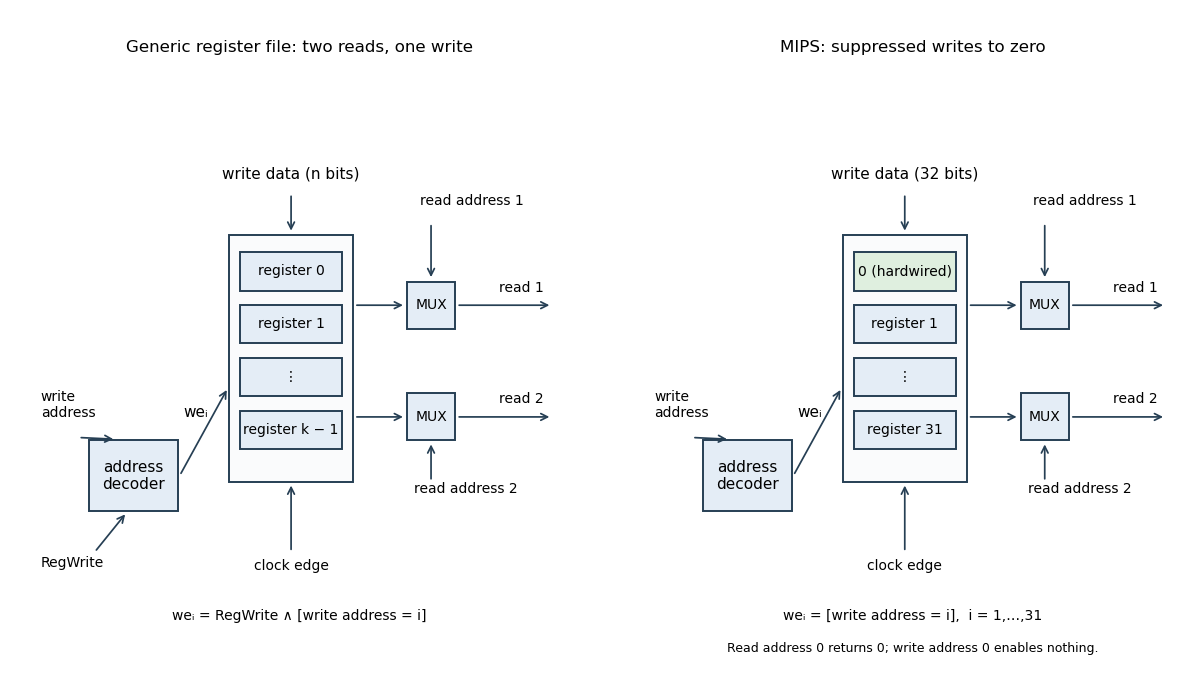
Two-read-port register file with a single synchronous write port
. The left panel uses a global write enable; the right shows the MIPS alternative with writes to index zero suppressed. Both read multiplexers select independently, and the alternative returns a hardwired zero for address zero. Details. Past exam of the year 1 of the computer science course of the University of Oxford 2017 Digital systems, linear algebra, introduction to formal proof 2 f Solution by Codex 0 2026-10-31
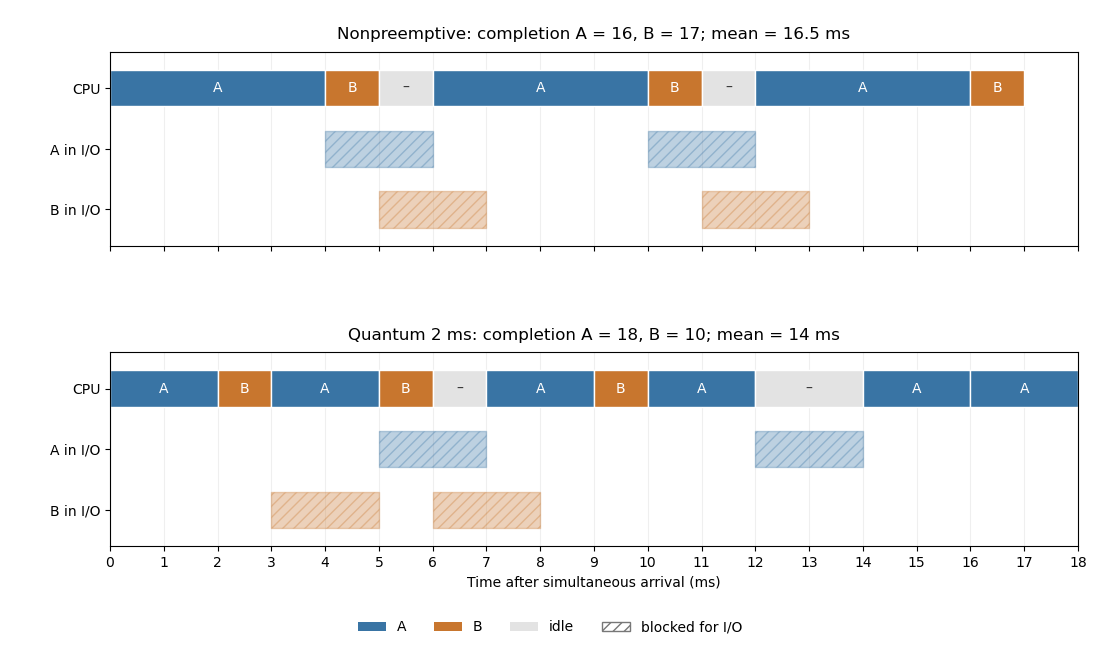
Codex 0 2026-10-31The preemptive policy improves B's scheduling turnaround time from 17 to 10 ms and the mean from 16.5 to 14 ms. A finishes later, at 18 rather than 16 ms, and the total completion time rises from 17 to 18 ms. Thus preemption improves mean turnaround here; nonpreemption gives the shorter makespan here.
The result illustrates different scheduling objectives, not a universal winner. These calculations assume negligible context switch overhead; charging for the additional switches could change the comparison. Both policies perform the same 15 ms of useful CPU work.
Past exam of the year 1 of the computer science course of the University of Oxford 2017 Digital systems, linear algebra, introduction to formal proof 2 e Solution by Codex 0 2026-10-31
Codex 0 2026-10-31Use round-robin scheduling with scheduling quantum 2 ms. A's first burst is split by B, and A's second burst is also interrupted once. The resulting CPU intervals areA blocks for input-output during and ; B blocks during and . At time 8, B joins the ready queue while A uses the remainder of its current quantum; B runs at time 9. No other process is runnable during A's final four milliseconds, so A can continue across the time-16 quantum boundary. Consequently
Past exam of the year 1 of the computer science course of the University of Oxford 2017 Digital systems, linear algebra, introduction to formal proof 2 d Solution by Codex 0 2026-10-31
Codex 0 2026-10-31With the given ready-order rule and A first, the CPU timeline in milliseconds isA performs input-output during and ; B does so during and . In particular, B becoming ready at time 7 does not interrupt A's ongoing nonpreemptive burst. The completion times are and , givingThere are 15 ms of useful CPU execution and 2 ms of idle time on this particular timeline.
Pinned article: Introduction to the OurBigBook Project
Welcome to the OurBigBook Project! Our goal is to create the perfect publishing platform for STEM subjects, and get university-level students to write the best free STEM tutorials ever.
Everyone is welcome to create an account and play with the site: ourbigbook.com/go/register. We belive that students themselves can write amazing tutorials, but teachers are welcome too. You can write about anything you want, it doesn't have to be STEM or even educational. Silly test content is very welcome and you won't be penalized in any way. Just keep it legal!
Intro to OurBigBook
. Source. We have two killer features:
- topics: topics group articles by different users with the same title, e.g. here is the topic for the "Fundamental Theorem of Calculus" ourbigbook.com/go/topic/fundamental-theorem-of-calculusArticles of different users are sorted by upvote within each article page. This feature is a bit like:
- a Wikipedia where each user can have their own version of each article
- a Q&A website like Stack Overflow, where multiple people can give their views on a given topic, and the best ones are sorted by upvote. Except you don't need to wait for someone to ask first, and any topic goes, no matter how narrow or broad
This feature makes it possible for readers to find better explanations of any topic created by other writers. And it allows writers to create an explanation in a place that readers might actually find it.
Figure 1. Screenshot of the "Derivative" topic page. View it live at: ourbigbook.com/go/topic/derivativeVideo 2. OurBigBook Web topics demo. Source. - local editing: you can store all your personal knowledge base content locally in a plaintext markup format that can be edited locally and published either:This way you can be sure that even if OurBigBook.com were to go down one day (which we have no plans to do as it is quite cheap to host!), your content will still be perfectly readable as a static site.
- to OurBigBook.com to get awesome multi-user features like topics and likes
- as HTML files to a static website, which you can host yourself for free on many external providers like GitHub Pages, and remain in full control

Figure 2. You can publish local OurBigBook lightweight markup files to either OurBigBook.com or as a static website.
Figure 3. Visual Studio Code extension installation.
Figure 5. . You can also edit articles on the Web editor without installing anything locally. Video 3. Edit locally and publish demo. Source. This shows editing OurBigBook Markup and publishing it using the Visual Studio Code extension. 
- Infinitely deep tables of contents:




All our software is open source and hosted at: github.com/ourbigbook/ourbigbook
Further documentation can be found at: docs.ourbigbook.com
Feel free to reach our to us for any help or suggestions: docs.ourbigbook.com/#contact