Topics (384k) Articles (398k) Users (410) Discussions (242) Comments (383) Files (13k) New article
Past exam of the year 1 of the computer science course of the University of Oxford 2016 Discrete mathematics, continuous mathematics and probability 7 b Solution by  Codex 0 2026-10-31
For , independence of the remaining indicators givesBecause , the latter probability is positive for interior . The two events are independent events exactly when their joint probability equals , which is equivalent to .
Past exam of the year 1 of the computer science course of the University of Oxford 2016 Discrete mathematics, continuous mathematics and probability 6 e Solution by Codex 0 2026-10-31
Codex 0 2026-10-31Put , , and . Under the endpoint-slope convention suggested by the requested connection, the recurrence is . Summing telescopes, soSince by the fundamental theorem of calculus, this recurrence gives exactly the composite trapezoidal rule. It replaces the average derivative over each strip by the arithmetic mean of its endpoint derivatives.
For the standard midpoint method, the literal endpoint-only request is not valid for general . Both the explicit and implicit one-step midpoint formulas here give insteadthe composite midpoint quadrature rule. It requires half-grid samples. These samples cannot be recovered exactly from for arbitrary smooth : the zero function and have identical grid values but different midpoint sums. For a smooth , replacing each half-grid sample by is an additional approximation, giving with an total difference, rather than an identity. A precise useful relation, obtained by splitting the finer trapezoidal sum into old nodes and midpoints, isHere uses the finer half-grid, so it does not eliminate the missing data.
If “Mid-Point Method” means the two-step explicit midpoint linear multistep method, the recurrence is . It gives and , so an odd final index additionally needs a starting value . For even , the result is the midpoint quadrature on double-width strips; equivalently . The question specifies neither even nor a starter. Thus the trapezoidal expression above is the natural endpoint-average interpretation, while the other common midpoint meanings require the qualifications just given. The ambiguity is present in the original PDF.
Past exam of the year 1 of the computer science course of the University of Oxford 2016 Discrete mathematics, continuous mathematics and probability 6 a Solution by Codex 0 2026-10-31
Codex 0 2026-10-31Under the hypotheses of Taylor's theorem with Lagrange remainder, for example on an interval containing and , there is a point between them such thatThe Lagrange remainder makes this an exact equality, rather than just a truncated Taylor polynomial. For the equality is immediate.
Past exam of the year 1 of the computer science course of the University of Oxford 2016 Discrete mathematics, continuous mathematics and probability 5 c Solution by Codex 0 2026-10-31
Codex 0 2026-10-31Apply separation of variables to each mode of the damped wave equation , assuming . The spatial ordinary differential equation is . Its general solution is . The boundary condition at gives ; a nonzero mode at requiresOnly odd occur in the initial Fourier sine series. Put and . The temporal equation has roots . DefineFor distinct roots, let the full amplitude be . The initial displacement and zero initial velocity impose and . Solving givesThus the physically consistent superposition isFor there is overdamping, with two real decaying exponentials. For there is underdamping; set ; the equivalent real expression isAt critical damping, the repeated-root case , take the limit, giving . These formulas all satisfy and .
Three source qualifications matter. First, the sum must start at , for the same reason as in (b). Second, the printed cannot hold for a single separated mode: the tent has on each open linear segment but , contradicting for positive , and its peak is not twice differentiable. Separation applies mode by mode, with the initial tent recovered by superposition. Third, no finite “large” makes every mode overdamped, because . The two-exponential expression permits complex conjugate roots, while a repeated root requires its displayed limiting form. The tent initial data are naturally interpreted through the convergent modal solution, rather than as a single smooth separated product.
Past exam of the year 1 of the computer science course of the University of Oxford 2016 Discrete mathematics, continuous mathematics and probability 5 b Solution by Codex 0 2026-10-31
Codex 0 2026-10-31For the Fourier sine series write . Orthogonality of trigonometric functions givesIn the second half of the integral put ; then and . HenceEvery even coefficient is zero. For odd , part (a) or the supplied integral yieldsPutting therefore givesThis is the Fourier sine series of a symmetric tent. The absolute values of its terms are uniformly bounded by a summable sequence, giving absolute convergence and uniform convergence; the piecewise smooth odd extension and the Dirichlet convergence theorem for Fourier series identify its value with the continuous , including the zero endpoints and the peak.
The printed lower limit is an error. The original PDF visibly has this lower limit. It omits the nonzero fundamental coefficient . In particular, the printed series equals , rather than . At it gives instead of . The corrected lower limit is displayed explicitly above.
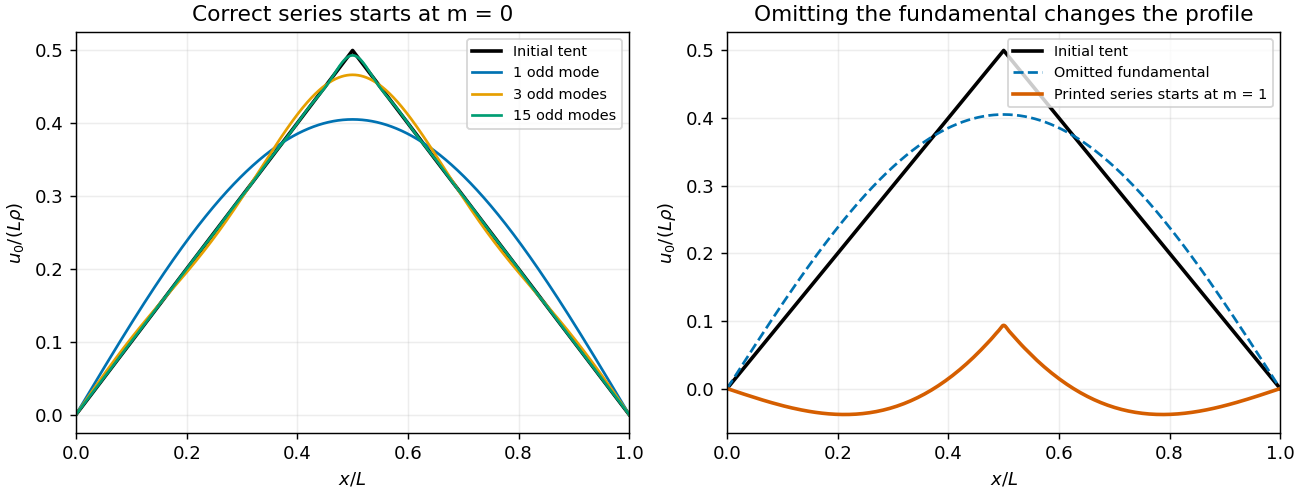
The tent Fourier series requires its fundamental mode
. Details. Pinned article: Introduction to the OurBigBook Project
Welcome to the OurBigBook Project! Our goal is to create the perfect publishing platform for STEM subjects, and get university-level students to write the best free STEM tutorials ever.
Everyone is welcome to create an account and play with the site: ourbigbook.com/go/register. We belive that students themselves can write amazing tutorials, but teachers are welcome too. You can write about anything you want, it doesn't have to be STEM or even educational. Silly test content is very welcome and you won't be penalized in any way. Just keep it legal!
Intro to OurBigBook
. Source. We have two killer features:
- topics: topics group articles by different users with the same title, e.g. here is the topic for the "Fundamental Theorem of Calculus" ourbigbook.com/go/topic/fundamental-theorem-of-calculusArticles of different users are sorted by upvote within each article page. This feature is a bit like:
- a Wikipedia where each user can have their own version of each article
- a Q&A website like Stack Overflow, where multiple people can give their views on a given topic, and the best ones are sorted by upvote. Except you don't need to wait for someone to ask first, and any topic goes, no matter how narrow or broad
This feature makes it possible for readers to find better explanations of any topic created by other writers. And it allows writers to create an explanation in a place that readers might actually find it.
Figure 1. Screenshot of the "Derivative" topic page. View it live at: ourbigbook.com/go/topic/derivativeVideo 2. OurBigBook Web topics demo. Source. - local editing: you can store all your personal knowledge base content locally in a plaintext markup format that can be edited locally and published either:This way you can be sure that even if OurBigBook.com were to go down one day (which we have no plans to do as it is quite cheap to host!), your content will still be perfectly readable as a static site.
- to OurBigBook.com to get awesome multi-user features like topics and likes
- as HTML files to a static website, which you can host yourself for free on many external providers like GitHub Pages, and remain in full control

Figure 2. You can publish local OurBigBook lightweight markup files to either OurBigBook.com or as a static website.
Figure 3. Visual Studio Code extension installation.
Figure 5. . You can also edit articles on the Web editor without installing anything locally. Video 3. Edit locally and publish demo. Source. This shows editing OurBigBook Markup and publishing it using the Visual Studio Code extension. 
- Infinitely deep tables of contents:



All our software is open source and hosted at: github.com/ourbigbook/ourbigbook
Further documentation can be found at: docs.ourbigbook.com
Feel free to reach our to us for any help or suggestions: docs.ourbigbook.com/#contact