On an equal-panel partition of an interval, with , sum the trapezoidal rule over adjacent panels:There are distinct quadrature nodes. Each interior sample belongs to two panels and therefore has quadrature weight , while each endpoint has quadrature weight . Equivalently, the composite trapezoidal rule integrates the piecewise linear function obtained by linear interpolation exactly.[ref]
For and , summing panel quadrature errors givesfor some . Thus panel quadrature errors of order accumulate to order , using big O notation.[ref]
3.5 Quadrature, subsection (i) Trapezoidal Rules. §3.5(i), equations 3.5.2–3.5.3: composite formula and signed error
On a nonuniform partition of an interval with widths and largest width , the bound is .For the polynomial on , direct summation yieldsBoth quadrature errors shrink by exactly four when doubles, with opposite signs. This exact relation belongs to this polynomial example; the trapezoidal rule is not always twice as inaccurate as the midpoint quadrature rule.
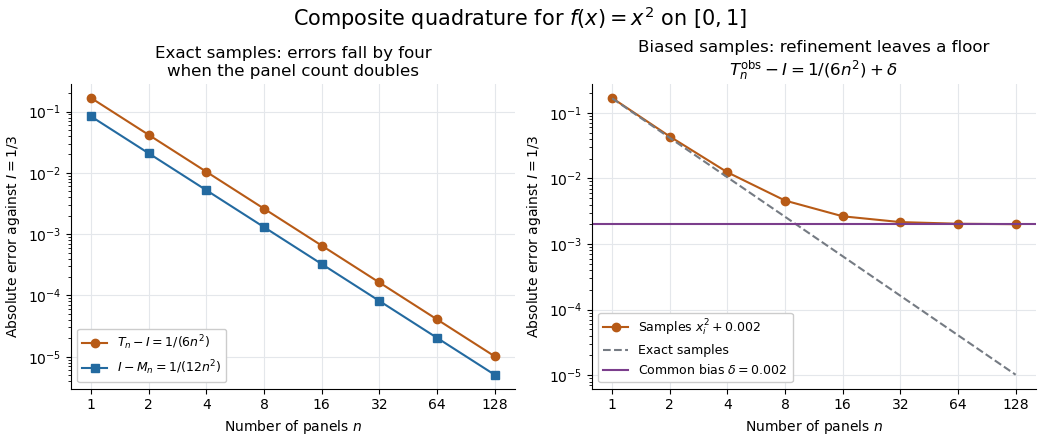
Quadratic quadrature errors fall by four on refinement while a common sample bias persists
. Details. 
The left plot uses exact polynomial sums; the right adds a common sample bias to the composite trapezoidal rule. That mathematical model converges to , showing why smaller panels alone do not ensure accuracy for noisy samples. It illustrates noise sensitivity of a quadrature rule, rather than measured data.
On a partition of an interval symmetric about zero, the composite trapezoidal rule gives opposite quadrature nodes equal quadrature weights. Samples of an odd function cancel pairwise, and a zero quadrature node contributes zero. For a continuous odd function, its exact integral over is also zero. Adding any affine function preserves exactness by linearity of the integral and of the quadrature rule. For example, is nonpolynomial but both the exact integral and every uniform-grid composite trapezoidal rule value on are two.
On a uniform partition of with width , the right Riemann sum and the composite trapezoidal rule have equal weights at every interior mesh point. They differ only by adding half a final-endpoint weight and removing half an initial-endpoint weight. This proves the displayed identity. For continuous , both converge to its definite integral; their finite endpoint correction need not be confused with the smaller trapezoidal discretization error for a smooth integrand.
If is twice continuously differentiable on , take a uniform bound . On one panel , two integrations by parts give the signed quadrature errorThe nonnegative kernel has integral , so the absolute error is at most . Summing equal panels proves the displayed bound. The maximum exists on the closed interval; a supremum or any known uniform bound also suffices. The estimate certifies a sufficient panel count, which need not be the least count achieving a particular actual error.
Articles by others on the same topic
There are currently no matching articles.