Amplitude amplification
ID: amplitude-amplification

Amplitude amplification increases the probability of obtaining an answer accepted by a specified Boolean function. It requires a coherent preparation , its inverse, and a marked-state phase oracle that negates accepted components. Alternating that sign change with a reflection operator about the prepared state directs interference toward the accepted subspace. Brassard, Høyer, Mosca, and Tapp developed the general framework, extending Grover's algorithm beyond a uniform quantum superposition. [ref]
https://arxiv.org/abs/quant-ph/0005055. Brassard et al., Quantum Amplitude Amplification and Estimation, 2000, §2
.If a normalized quantum state has good amplitude , the product of the reflection in the bad axis and the reflection in the state line rotates its good-bad plane by . After iterations the good probability isso iterations raise a small good amplitude close to one. Success subsequently oscillates, making the stopping time part of the algorithm.
Compute the exact Grover search on four entries directly. Order the computational basis as and mark . The Hadamard transform prepares amplitudes . The marked-state phase oracle changes these to , whose arithmetic mean is . The Grover diffusion operator performs inversion about the mean:The three unmarked amplitudes become , while the marked amplitude becomes . All three stages have squared norm one. Here , so and one iteration gives , agreeing with the explicit calculation.
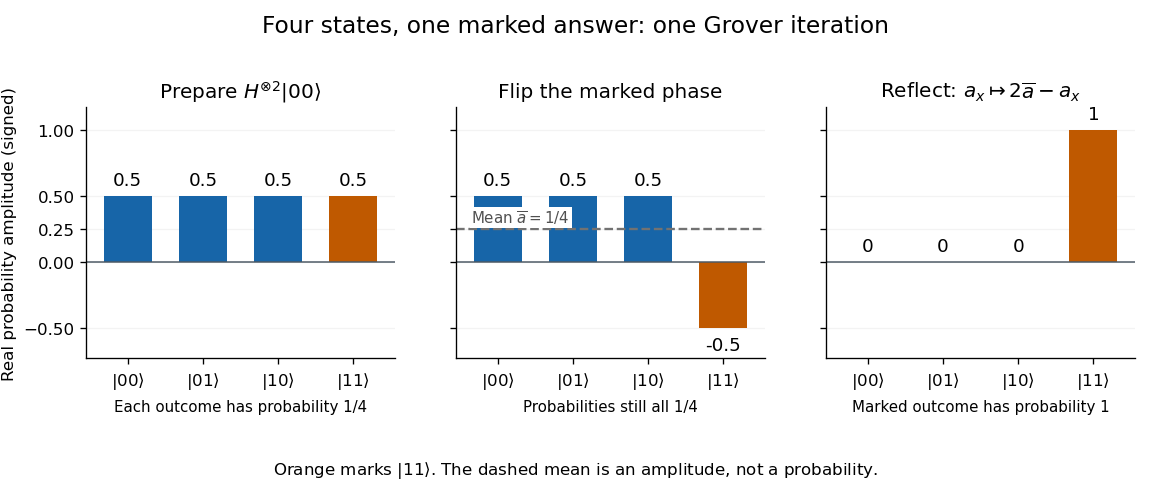
One Grover iteration on four states: a phase flip followed by reflection about the mean concentrates all amplitude on the marked state
. Details. Grover's original search paper was submitted on 29 May 1996; its algorithm combines selective sign changes with inversion about the mean. The example exposes the beauty of that construction: a change initially invisible to computational-basis measurement becomes complete cancellation of every wrong answer. [ref].
The marked-state phase oracle is an assumed operation, whose implementation cost must be counted. Computational-basis measurement yields a candidate label, here ; using it to retrieve a record requires the relevant data access. Preparing a quantum superposition does not make all its entries available as classical outputs. The improvement concerns the number of oracle queries needed to obtain an accepted label.


Amplitude amplification is a technique used in quantum computing to increase the probability of measuring a desired outcome in a quantum state. It is most famously implemented in the Grover's algorithm, which is designed for searching an unsorted database or solving combinatorial problems more efficiently than classical algorithms. ### Key Concepts: 1. **Superposition**: In quantum computing, a quantum system can exist in multiple states simultaneously, called superposition.
New to topics? Read the docs here!