The normalized Hadamard transform maps a vector indexed by binary strings through entries , where the dot product is evaluated modulo two. It is its own inverse and an orthogonal transformation, hence also a unitary operator on complex input vectors. The Hadamard gate is the quantum case, and the Hadamard basis is the image of the computational basis. The Walsh-Hadamard transform gives the same tensor product construction.
For two qubits, applying one Hadamard gate to each prepares the uniform quantum superpositionEach probability amplitude is , so each computational-basis measurement outcome has probability . Applying the Hadamard transform again reconstructs : signed contributions cancel at the other three outputs. Its usefulness lies in combining simple local quantum gates into an operation on exponentially many amplitudes. Extracting useful information still requires an appropriate subsequent transformation and measurement.
The Hadamard gate is the unitary operatorwhere is the identity operator. It maps the computational basis to the Hadamard basis:
These outputs have equal computational-basis measurement probabilities, but their relative quantum phase differs. Applying another Hadamard gate sends them to different definite outputs. Calling this gate a classical coin toss would discard precisely the information that makes this possible. [ref]
https://quantum.cloud.ibm.com/learning/en/courses/basics-of-quantum-information/single-systems/quantum-information. Watrous, IBM Quantum Learning, unitary operations on qubits
.Starting from , compare two quantum circuits, reading matrix products from right to left:Here is the Pauli Z gate. After the first Hadamard gate, the probability amplitudes are . Inserting changes them to without changing their squared magnitudes. At the final gate, the contributions to output zero cancel and those to output one add. Without , cancellation occurs at output one instead. This is controlled interference, with the quantum phase determining which answer emerges.
The same calculation works for any phase gate :For example, gives , while gives . The output-one amplitude at is : its two complex contributions add before the Born rule is applied. A phase gate alone leaves the populations unchanged; recombination converts its relative quantum phase into observable probabilities.
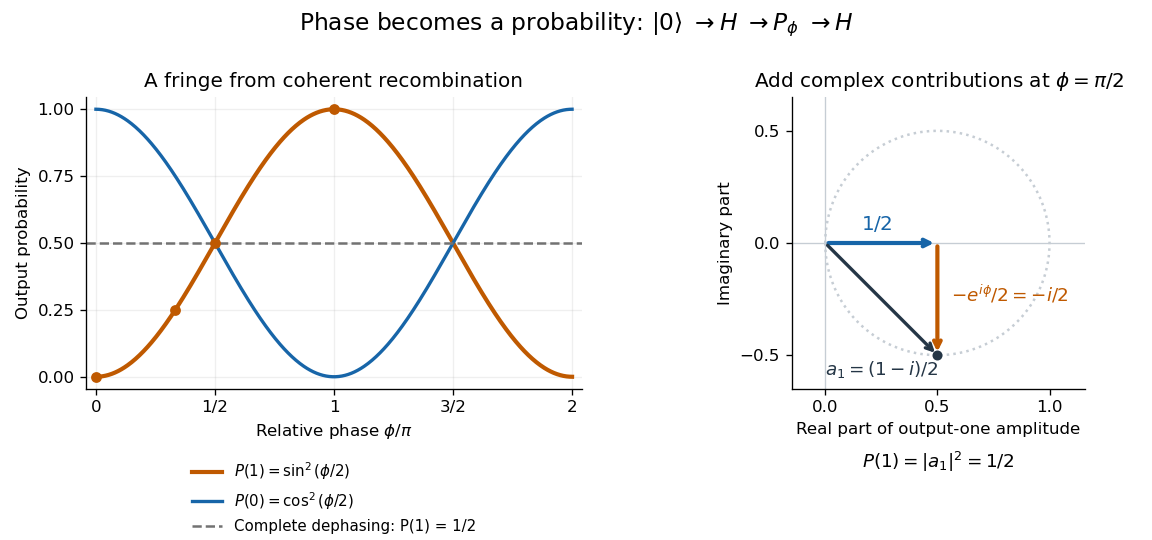
Hadamard interference: a relative phase changes output probabilities through complex amplitude addition; the dotted circle traces the output-one amplitude as the phase varies
. Details. If quantum decoherence completely removes the computational basis coherence between the gates, the intermediate density matrix becomes . Both the phase gate and final Hadamard gate leave unchanged, so for every . The disappearing fringe explains why preserving quantum coherence matters: it enables the gate sequence to carry phase information into the final measurement.
A flat reference over adjacent Fock states has overlap with a one-photon shift and with a two-photon shift. These overlaps, obtained by counting shared number states, determine the reduced qubit channel of a number-conserving Hadamard interaction. For , its squared fidelity with the desired pure output is for input Bloch vector . Its worst-case infidelity is because . At the two-shift overlap is zero, not , and the fidelity is . Broad coherent number support, rather than merely a large fixed photon number, suppresses distinguishability of the outgoing field states.
Articles by others on the same topic


The Hadamard transform is a mathematical operation used in various fields, including quantum computing, signal processing, and information theory. It is a specific kind of unitary transformation that takes an input vector and transforms it into another vector of the same dimension. The Hadamard transform is particularly useful because it creates superposition states in quantum computing and can be implemented efficiently.