Aperture-dependent diffuse transmission in nail measurements
ID: aperture-dependent-diffuse-transmission-in-nail-measurements

Aperture-dependent diffuse transmission in nail measurements is the change in measured transmittance caused by accepting different outgoing directions from a nail plate. The material can remain unchanged while the collected fraction changes. The relevant quantity is the optical acceptance, not aperture area alone.
For an original geometric model, take a small emitting region with constant diffuse radiance, viewed by a coaxial circular opening of radius at distance . Its limiting angle obeys . Projected-area weighting gives the accepted diffuse fractionIf the direct beam is fully collected, a direct fraction and a total diffuse fraction produce . This assumes geometric propagation and negligible finite-source and diffraction effects. In particular, the direct-beam assumption is not valid for an arbitrarily small physical opening.
At stipulated mm, and , openings of radius 5 and 10 mm collect and 0.50. The respective measured fractions are 0.056 and 0.080, although total transmittance is 0.12 in both cases. Doubling the aperture radius quadruples its area but does not quadruple the collected diffuse fraction.
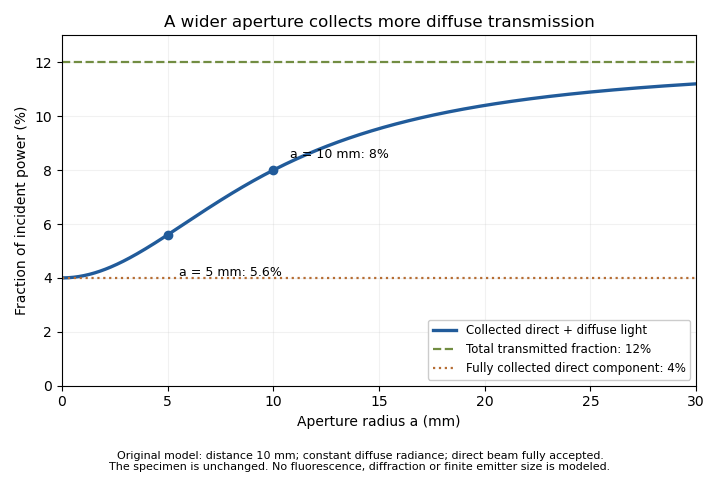
An unchanged hypothetical nail specimen gives different measured transmission as collection radius changes
. Original constant-radiance geometric model at distance 10 mm. The direct fraction is 4 percent and the diffuse fraction is 8 percent. These are stipulated values, not measured human-nail data. Details.
An aperture-scan separation of direct and diffuse nail transmission needs distinct acceptances and a stable angular model. In the ideal two-aperture case,For the stated values, the two measurements recover 0.08 and 0.04. Nearly equal acceptances amplify measurement differences by a large factor. Changing distance or source size during the scan would change the model as well as the acceptance.
The primary nail experiment used an integrating sphere with a monochromator and photodiode to measure transmitted radiation.[ref]
The transmission of optical radiation through human nails by S. G. Parker and B. L. Diffey. Abstract, collection apparatus
The sphere provides a different angular collection arrangement from this opening model; it does not establish the assumed diffuse radiance law. A useful comparison characterizes each detector geometry before interpreting a signal difference as a change in the nail plate. New to topics? Read the docs here!