Atomic displacement ellipsoid
ID: atomic-displacement-ellipsoid

An atomic displacement ellipsoid visualizes the directional positional spread represented by an anisotropic atomic displacement parameter. For a centered three-dimensional normal distribution with positive-definite Cartesian covariance matrix , its probability surfaces have the formThe eigenvectors of give the principal directions; if its eigenvalues are , the semiaxis lengths are . The atomic displacement probability level specifies how much modeled probability is enclosed.[ref]
Atomic displacement parameter nomenclature (IUCr report). Section2.3.1, ellipsoids of constant probability
The squared Mahalanobis distance has a chi-squared distribution with3 degrees of freedom in this Gaussian model. A50% ellipsoid uses . Taking instead encloses only about19.9%, so a three-dimensional probability ellipsoid cannot be read as a one-dimensional one-standard-deviation interval.
For an original example, gives50% semiaxes approximately0.154,0.308 and0.461 angstroms. An isotropic matrix with the same equivalent isotropic atomic displacement parameter, , instead gives a sphere of radius about0.332 angstroms.
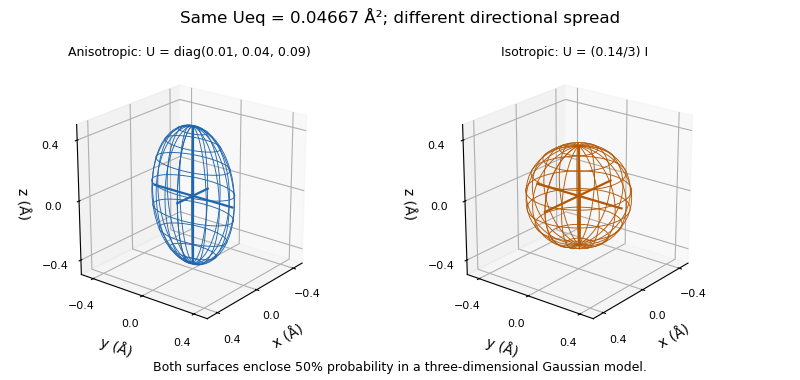

The ellipsoid represents modeled positional spread, including possible static disorder, rather than the atom's physical surface or a confidence region for its refined mean position. Its interpretation depends on the displacement model; the Gaussian probability construction requires a positive-definite covariance and does not turn a negative fitted eigenvalue into a physically meaningful radius.[ref]
Atomic displacement parameter nomenclature (IUCr report). Section2.3.1, positive eigenvalues and model interpretation
New to topics? Read the docs here!