Bellman–Ford algorithm
ID: bellman-ford-algorithm

The Bellman-Ford algorithm solves the single-source shortest path problem in a finite directed graph with finite real edge weights, allowing negative weights. It repeatedly applies edge relaxation, so an improved tentative distance can improve its neighbours on a later visit. This makes it a label-correcting shortest-path algorithm.[ref]
BellmanFordSP.java. Algorithms, 4th edition by Robert Sedgewick and others; Robert Sedgewick and Kevin Wayne, BellmanFordSP.java, signed-weight single-source solver and queue-based relaxation
If no negative-cost directed cycle is reachable from the source, at most complete passes suffice for all distances; a further check detects a reachable negative-cost directed cycle.[ref]Lecture 17: Shortest Paths III: Bellman-Ford. 6.006 Introduction to Algorithms, Fall 2011 by Massachusetts Institute of Technology, 6.006 course staff; MIT 6.006, Lecture 17, pp. 3–4: complete-pass algorithm, proof and reachable-cycle corollary
There are two orientations to keep distinct. The usual single-source problem asks for distances from , extending routes along outgoing directed edges. The Bellman inequalities above instead concern distances to a sink , prepending incoming directed edges to known routes. The All-to-one Bellman-Ford recurrence below preserves that convention. Reversing every directed edge, with its weight unchanged, converts one problem into the other.
Here is an original single-source example with source , vertex set , and precisely these directed edges:The negative edge is harmless: this directed graph has no directed cycle. Its best route to is , of cost . The other routes to cost through and through .
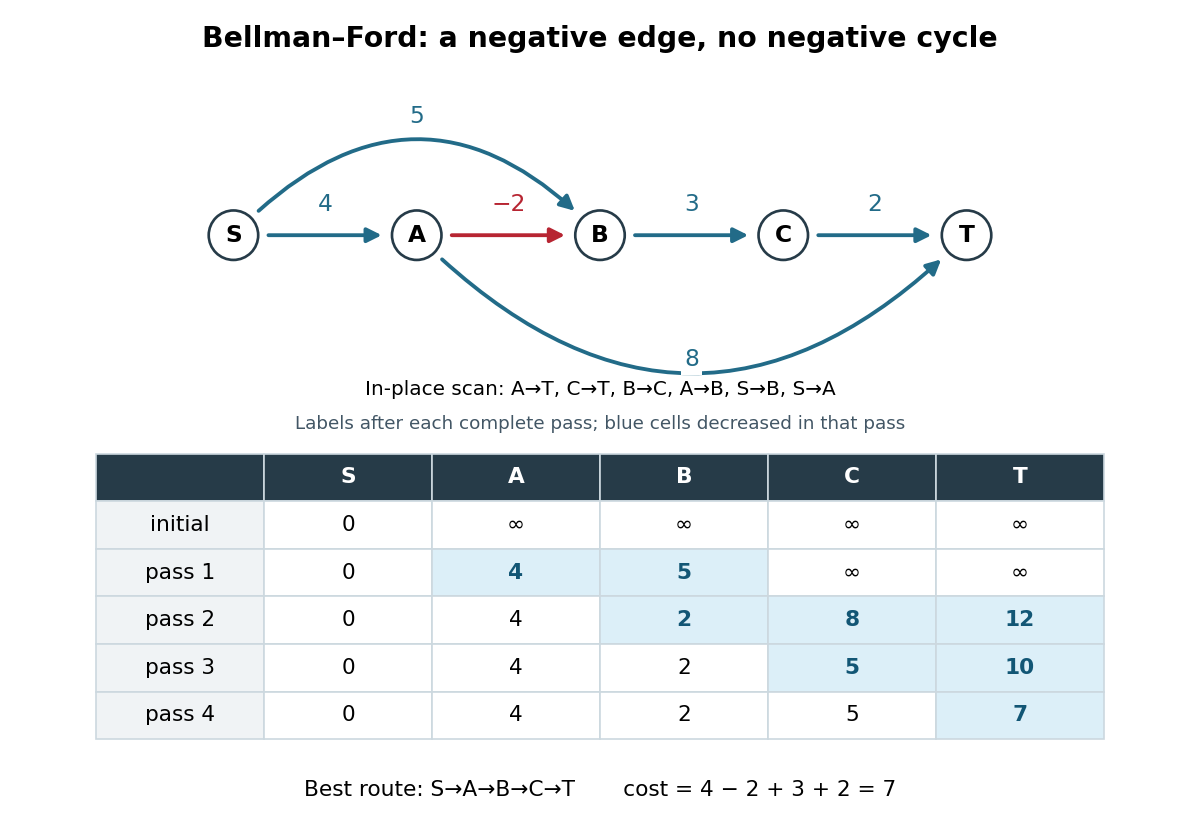
Initialize and the other tentative distances to . In each pass apply single-source edge relaxation, , scanning in the order , , , , , . Skip a candidate with . The figure records labels after each complete pass and uses current labels immediately: it is an in-place trace. In pass 2, still uses , giving ; only later does lower to . Pass 3 carries that improvement to , and pass 4 carries it to . The final labels in order are ; the final shortest-path predecessors are for respectively.
The scan order explains the delay. Scanning instead as , , , , , gives those same final labels in just one in-place pass. The Synchronous Bellman-Ford recurrence has a precise bound on the number of edges used by a recorded route; an in-place pass can propagate along several edges and need not have that interpretation. Both implementations have the pass guarantee under the stated no-reachable-negative-cycle hypothesis.
With a stored list of edges, complete-pass Bellman-Ford algorithm has time complexity and uses extra space for labels and shortest-path predecessors, using Big O notation and constant-cost arithmetic. The extra accounts for initialization even when is empty. A pass with no strict decrease permits early termination. A queue variant instead revisits outgoing edges of vertices whose labels improved; the authored implementation provides this alternative and has worst-case running time on its usual nontrivial instances.[ref]
BellmanFordSP.java. Algorithms, 4th edition by Robert Sedgewick and others; Robert Sedgewick and Kevin Wayne, BellmanFordSP.java, class documentation, constructor and relax method
For nonnegative weights, the Dijkstra algorithm and its existing distance-frontier figure explain how permanent labels can avoid these repeated passes; the existing edge relaxation figure illustrates one update at a time.

The Bellman-Ford algorithm is an efficient algorithm used to find the shortest paths from a single source vertex to all other vertices in a graph. It is particularly useful for graphs that may contain edges with negative weights, making it more versatile than Dijkstra's algorithm, which only works with non-negative weights.
New to topics? Read the docs here!