The Bellman-Ford algorithm solves the single-source shortest path problem in a finite directed graph with finite real edge weights, allowing negative weights. It repeatedly applies edge relaxation, so an improved tentative distance can improve its neighbours on a later visit. This makes it a label-correcting shortest-path algorithm.[ref]
BellmanFordSP.java. Algorithms, 4th edition by Robert Sedgewick and others; Robert Sedgewick and Kevin Wayne, BellmanFordSP.java, signed-weight single-source solver and queue-based relaxation
If no negative-cost directed cycle is reachable from the source, at most complete passes suffice for all distances; a further check detects a reachable negative-cost directed cycle.[ref]Lecture 17: Shortest Paths III: Bellman-Ford. 6.006 Introduction to Algorithms, Fall 2011 by Massachusetts Institute of Technology, 6.006 course staff; MIT 6.006, Lecture 17, pp. 3–4: complete-pass algorithm, proof and reachable-cycle corollary
There are two orientations to keep distinct. The usual single-source problem asks for distances from , extending routes along outgoing directed edges. The Bellman inequalities above instead concern distances to a sink , prepending incoming directed edges to known routes. The All-to-one Bellman-Ford recurrence below preserves that convention. Reversing every directed edge, with its weight unchanged, converts one problem into the other.
Here is an original single-source example with source , vertex set , and precisely these directed edges:The negative edge is harmless: this directed graph has no directed cycle. Its best route to is , of cost . The other routes to cost through and through .
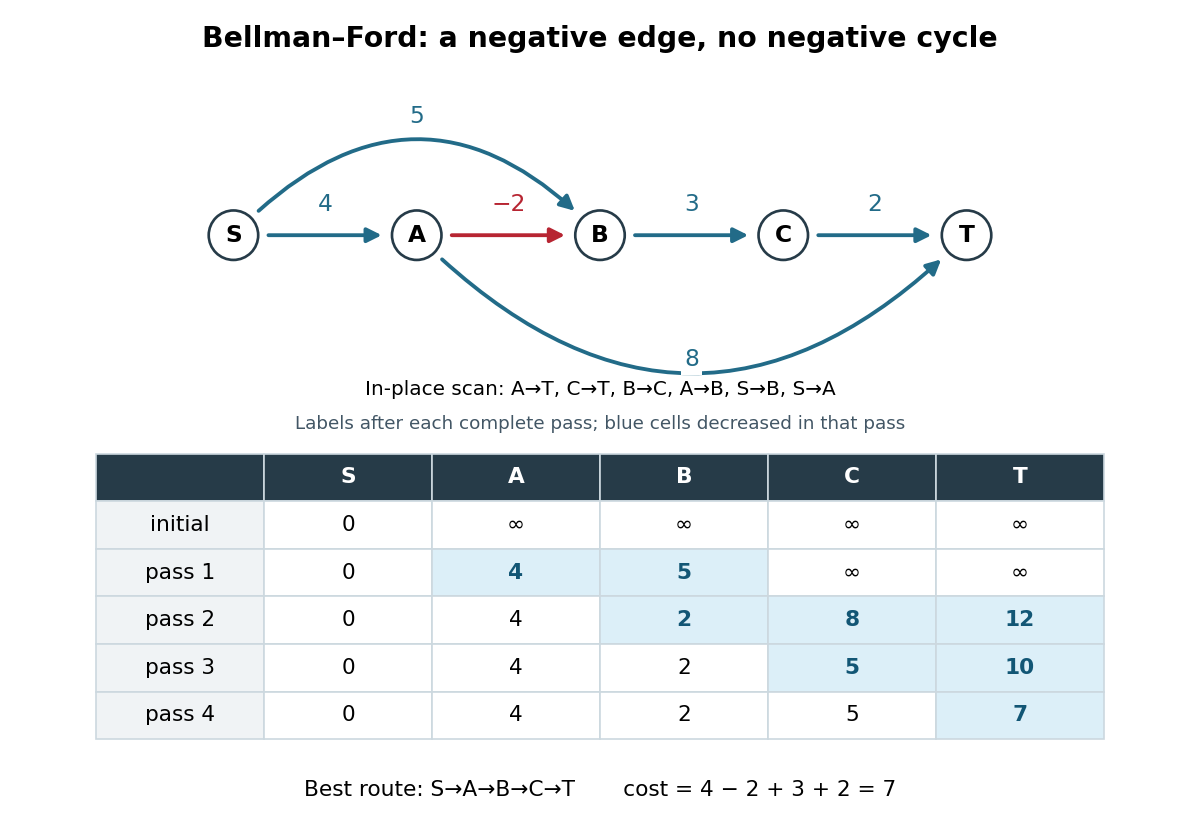
Initialize and the other tentative distances to . In each pass apply single-source edge relaxation, , scanning in the order , , , , , . Skip a candidate with . The figure records labels after each complete pass and uses current labels immediately: it is an in-place trace. In pass 2, still uses , giving ; only later does lower to . Pass 3 carries that improvement to , and pass 4 carries it to . The final labels in order are ; the final shortest-path predecessors are for respectively.
The scan order explains the delay. Scanning instead as , , , , , gives those same final labels in just one in-place pass. The Synchronous Bellman-Ford recurrence has a precise bound on the number of edges used by a recorded route; an in-place pass can propagate along several edges and need not have that interpretation. Both implementations have the pass guarantee under the stated no-reachable-negative-cycle hypothesis.
With a stored list of edges, complete-pass Bellman-Ford algorithm has time complexity and uses extra space for labels and shortest-path predecessors, using Big O notation and constant-cost arithmetic. The extra accounts for initialization even when is empty. A pass with no strict decrease permits early termination. A queue variant instead revisits outgoing edges of vertices whose labels improved; the authored implementation provides this alternative and has worst-case running time on its usual nontrivial instances.[ref]
BellmanFordSP.java. Algorithms, 4th edition by Robert Sedgewick and others; Robert Sedgewick and Kevin Wayne, BellmanFordSP.java, class documentation, constructor and relax method
For nonnegative weights, the Dijkstra algorithm and its existing distance-frontier figure explain how permanent labels can avoid these repeated passes; the existing edge relaxation figure illustrates one update at a time.For the single-source problem, let be the minimum cost of a directed walk from to using at most edges. Set and for , use for finite , and let a minimum over an empty set be . ThenEvery entry on the right comes from the previous round, requiring separate old and new arrays. The proof is the last-edge decomposition: a permitted directed walk either already uses at most edges, or ends with some after a prefix using at most . Conversely, each candidate describes a permitted directed walk. This dynamic programming viewpoint gives an exact meaning to every intermediate label, even when negative-cost directed cycles exist. Apply the formula to the source too: its initial zero is not a permanent constraint.
If no negative-cost directed cycle is reachable from , removing repeated-vertex portions of a directed walk cannot increase its cost. Whenever a destination is reachable, some shortest directed path therefore uses at most edges, and . Unreachable vertices keep distance . For in-place passes, every finite label still comes from a discovered directed walk; moreover, pass has offered every prefix of length of a shortest directed path, regardless of scan order. Its labels can improve faster than the synchronous labels, while the same upper bound on passes remains valid. This is why repeated local corrections eventually settle a global shortest path problem.
A negative-cost directed cycle matters to a particular destination precisely when it is reachable from and can itself reach .[ref]
Lecture 17: Shortest Paths III: Bellman-Ford. 6.006 Introduction to Algorithms, Fall 2011 by Massachusetts Institute of Technology, 6.006 course staff; MIT 6.006, Lecture 17, p. 1: cycle between source and destination; p. 4: reachable-cycle corollary
Repeating it times adds times its negative total cost to a route. Thus the infimum of directed walk costs is , rather than the cost of a finite shortest directed walk. The distinction is about reachability, not simply the presence of a negative edge or a negative-cost directed cycle anywhere in the graph.Add of weight to the worked example. Now has total weight . Add also an isolated vertex with a self-loop of weight . From , the distances of are , because all four are reachable from the first negative-cost directed cycle. The source retains distance : no directed edge leads back to . The unreachable retains distance , despite its negative-cost self-loop.
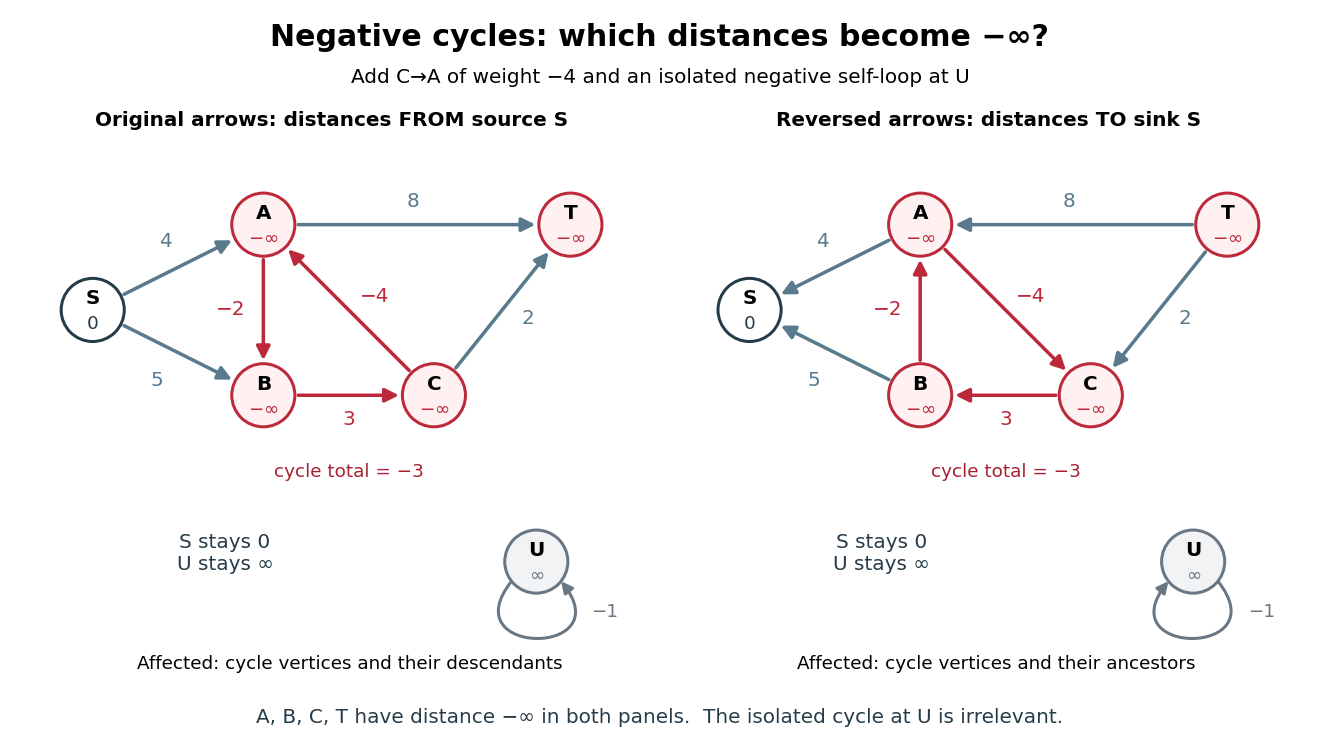
Relevant negative-cost directed cycles: descendants from a source become ancestors when every directed edge is reversed
. Details. For example, extra laps before proceeding to give costs . This construction also shows why requiring a directed path with no repeated vertices would change the problem: only directed walks permit arbitrarily many laps. Merely finding one reachable negative-cost directed cycle does not justify setting every reachable label to ; in the figure is a counterexample.
To detect and classify, perform full passes without clamping any label, then test all directed edges against a fixed copy of the resulting labels. Collect heads of edges satisfying and . An empty collection certifies that no negative-cost directed cycle is reachable from . Otherwise run graph search forwards from all collected vertices: precisely the reached vertices have distance . A vertex unreachable from still has distance ; each remaining vertex has its finite shortest distance.
Why is this classification exact? Every unaffected reachable vertex already has its shortest distance after passes, since any route ending there avoids reachable negative-cost directed cycles. Thus it cannot be the head of a strict improvement, or be reached from such a head. Conversely, all vertices on a reachable negative-cost directed cycle have finite labels by that time. If none of its edges could improve a label, summing around it would imply . At least one of its heads is therefore collected, and the forward graph search reaches the entire directed cycle and every affected descendant. Detecting a directed cycle alone and marking its descendants are separate tasks; finite intermediate labels in the affected region are not answers.
Keep the original all-to-one orientation of the Bellman inequalities: concerns routes from to a fixed sink , and belongs to the original directed edge . Initialize and for . The synchronous dynamic programming recurrence isIt prepends the first edge of a route instead of appending the last: is the minimum cost of a directed walk from to using at most edges. In particular, improving can improve labels on incoming directed edges . The same original directed edge therefore updates its tail in this convention, whereas single-source edge relaxation updates its head.
If no negative-cost directed cycle can reach , rounds suffice for every distance to , and automatically. This hypothesis concerns directed paths from the cycle to the sink, not paths from the sink to the cycle. In the base example with its original arrows and sink , the distances in order are . Once of weight is added, instead have distance to , while keeps distance and keeps .
More generally, precisely when can reach a negative-cost directed cycle that can reach . Thus the affected vertices are the ancestors of such a directed cycle. A negative-cost directed cycle unable to reach is irrelevant. Reversing all arrows makes a single source, turns these ancestors into descendants, and makes the detection and forward graph search above directly applicable. The right panel of the figure uses that reversal with sink ; its distances to equal the left panel's distances from .
Do not force the root to remain zero outside the hypothesis. Consider the two directed edges of cost and of cost , with sink . The recurrence gives and : the latter records one lap of a negative-cost directed cycle through . Repetition makes both unrestricted distances . Clamping at zero and omitting its update would instead leave the stationary labels , concealing that behaviour. Initialization specifies the cost of the empty directed walk; it does not forbid cheaper nonempty returns to the root. Cycle detection must test every relevant directed edge, including those whose relaxation updates the root.
Articles by others on the same topic



The Bellman-Ford algorithm is an efficient algorithm used to find the shortest paths from a single source vertex to all other vertices in a graph. It is particularly useful for graphs that may contain edges with negative weights, making it more versatile than Dijkstra's algorithm, which only works with non-negative weights.