
The best glide speed is the airspeed giving the greatest horizontal distance per unit height lost in a specified steady glide condition. In still air this is the speed for maximum lift-to-drag ratio. It differs from the minimum sink speed, whose objective is longest time aloft for a given height loss.[ref]
Write a glider sink polar as downward rate . The horizontal air-relative speed is , so the exact still-air range per unit height is . For a shallow glide angle, and maximizing range is approximately minimizing . At an interior optimum,Geometrically, a line from the origin is tangent to the positive-downward-rate polar. This is not the horizontal tangent defining minimum sink speed.
For an original calculation, take a parabolic drag polar and approximate . At fixed air mass density , wing area and gravitational weight ,Minimizing givesStipulate , , , and . Then , in the corresponding SI units, , and the model gives . Its shallow-glide range ratio is . These parameters are invented; an attainable lift coefficient and a valid drag polar are prerequisites, not consequences of the optimization.
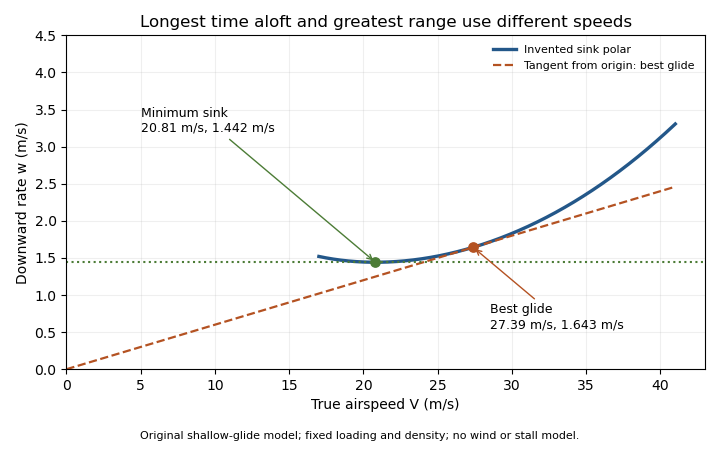
Minimum sink and best glide are different optima of an original shallow-glide polar. Positive vertical values denote downward speed; the curve is an invented model, not measured aircraft performance.
Details. 
Wind changes the ground-range objective to for an along-track wind component and no vertical air motion. Therefore the still-air optimum need not maximize ground distance. The FAA constructs the corresponding shifted tangents on its performance polars.[ref]
Glider Flying Handbook by Federal Aviation Administration. Chapter 5, printed pp. 5-10–5-11, wind and sinking-air polar constructions
A controlled performance measurement records steady airspeed and height loss at several speeds; wind, vertical air motion and changes of loading must be distinguished from the polar itself. New to topics? Read the docs here!