Bi-Lipschitz distortion
ID: bi-lipschitz-distortion

For an injective function between metric spaces with at least two source points, consider all distance ratiosIf constants satisfythen is a bi-Lipschitz map: both and its inverse on are Lipschitz maps. The bound compares the most expanded pair with the most contracted pair. To define the bi-Lipschitz distortion of this particular metric embedding, use the sharp bounds and :Here the Lipschitz constant of is . If no positive finite bounds exist, the bi-Lipschitz distortion is infinite. For a finite source, every injective function has finite bi-Lipschitz distortion, but its size can depend on the source. Matoušek gives the equivalent definition using one scale factor and a multiplicative error bound. [ref]
Lecture notes on metric embeddings by Jiří Matoušek. Matoušek, Section 1.1: distortion and Lipschitz maps
Changing units is harmless: replacing by , with , multiplies both and by and leaves unchanged. In a normed vector space this can be achieved by multiplying every output vector by . Thus bi-Lipschitz distortion one means that all distances change by the same factor; an isometric embedding additionally requires that factor to be one. A stretch factor with a specified normalization is a related quantity; when comparing sources, check which overall scale has been fixed.
Take the four corners , , , of a square, with Euclidean distance in both source and target. For the linear map , the six unordered pairs exhaust the possibilities: the two vertical sides have ratio , the two horizontal sides have ratio , and the two diagonals have ratio . Consequently , , and . In contrast, , three times the identity function, gives ratio for every pair and has bi-Lipschitz distortion .
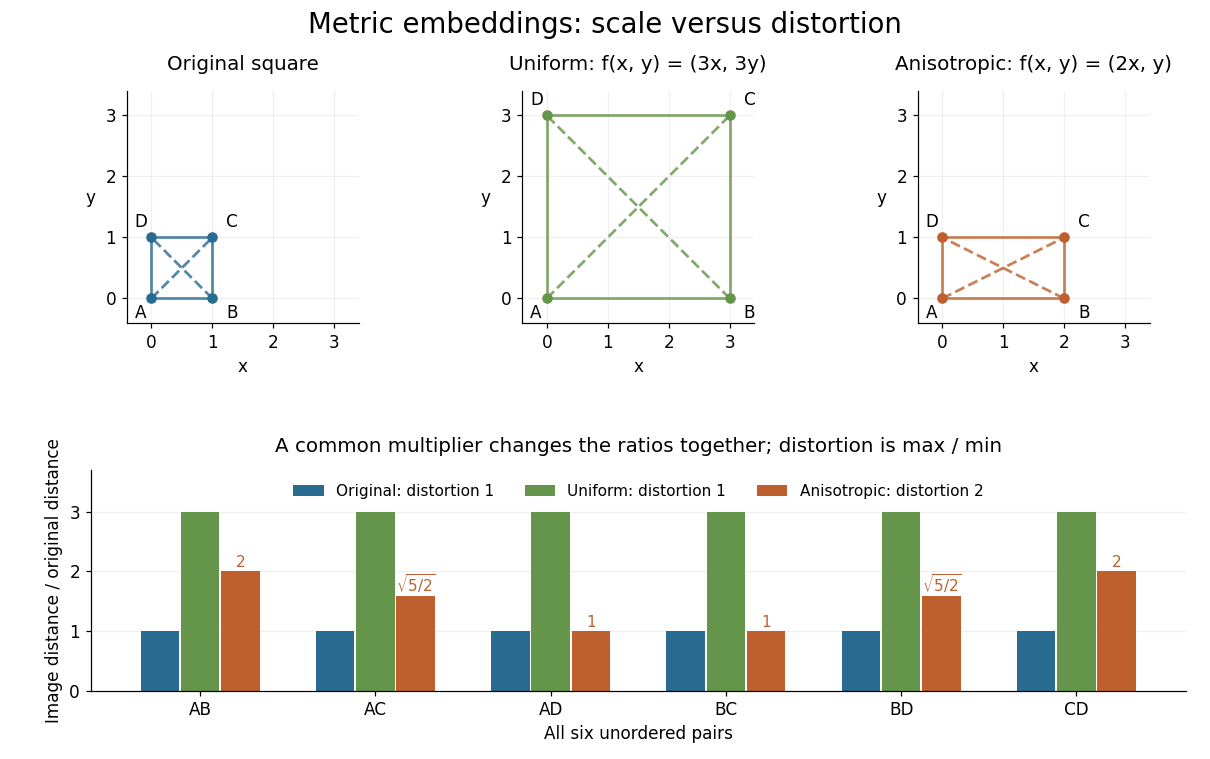
Uniform scaling keeps distortion one; unequal coordinate scaling gives distortion two
. Details. 
The ratio chart makes the reason visible: a common multiplier moves every ratio together, while unequal coordinate scaling spreads the ratios apart. More generally, in a normed vector space, the ratio bounds giveThis normalization gives Lipschitz constant one and inverse Lipschitz constant . It is only a change of scale, so it cannot improve the bi-Lipschitz distortion.
The best possible bi-Lipschitz distortion of a source into a specified target is a separate quantity:The infimum runs over all injective functions, and need not be attained. The notation means the analogous infimum over metric embeddings into an Lp space. A calculation for one chosen gives an upper bound for ; proving optimality also requires a lower bound for every possible .
New to topics? Read the docs here!