A normed vector space is a vector space equipped with a norm, whose induced metric is . The norm must be positive on nonzero vectors, scale by the absolute value of a scalar, and satisfy the triangle inequality. These conditions make distance compatible with addition and scaling.
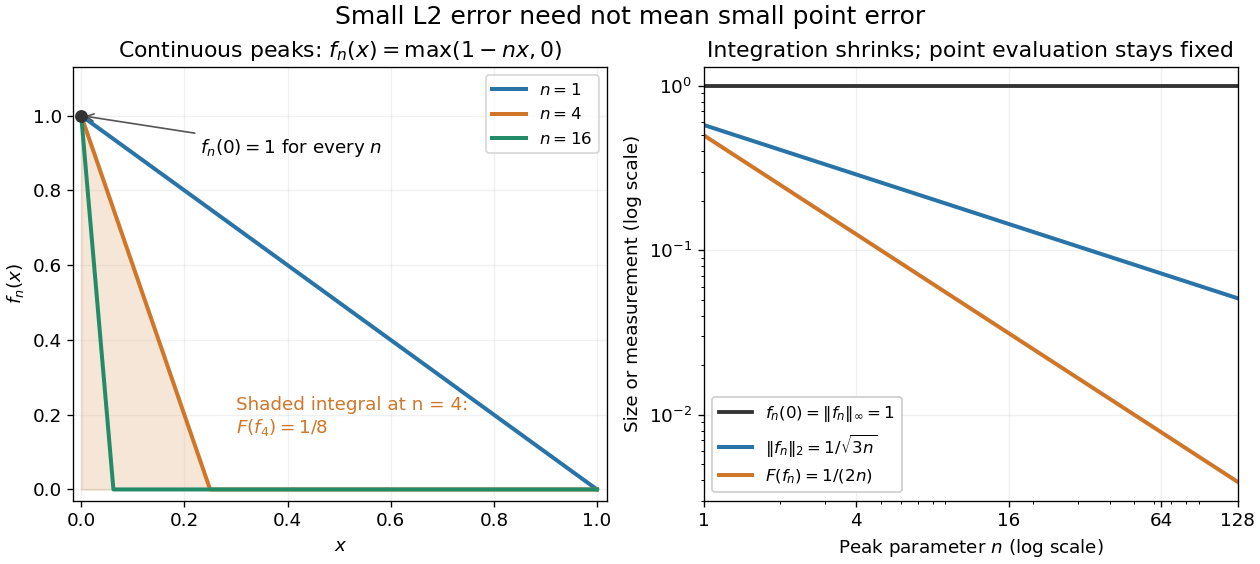
On , both the supremum norm and the L2 norm are genuine norms. A nonzero continuous function stays nonzero on an interval of positive length, so its squared integral cannot vanish. For , they give and , respectively. Always , but the shrinking peaks below show that no uniform reverse bound exists. Unlike the finite-dimensional equivalence of norms, infinite-dimensional vector spaces can support inequivalent norm topologies.
A total family has dense linear span; it is minimal when no vector lies in the closed span of all the others. Equivalently, no proper subfamily remains total. Such a family has unique bounded coordinate functionals making a biorthogonal system. Indeed put and . The functional on is bounded by , so the Hahn-Banach theorem extends it to . Its norm is exactly , by the distance infimum. Uniqueness follows because its values on the total family determine it on a dense subspace. For a countable family, minimality and totality alone do not ensure norm-convergent expansions; the uniform partial-sum criterion for a Schauder basis supplies the additional condition.
In a nonzero normed vector space, a unit vector is approached from outside the unit ball by , so no boundary point is interior. It is approached from inside by , so every boundary point is in the closure of the open ball. The zero space satisfies the same identities trivially. These statements need the radial structure of a normed space; a two-point discrete metric space with interpoint distance one disproves both analogous claims for general metric balls.
A normed vector space is uniformly convex if, for each , there is such that unit-ball vectors with satisfy . Completeness is not part of this definition; a complete example is a uniformly convex Banach space.
A normed vector space is strictly convex when distinct unit vectors have their midpoint strictly inside the unit ball. The Lp space is strictly convex for : strict convexity of gives a strict integrated midpoint inequality for distinct unit functions. The endpoint spaces and need not have this property.
If two distinct elements of a linear subspace both minimize distance to , normalize their residuals by the common positive minimum . Strictly convex normed space geometry gives , a contradiction. If , both elements equal . This proves uniqueness when a best approximant exists, without asserting existence for a nonclosed subspace.
A strictly convex norm permits at most one best approximation from a linear subspace, but does not force the distance infimum to be attained. In the Hilbert space , the finite-support vector subspace is dense and omits . Its distance from is zero and no member attains that distance. Finite-dimensionality restores existence by compactness of bounded sets in the vector subspace. If is a bounded projection onto a vector subspace, the estimate follows directly by writing for each candidate , even when the infimum is not attained.
Given in a normed vector space and a vector subspace , an element is a best approximation if . Existence is automatic for a finite-dimensional vector subspace: a minimizing sequence can be bounded by the triangle inequality, and a subsequence converges by compactness in finite dimension. An arbitrary infinite-dimensional vector subspace need not contain a minimizer. The norm matters: best uniform approximation uses the supremum norm, while approximation minimizes integrated absolute error.
For and , existence follows from finite-dimensional compactness and uniqueness from strictly convex normed space geometry. Translation by and negative translation by preserve the target and the error norm. Uniqueness forces the minimizing trigonometric polynomial to be invariant under the first operation and the negative of itself under the second. Invariance removes every nonzero frequency below ; negative invariance removes the remaining constant.
For real functions, let and put . If for every , then is a best approximation in a normed space using the norm. The proof is the pointwise inequality , followed by integration. This is a sufficient criterion even if the residual vanishes on a positive-measure set; a general necessary criterion may choose any subgradient in on that zero set.
The volume ratio of a -dimensional normed vector space is , where is its John ellipsoid. It is unchanged by invertible linear changes of coordinates. In John position, polar integration gives , with normalized spherical measure. Consequently .
In a -dimensional normed vector space in John position, two orthogonal -dimensional subspaces admit . To see this, take -nets in two orthogonal half-dimensional unit spheres, each of size at most , and rotate them uniformly together. The volume ratio bound makes the probability that any net point has norm below at most . With this is less than . Since is -Lipschitz for the Euclidean metric, the successful nets give the stated inequality everywhere on both spheres. A dimension-independent constant therefore requires a bound on the volume ratio; it does not hold for arbitrary normed vector spaces.
On continuous functions on a compact interval, evaluation at an interior point is not continuous in the integral norm. Narrow triangular peaks have fixed point value and integral tending to zero. Subtracting such a peak from the constant function one gives functions vanishing at the point and converging in the integral norm to one. Thus the evaluation kernel is not closed, although it is closed in the uniform norm.
Here is a fully computed endpoint version, now using the L2 norm on the actual continuous functions . For each integer , set . Its point evaluation at zero is , whileConsequently in the L2 norm but : point evaluation is discontinuous on this normed space. Quantitatively is unbounded. At , the L2 norm is approximately , the integral is , and the point value is still . In the supremum norm, and , so has operator norm one instead.
Set . Then and , although . Thus the kernel of fails to be a closed set. On the full L2 space, a further distinction is essential: its elements are equivalence classes under equality almost everywhere, and changing a representative at zero does not change its class. Arbitrary point evaluation is therefore not even well-defined there. Restricting first to continuous functions makes the discontinuity statement precise.[ref]
https://ocw.mit.edu/courses/18-102-introduction-to-functional-analysis-spring-2021/aad5fcf3b0f85788519a0324258dd296_MIT18_102s21_lec13.pdf. MIT 18.102, lecture 13: Lp spaces and almost-everywhere identification
In a normed vector space, this set consists of all points at a fixed positive norm distance from . It also makes sense in an infinite-dimensional Hilbert space, unlike a specifically Euclidean sphere. In a real Hilbert space, the sphere in a normed vector space has tangent variations satisfying ; this follows by differentiating the fixed squared norm. This is the geometric constraint used in fixed-energy initial-condition optimality.
The completion of a normed vector space is a Banach space containing an isometric dense copy of . Construct it from Cauchy sequences modulo sequences whose difference tends to zero; define the norm by . Equivalently, the canonical evaluation map into the bidual space is an isometry by the Hahn-Banach theorem, and the closure of its image supplies a completion.
A Banach space is precisely a normed vector space in which every Cauchy sequence converges in norm to an element of the same space. Completion of a normed space fills missing limits without changing distances between existing elements. For example, with the L2 norm completes to L2 space on the interval with Lebesgue measure. The bounded integral functional extends uniquely to that completion of a normed space: define for any approximating sequence of continuous functions. Its bound makes this independent of the approximation. The unbounded point evaluation has no continuous extension agreeing with its values on all continuous functions.[ref]
https://ocw.mit.edu/courses/18-102-introduction-to-functional-analysis-spring-2021/3d4cc88026d44a01f936cd6a0aa995cb_MIT18_102s20_lec_FA.pdf. Richard Melrose, Functional Analysis, chapter 1, sections 5–6: completion and continuous extension
For , a normed vector space is lambda-injective when every bounded linear operator from a subspace of any normed space into extends to with the displayed norm bound. The space of bounded scalar functions on an index set is 1-injective: extend each coordinate functional by the Hahn-Banach theorem and reassemble it using the coordinate functional representation of an operator into bounded indexed functions.
A space is a lambda-injective normed space exactly when every linear isometry has a bounded left inverse as displayed. Necessity extends the inverse on . For sufficiency, embed in bounded scalar functions on an index set, extend the composed operator coordinatewise, and compose that extension with the assumed left inverse. The associated operator is a projection onto .
A sequence in L2 space converges in its L2 norm when . This concerns the integral of the squared error and need not imply pointwise convergence. In particular a complete Fourier sine basis reconstructs each odd L2 function in this norm, while pointwise claims about its Fourier series require additional hypotheses.
Every finite-dimensional vector space subspace of a normed vector space is closed. Coordinates in a finite basis identify it homeomorphically with a finite-dimensional scalar space; it is therefore complete, and every complete subspace of a metric space is closed.
An isometric isomorphism between normed spaces is a bijective linear map satisfying for every vector .
A norm assigns a nonnegative length to each vector, is zero only at the zero vector, is absolutely homogeneous, and satisfies the triangle inequality.
For a real or complex polynomial , this finite sum defines a norm: definiteness follows from uniqueness of polynomial coefficients, absolute homogeneity of a norm follows termwise, and the triangle inequality follows by summing . On , its supremum norm satisfies , since . The reverse comparison has no constant independent of the degree of a polynomial: for , the two norms are and respectively, by the binomial theorem.
A quasi-norm on a vector space is nonnegative, vanishes only at zero, is absolutely homogeneous, and satisfies a triangle inequality with one constant factor . For , on an Lp space is a quasi-norm: gives a quasi-triangle inequality. Measure-preserving composition preserves this quantity even though the Minkowski inequality is unavailable below exponent one.
A dual norm measures how strongly a bounded linear functional can respond to a unit-sized input. If is a bounded linear functional on a normed vector space , write and defineIt is the operator norm of when its scalar output is measured by absolute value. On , represent using a coefficient vector . The unit ball is symmetric, so maximizing gives the same value as maximizing : negate an input whenever its output is negative.[ref]
Convex Optimization by Stephen Boyd and Lieven Vandenberghe. §A.1.6, printed p. 636: dual norm and scalar operator-norm interpretation
For an original two-coordinate example, fix , so . The input norm changes the allowable unit ball and hence the dual norm:Under the L1 norm, , and attains the bound. Under the Euclidean norm, the Cauchy-Schwarz inequality gives , with equality at the displayed normalized vector. Under the maximum norm, each coordinate can reach unit absolute value, so ; attains it. Thus the dual norms of these three vector norms are respectively the maximum norm, the Euclidean norm, and the L1 norm. For , Lp norms on a finite coordinate space pair with their Holder conjugate exponents.[ref]
Convex Optimization by Stephen Boyd and Lieven Vandenberghe. §A.1.6, printed p. 637: Euclidean self-duality and one-, infinity- and p-norm duality; the numerical vector and maximizing points here are independent examples
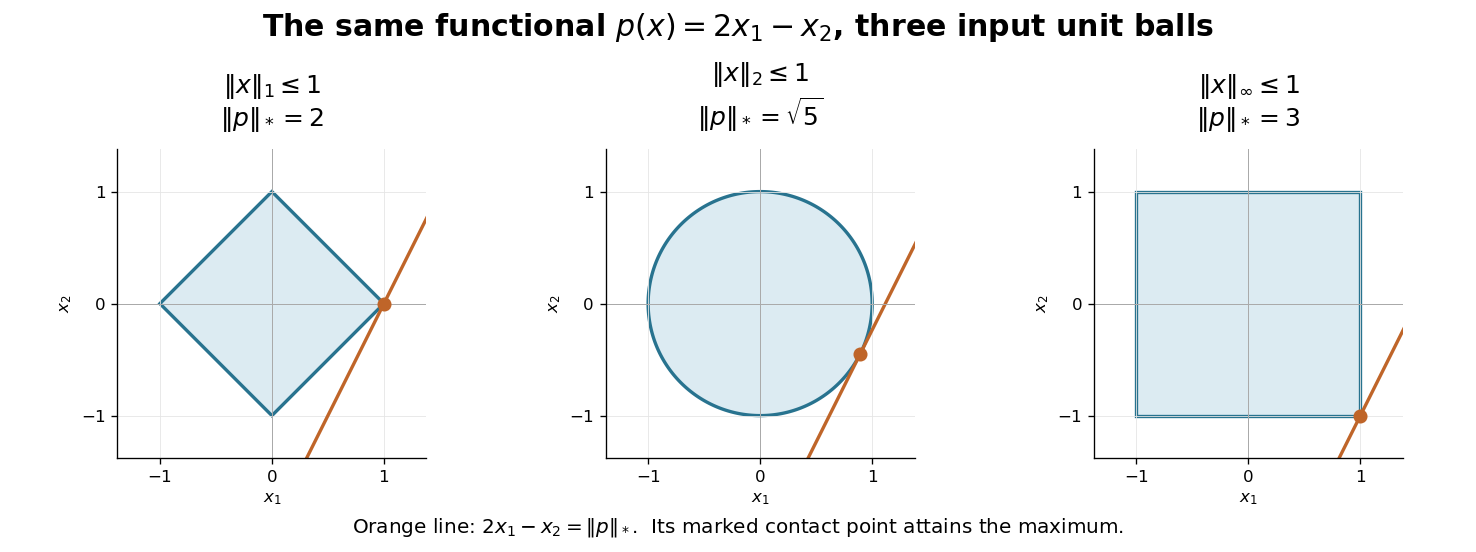
This geometry explains the usefulness of a dual norm: it translates a bound on inputs into the sharp bound on a linear output. The support function of the unit ball gives its value in the coefficient direction . Changing the input budget changes the set of possible inputs; the three different answers do not conflict. In finite dimensions a closed unit ball is compact, so a continuous linear functional achieves its maximum absolute value. In an infinite-dimensional normed vector space, the supremum remains the definition and need not be achieved.
Suppose a perturbation satisfies , with . Absolute homogeneity of a norm and the dual norm definition giveFor nonzero , divide it by its norm to obtain an input in the unit ball; for zero perturbation the inequality is immediate. This is an exact error bound for a linear functional, for every perturbation in the stated input set.
For and a budget , the sharp output-error bounds are for , for , and for . Scale the maximizing vectors from the preceding example by to attain the positive endpoints; their negatives attain the negative endpoints. The L1 norm budget constrains a total absolute error; the maximum norm budget permits each coordinate to have that error separately. These budgets define nested sets and carry different information.
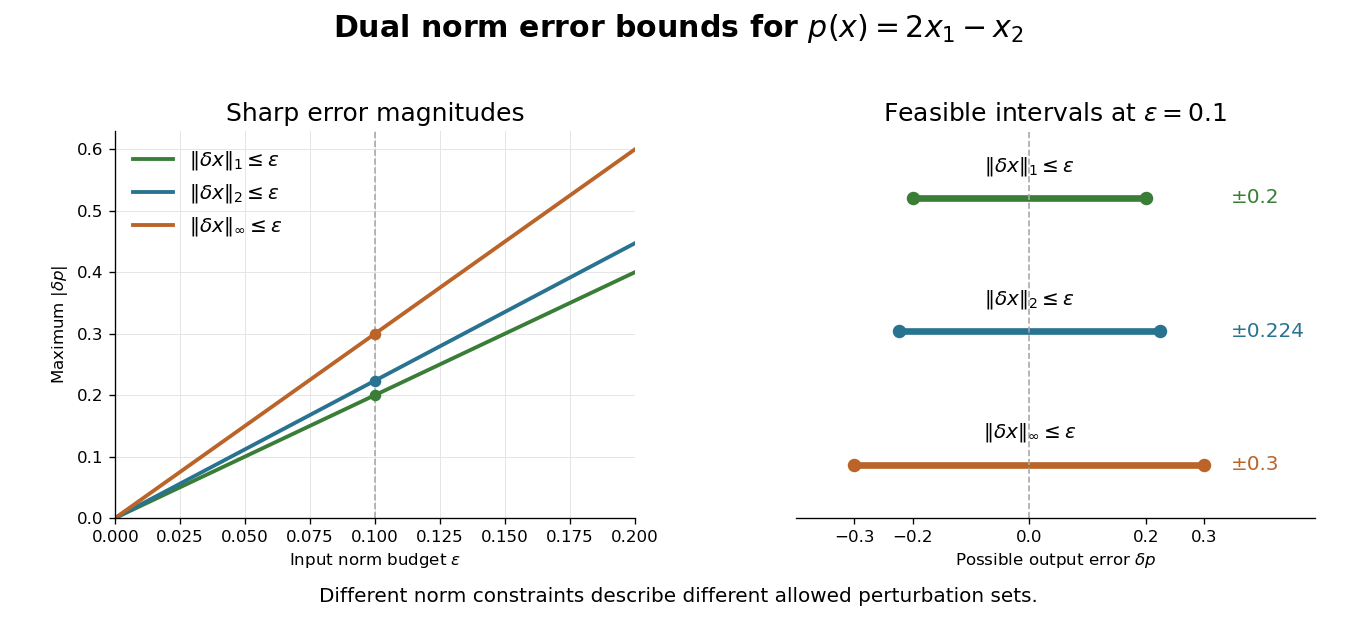
Dual norms give exact worst-case errors for the same linear functional
. Original bounds for . Lines show the sharp error magnitude as the stated input norm budget increases. The right panel gives the full possible error intervals at ; these are the full feasible intervals for the stated deterministic bounds. Details.The coordinates must use the stated scale and units. Rescaling one coordinate changes both its coefficient in and the meaning of its input budget. For a nonlinear differentiable function with scalar values, its Fréchet derivative at the base point is a linear functional governing the first-order response. An exact finite-perturbation error bound additionally needs control of the Taylor remainder or of the Fréchet derivative along the path.
On the real space of sequences converging to zero , use the supremum norm and define the linear functionalThe geometric series gives , so is a bounded linear functional and . The sequence with its first entries equal to one and all later entries zero belongs to , has unit supremum norm, and gives . Hence . But if and , not all coordinates can equal one or all equal minus one. Since every weight is positive, . The supremum is approached but never attained on the unit ball.
The block mixed norm sums the norm of each block, for . Its dual norm is , where for and for . Apply Holder inequality blockwise and choose a norming block to attain equality. Absolute values are essential for signed components.
For a linear map between finite-dimensional real inner product spaces,Thus the penalty is the support function of the compact convex set . The Moreau decomposition makes its proximal operator the identity minus the Euclidean projection onto a convex set.
Definiteness says that a norm vanishes only at the zero vector. The box norm on a nonempty finite Cartesian product is definite because its defining sum of squares includes equal-column terms, each of which is the square of an average of squares. Omitting repeated coordinates would destroy this proof and can produce a different quantity.
Absolute homogeneity is the norm axiom for every scalar and vector . It distinguishes a norm from a merely homogeneous expression of a different degree; for example the fourth root in the box norm converts a degree-four expression into a degree-one norm.
Suppose contains zero, is convex, and meets every line , , in the finite symmetric open segment with . Then its Minkowski functional is a norm, with and . Absolute homogeneity follows by rescaling the segment. If and , convexity puts in , giving ; passing to the infima proves the triangle inequality. Conversely the open unit ball uniquely determines any norm by the displayed formula. No prior topology on the vector space is needed for these radial hypotheses.
On a uniform -dimensional spatial grid, the discrete L2 norm weights the squared Euclidean norm by the cell volume. It approximates the continuous L2 norm and is induced by the discrete L2 inner product. A contraction bound in this norm with a mesh-independent constant proves stability of a numerical method for the spatially discretized evolution.
For , interpret the nonnegative sum as an extended-valued functional on the l2 sequence space. Finiteness implies , but unbounded weights can make it infinite even there. It is proper and convex. Every finite partial sum is norm-continuous, so their supremum is sequentially lower semicontinuous and also weakly lower semicontinuous. This is useful as a sparsity penalty in variational regularization.
The coordinate conditions define a subgradient precisely when and . They follow by varying one coordinate; summing their scalar supporting inequalities proves sufficiency. Since , a subgradient can exist only at finitely supported . At such a base point , , allowing the value infinity. Merely having finite penalty does not guarantee a nonempty subdifferential in the ambient l2 sequence space.
Taxicab geometry equips Euclidean coordinate space with the distance induced by the L1 norm, so the distance between two points is the sum of their coordinatewise absolute differences.
The trace norm of a finite-dimensional operator is the sum of its singular values:For a Hermitian operator , it equals .
For a finite square matrix , maximize over unitary operators. Write its singular value decomposition as . Then , since every diagonal entry of a unitary has modulus at most one. Choosing attains equality, proving the formula for the trace norm.
A Hermitian operator satisfies . Each diagonal entry of in an eigenbasis of lies between minus one and one, giving the upper bound . The sign operator of attains it. The substitution converts this formula to optimization over binary POVM effects and proves the Holevo–Helstrom theorem.
For any orthonormal basis and Hermitian operator, . In the trace-norm variational principle for Hermitian operators, choose the diagonal whose entries are the signs of these diagonal entries. This bounds the total distinguishability visible in one fixed measurement basis.
The induced trace norm of a linear map between matrix spaces isIt measures the largest trace-norm amplification available without an auxiliary tensor factor.
The diamond norm is the stabilized induced trace normFor a map on -dimensional inputs, an auxiliary space of dimension suffices. The tensor factor lets the norm detect how acts on one half of an entangled input.
For an orthogonal matrix , the identity gives . Thus multiplication by preserves the Euclidean norm. Applying this on both input and output sides proves for orthogonal matrices and the Euclidean operator norm. The analogous invariance of the Frobenius norm follows by summing column lengths or by a trace calculation.
For a nonzero vector , put and . The gradient of the Euclidean norm is . Differentiate its components to obtain the Hessian matrixThe factor is the orthogonal projection matrix onto the orthogonal complement of the radial direction. Thus the Hessian matrix has eigenvalue zero radially and on each tangential direction, explaining the convexity of the Euclidean norm. Taking the trace gives away from the origin. The Euclidean norm is not differentiable at the origin: its restriction to any line is a nonzero multiple of the absolute value.
For a real vector , the square of its Euclidean norm is . Unlike the norm itself it is a quadratic function, so expanding sums directly exposes diagonal and cross terms. This is useful for the mean-square displacement of an isotropic planar random walk.
The Euclidean norm is self-dual:The upper bound is Cauchy-Schwarz inequality, and equality holds at when .
The Euclidean unit ball is the closed unit ball of the Euclidean norm, centered at zero. Its radial function is identically , making it a natural reference body for John ellipsoids and volume ratios.
The closed unit ball of a normed vector space is the set of vectors of norm at most one. In a continuous dual space it is compact in the weak-star topology by the Banach-Alaoglu theorem.
The supremum norm of a bounded real- or complex-valued function on a set isFor a continuous function on a compact space, the extreme value theorem makes this supremum a maximum.
Let be a nonempty compact space and let be continuous and nowhere zero. On , define . Multiplication by is an isometry onto with its ordinary uniform norm, because division by the continuous nonvanishing provides the inverse. Thus the weighted space is a Banach space. Equivalently, the extreme value theorem gives , and . A weighted Cauchy sequence is uniformly Cauchy, has a continuous uniform limit, and the upper bound gives convergence also in the weighted norm.
On a nondegenerate interval, point evaluation of the derivative is unbounded for the supremum norm on smooth functions. The functions have supremum norm at most one but . Adding the supremum norm of the derivative makes this evaluation a bounded linear functional.
For a function with bounded derivatives through order , the derivative supremum norm is , with any equivalent finite-dimensional norm for each derivative tensor. This is a classical norm; it is different from the Lp norm with exponent .
Every surjective isometry between real normed vector spaces is affine. In particular, if , then is real-linear.
For in a real normed space, start with the points at distance from both endpoints and repeatedly retain those within half the previous diameter of every retained point. Reflection about preserves every stage, the midpoint belongs to every stage, and the diameters decrease by a factor at least two. Their intersection is therefore exactly the midpoint.
Surjectivity in the Mazur-Ulam theorem is essential. The mappreserves all distances and fixes zero, but it is not linear and does not preserve every midpoint.
Two norms on one vector space are equivalent when constants satisfyfor every vector. Equivalent norms define the same convergent sequences, open sets, and continuous linear functionals.
Two norms on a vector space give the same topology if and only if for some positive constants. Indeed, continuity of the identity at zero gives . For , apply this to to obtain . Reverse the roles of the norms for the lower bound. Conversely the two inequalities compare every translated open ball. This proof uses absolute homogeneity of a norm, not finite dimension.
Relative to a Schauder basis, take the supremum over successive finite intervals whose minima belong to a specified hereditary family , and signs . If this supremum is bounded above by a multiple of the original norm and the family contains all singletons, it gives an equivalent norm. Composing two admitted signed interval projections costs at most a factor of two in this norm: split their nonempty intersections according to which interval supplies the later left endpoint. In each of the two resulting families the minima form a subset of one original list, so heredity preserves admissibility. This estimate lets bounded distortion of a Banach space give a uniform bound independent of the complexity of .
Bounded distortion means there is one finite bound on the ratio between the largest and smallest relative sizes of any equivalent norm after restriction to a further infinite-dimensional block subspace. The comparison is invariant under scalar multiplication of the new norm. A literal two-sided bound without an allowed rescaling would fail even for a scalar multiple of the original norm.
On for compact Hausdorff , any complete norm making every point evaluation functional continuous is equivalent to the uniform norm. If converges in the new norm to and uniformly to , evaluation gives for every , so the identity map between the two Banach spaces has closed graph. The closed graph theorem and open mapping theorem make the identity and its inverse bounded. Completeness of the proposed norm is essential to this argument.
Any two norms on a finite-dimensional real or complex vector space are equivalent. Relative to a fixed basis, continuity and positivity of a norm on the compact Euclidean unit sphere give uniform positive lower and finite upper bounds.
A Banach space is a normed vector space over the real numbers or complex numbers that is complete for the metric . Explicitly, whenever a sequence satisfiesthere is an element of the same space with . The hypothesis says that the approximations eventually agree to any requested accuracy; completeness says that they describe an actual object in the space. The Cauchy sequence condition can be checked before anyone knows what that object is.
This makes a Banach space a natural setting for constructing solutions by successive improvements. If corrections have , their partial sums form a Cauchy sequence by the triangle inequality, and completeness supplies their sum. In fact, convergence of every such absolutely summable vector series characterizes a Banach space. The contraction mapping theorem uses precisely this mechanism: each correction is smaller than the preceding one by a fixed factor.[ref]
https://ocw.mit.edu/courses/18-102-introduction-to-functional-analysis-spring-2021/3d4cc88026d44a01f936cd6a0aa995cb_MIT18_102s20_lec_FA.pdf. Richard Melrose, Functional Analysis, chapter 1, section 3, Proposition 1.2: completeness and summable series
Every normed vector space of finite dimension is a Banach space. Infinite-dimensional examples include the absolutely summable sequence space and the l-infinity sequence space; the choice of norm remains part of the specification. A collection of increasingly accurate finite descriptions can require an infinite description for its limit, as the finitely supported sequence example below demonstrates. Completion of a normed space adds these missing limits while preserving all original distances.
A normed vector space is a Banach space exactly when every absolutely convergent series converges in the space. Completeness implies the assertion because the triangle inequality makes the partial sums a Cauchy sequence. Conversely, select from any Cauchy sequence a subsequence whose consecutive differences have norm at most . The series of these differences converges by hypothesis, so the subsequence converges. The original Cauchy sequence then has the same limit. This provides a useful way to demonstrate incompleteness by a summable-norm series whose candidate sum lies outside the space.
For a closed linear subspace of a Banach space , finite codimension means the vector quotient has finite dimension. This definition does not subtract two infinite dimensions. A local stable manifold has the codimension of its tangent subspace. If the linearized phase space has a direct sum decomposition with , then is isomorphic to , so a local stable manifold tangent to has codimension one.
A Banach space has the Banach-Saks property if every bounded sequence contains a subsequence whose arithmetic averages converge in norm. The weak Banach-Saks property requires this only for weakly convergent sequences. The weak Banach–Saks theorem in a Hilbert space establishes that weak version in Hilbert spaces.
A Banach space has cotype , , if a constant independent of the number of vectors satisfies for independent symmetric Rademacher random variables. It prevents many large vectors from having a small random sum.
This is cotype of a Banach space with . The Lp space has cotype 2 with constant at most : the triangle inequality for the Euclidean norm gives , and the sharp Rademacher second-moment inequality, followed by Fubini theorem, bounds this by .
If a Banach space has cotype 2 constant , every bounded linear operator satisfies and , uniformly in . The first bound follows from Pietsch factorization theorem and the fourth moment bound for Rademacher sums. For the second, 2-summing domination gives a weighted coordinate norm; clipping coordinates at a variable threshold yields , which absorbs the first bound.
A closed vector subspace of a Banach space is complemented if a bounded linear operator satisfies and . Equivalently, is the topological direct sum of and a closed subspace: a projection gives , and the coordinate projection of such a decomposition is bounded.
For a Banach space satisfying , a complemented subspace is absorbed by : write , expand the countable sum, and absorb one additional copy of into the countably many summands. Hence . If is complemented in and contains a complemented copy of , write with complemented in ; the preceding argument gives . The decompositions are Banach space isomorphisms, not merely algebraic decompositions.
An infinite-dimensional Banach space is hereditarily indecomposable if no closed infinite-dimensional subspace is a topological direct sum of two infinite-dimensional closed subspaces. Equivalently, for any two infinite-dimensional closed subspaces and any , some unit vectors satisfy . A positive lower bound on such distances would make the addition map from an isomorphism onto a closed subspace.
Every infinite-dimensional Banach space contains either an unconditional basic sequence or a hereditarily indecomposable Banach space. For a space with a basis and no unconditional basic sequence, apply the block Ramsey theorem to finite sequences whose odd and even spans contain nearby unit vectors. A diagonal sequence of successively sharper games gives a subspace in which every pair of infinite-dimensional subspaces has angle zero.
For a closed vector subspace of a Banach space , the quotient vector space is complete with its quotient norm. Closedness makes the quotient seminorm a norm. Completeness follows by choosing representatives of a rapidly Cauchy subsequence whose successive differences have summable norms in .
If a Banach space has separable dual and is a quotient by a closed subspace, every weakly null sequence in the quotient's closed unit ball has a subsequence with approximate weakly null lifts of norm at most . Choose representatives of norm below , pass to a common bidual weak-star limit, and subtract convex blocks whose quotient images tend to zero in norm. Convex-block cancellation of a weak-star limit gives weak nullity and the triangle inequality gives the bound .
The quotient norm measures the smallest norm among representatives of a coset. Its infimum need not be attained. Nevertheless, for every , an element has a representative with . The quotient map is contractive.
A convex block of a sequence in a Banach space is a sequence of convex combinations supported on successively disjoint finite intervals, with , , and . Zero coefficients can fill gaps and ensure strict endpoint inequalities. By the Mazur theorem, every weakly null sequence has convex blocks tending to zero in norm.
If a bounded sequence in converges weak-star to under the canonical embedding into the bidual, then any convex blocks have the same scalar limit on every . Thus is a weakly null sequence, even when does not belong to the embedded space .
The duality mapping takes a vector to its supporting dual functionals for half its squared norm. Equivalently when and . This follows from the dual-norm inequality and equality in the conjugate relation for squared norms. In a Hilbert space, the Riesz representation theorem identifies it with the identity; in a general Banach space it can be set-valued.
For an arbitrary set and scalar field , this is the space of bounded functions with the supremum norm . Uniform limits of Cauchy sequences prove it is a Banach space. For it is the l-infinity sequence space; for the empty index set it is the zero space, with norm zero.
A bounded linear operator is exactly a uniformly bounded family of bounded linear functionals through . Evaluation shows ; conversely the family bound gives , proving equality. Taking all functionals in the dual unit ball gives an isometric embedding by the Hahn-Banach theorem.
A Banach space is separable when it has a countable dense subset for its norm topology. It then has a countable base of norm balls and a countable norming family. Its continuous dual space need not be norm separable.
The Banach space consists of absolutely summable scalar sequences, with norm . Its continuous dual is , under the pairing . Finitely supported sequences are norm dense, which identifies a linear functional from its values on coordinate vectors. The space of sequences converging to zero inside this dual is a norming subspace of infinite codimension.
For example, belongs to the absolutely summable sequence space and has norm one, by the geometric series formula. Merely tending to zero is insufficient: tends to zero but its series of absolute values diverges. Thus this sequence space records total absolute size, rather than just the eventual size of individual coordinates. Its completeness ensures that a Cauchy sequence in this total-error norm has an absolutely summable limit.[ref]
https://people.clas.ufl.edu/mjury/files/6617notes30nov2015.pdf. Michael Jury, MAA6617 course notes, section 20.1(b): Banach sequence spaces
Suppose the distinct complex numbers satisfy . The geometric sequences in the displayed formula belong to the absolutely summable sequence space and have dense linear span. Otherwise the Hahn-Banach theorem gives a nonzero annihilating functional, represented by a bounded sequence . Its power series is holomorphic in the unit disk and vanishes at every . Compactness supplies an accumulation point inside that disk. The identity theorem forces and hence all its coefficients zero, a contradiction. This is a useful form of density by annihilators that converts a Banach-space problem into uniqueness of an analytic function.
For positive weights , the sequence space with norm is isometrically isomorphic to : multiplication by is a linear bijection onto the absolutely summable sequence space, with inverse multiplication by . Thus it is a separable Banach space. Density can also be seen directly by truncating a weighted summable sequence and then approximating its finitely many coordinates by rational numbers.
The l2 sequence space is a uniformly convex Banach space. If , the parallelogram law givesThus permits the modulus .
A finitely supported sequence has only finitely many nonzero coordinates. Their vector space is commonly denoted .
Equip the vector space of finitely supported sequences with the norm inherited from the absolutely summable sequence space. Consider the truncationsFor , the geometric series givesTherefore is a Cauchy sequence. Any possible norm limit must have coordinate equal to , since . That forces infinitely many nonzero coordinates, so no limit lies in . There is nothing wrong with the approximations: the space is missing their limit.
Inside the absolutely summable sequence space, the limit is and its exact truncation error is . Four retained coordinates leave error ; ten leave . More generally, truncating any element of the absolutely summable sequence space leaves a tail whose norm tends to zero. Together with completeness, this identifies that Banach space as the completion of a normed space with this norm. Finite storage and an infinite mathematical object fit together through a controlled error.
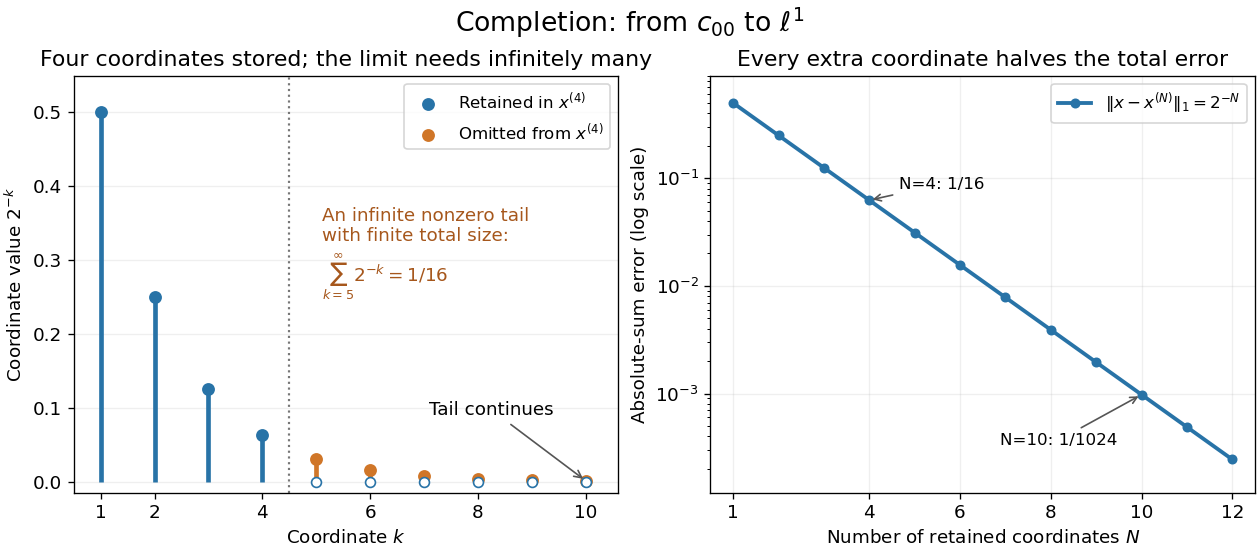
For , coordinate truncations converge in , so is dense. It is not dense in : every finitely supported sequence is at distance at least one from the constant-one sequence.
A generalized limit on real bounded sequences is a positive linear functional of operator norm one that extends the ordinary limit of a sequence. Such a functional can be chosen by the Hahn-Banach theorem: extend the limit on the convergent sequence space while dominating it by the sublinear functional . Applying the same domination to gives the displayed lower bound. A Banach limit additionally has invariance under the left shift on bounded sequences.
A Banach limit is a positive linear functional on the real l-infinity sequence space that extends the ordinary limit on the convergent sequence space, has operator norm one, and is invariant under the left shift on bounded sequences. The Hahn-Banach theorem constructs one by separating the constant sequence from the subspace , whose distance from is one. The functional is generally not unique.
Suppose is a sublinear functional on the bounded real sequences, dominated by the limit superior and nonpositive on every shift difference . The Hahn-Banach theorem then yields a Banach limit. Indeed implies , so agrees with the ordinary limit on convergent sequences. Extend this linear limit functional by Hahn-Banach to a linear . Domination on and on its negative forces . The two-sided limit bounds give positivity, norm one and agreement with ordinary limits. In finite-shift averaging constructions, the needed bound on shift differences follows by telescoping consecutive averages to .
Articles were limited to the first 100 out of 114 total.



