
A bivector is an element of the second exterior power . A simple bivector is one exterior product ; in real Euclidean space, it records the oriented area generated by those two vectors. A general bivector is a sum of such elements and need not describe just one plane. Covariant counterparts are differential two-forms, which take two vectors as inputs rather than belonging to .
In , chooseExpanding by bilinearity givesThe three coefficients are signed areas of the projections onto the , , and coordinate planes. They are three components of one bivector, not the three coordinates of either input vector.
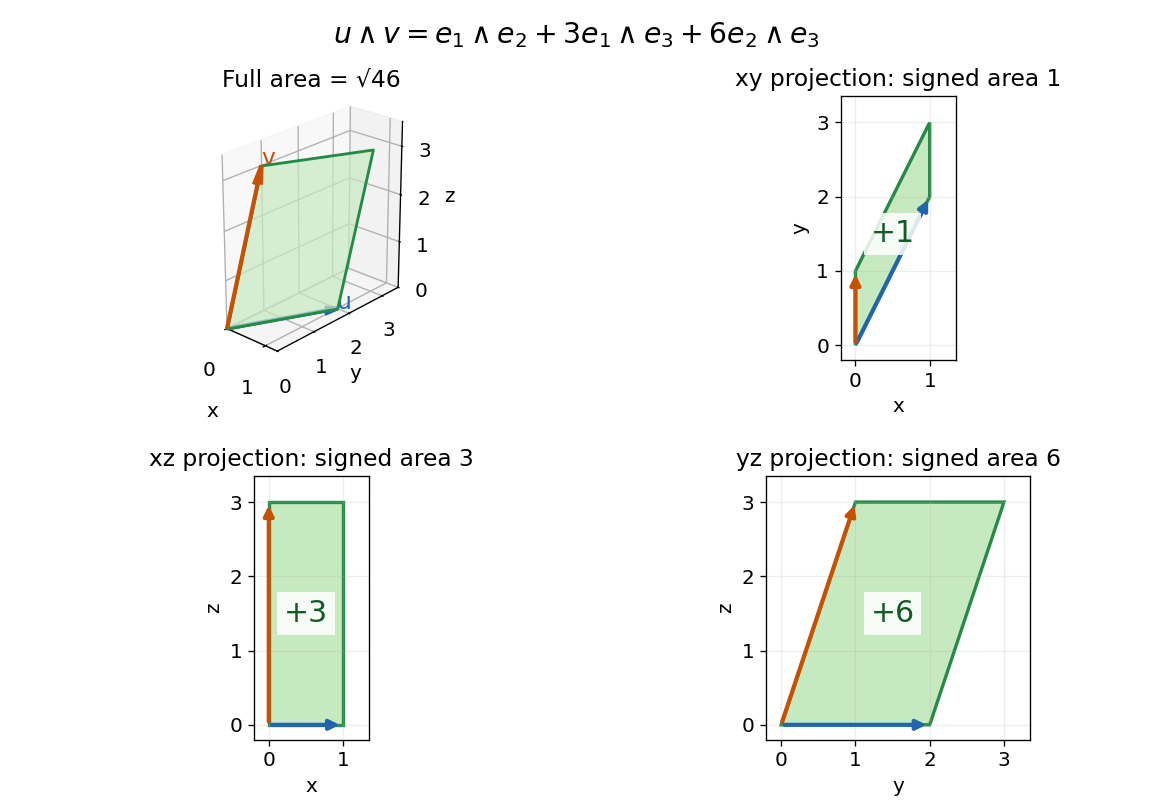
With the usual dot product and a fixed orientation of a vector space, the cross product represents this area element by the normal vector . The order of the components matters: corresponds to , while corresponds to . The Gram determinant checks the full area:Here the norm on bivectors is the one induced by the Euclidean inner product. The exterior product exists without that metric and in arbitrary dimension; the familiar cross product description relies on the additional three-dimensional geometry.


A bivector is a geometric object that arises in the context of multivector algebra, particularly within the framework of geometric algebra. It represents an oriented area element and can be thought of as being associated with the plane spanned by two vectors in a vector space. In more formal terms, a bivector is defined as the exterior (or wedge) product of two vectors.
New to topics? Read the docs here!