Boltzmann entropy when a restriction is removed
ID: boltzmann-entropy-when-a-restriction-is-removed

In Boltzmann entropy of a two-box occupancy, impose an initial restriction that all labels are left. There is one allowed coarse microstate. Remove that restriction, allowing all occupancy values: the allowed set is now the union of every occupancy macrostate, containing strings. If the final description assigns equal probability to this whole set, its Boltzmann entropy change isThe counting identity is the binomial theorem. For twenty labels, . This final description fixes neither box occupancy; it is coarser than the particular macrostate , whose Boltzmann entropy is . The two counts answer different questions, so substituting the balanced macrostate for the full allowed set would change the calculation.
For four labels, the initial all-left string is
0000; removing the restriction makes all sixteen strings available. The column has only six strings. Accordingly, the whole allowed set has Boltzmann entropy , while the balanced macrostate has Boltzmann entropy .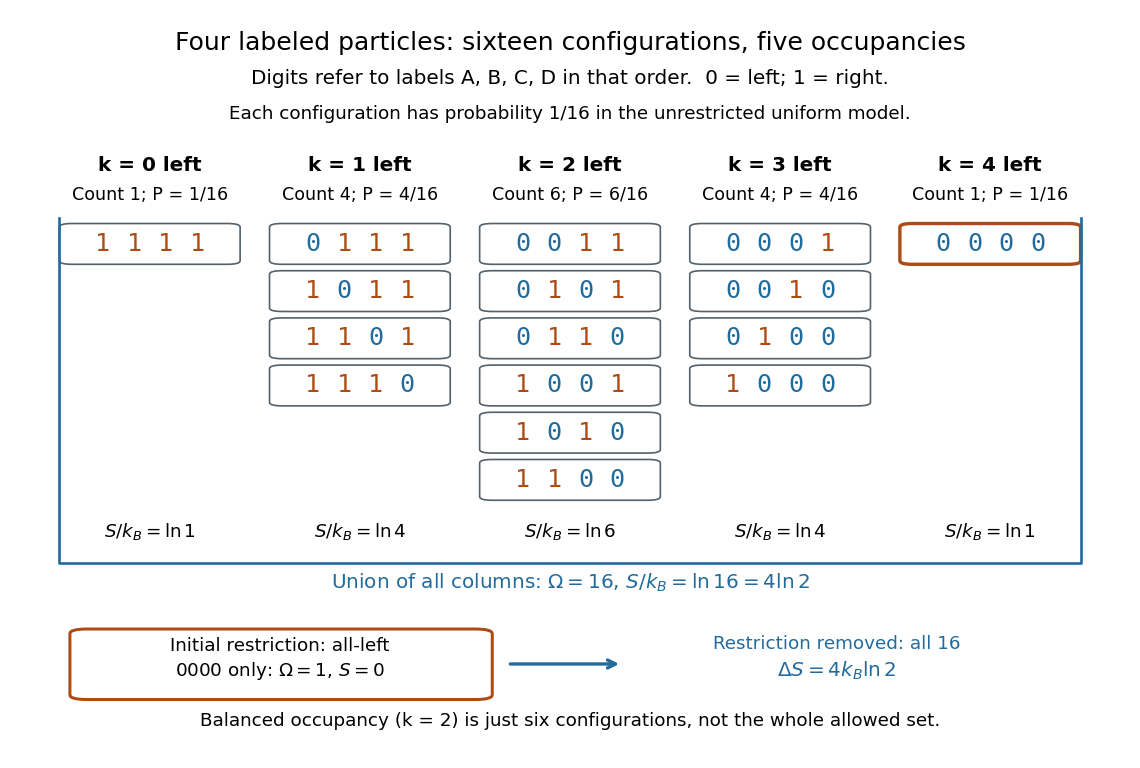
Sixteen configurations of four labeled particles grouped by left occupancy, compared with the all-left restriction
. Details. 
Removing a barrier changes the allowed set immediately, but it does not instantaneously randomize the actual probability distribution. Motion and equilibration must make those configurations accessible. The counting result illustrates the configurational contribution to free expansion; it does not describe the relaxation time or every contribution to the entropy of a real gas.
New to topics? Read the docs here!