Entropy is an extensive quantity and a state function of an equilibrium system, measured in . Differences between equilibrium states are calculated along a reversible thermodynamic process:Here heat entering the system is positive and is its absolute thermodynamic temperature. The reversible path used for calculation need not be the path actually taken. Dividing the actual heat by a single temperature generally fails for an irreversible process.
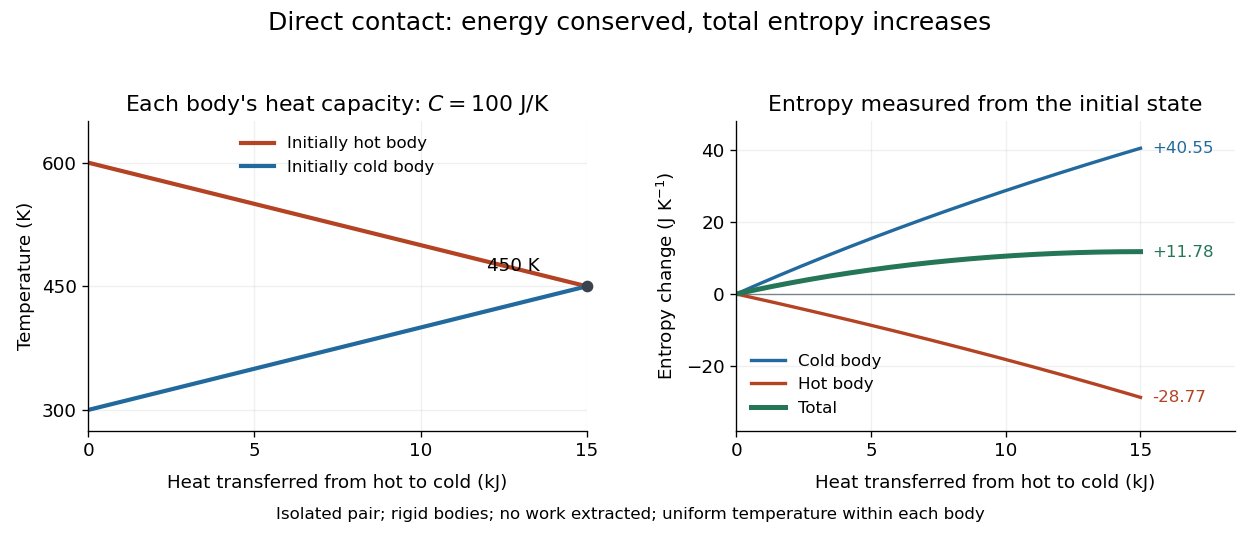
For example, put two rigid bodies, each with constant heat capacity , at and in an otherwise isolated system. Assume each body has a uniform internal temperature, no phase transition occurs, and no work is extracted. Their final thermal equilibrium is at , because the internal energy lost by one equals that gained by the other. Using entropy from heat capacity,so . One body's entropy decreases while the total increases. [ref]
https://web.mit.edu/16.unified/www/FALL/thermodynamics/notes/node41.html. MIT, Entropy changes and the hot-brick problem
In statistical mechanics, Boltzmann's entropy formula counts equally likely microstates compatible with a macrostate; Gibbs entropy handles a specified probability distribution over microstates. If the number of equally likely microstates doubles, entropy increases by . The logarithm makes multiplicative counts additive for independent systems. These are precise statements about states and probabilities, not a universal measure of visible messiness. Calling entropy merely "disorder" obscures the thermal calculation above and hides which microstates are being counted. [ref]
https://web.mit.edu/16.unified/www/FALL/thermodynamics/notes/node57.html. MIT, Statistical entropy and randomness
The usefulness of entropy is that measurable heat capacities determine its changes, and the Second law of thermodynamics turns those changes into constraints on processes. It also connects macroscopic measurements to microscopic descriptions without requiring us to track every particle.
entropy associated with positions of independently translating objects. Connecting segments into one polymer leaves fewer independently translating objects than treating the same segments as separate molecules; this reduces mixing entropy per segment.
The entropy change per specified extent of a reaction, equal to the stoichiometric product-minus-reactant sum of partial molar entropies.
Molar entropy in a specified standard state. Absolute entropies of elemental reference substances are generally not zero, unlike their conventional standard formation enthalpies.
For a body of constant heat capacity cooling from to a thermal reservoir at , the body's entropy change is , while the reservoir gains . Their sum is nonnegative because for . The logarithmic body contribution is computed along a hypothetical reversible path; the actual finite-temperature-difference heat transfer is irreversible.
Residual entropy is entropy remaining in the zero-temperature limit. An equilibrium ground-state degeneracy gives for the complete system; an extensive residual entropy requires a correspondingly large state count. Frozen configurational disorder can also leave an experimentally inferred residual entropy when a sample fails to equilibrate. The zero-entropy perfect-crystal form of the third law of thermodynamics assumes a unique, fully ordered equilibrium ground state.
Specific entropy is entropy per unit mass. For a perfect gas with constant specific heat capacity at constant volume and specific-heat ratio , differences obeywhere is pressure and is mass density. Thus a homentropic flow has constant .
Why does a gas spread through an available container? One part of the answer is counting: a nearly uniform macrostate can be realized by vastly more microstates than a macrostate with every particle crowded into one corner. Boltzmann's entropy formula turns that multiplicity into entropy. The useful insight is that a large entropy measures how many microscopic realizations fit a specified macroscopic description, rather than how untidy a picture looks.
For a specified macrostate containing accessible, equally likely microstates, writeHere is the Boltzmann constant, and is the natural logarithm, also written in this article's title. The count is dimensionless; entropy has units of energy divided by temperature. Always specify the macrostate, the constraints and the model's microscopic resolution before counting. A microcanonical ensemble provides a familiar equilibrium setting for the equal-probability assumption. [ref]
https://web.mit.edu/16.unified/www/FALL/thermodynamics/notes/node57.html. MIT, §7.4: equiprobable microstates and S = k ln Ω
The natural logarithm compresses an enormous count into a manageable number and makes products of counts into sums of entropies; see additivity of Boltzmann entropy. With this counting convention, one allowed microstate has zero Boltzmann entropy. This zero refers to the chosen model and resolution; it does not by itself assign an absolute entropy to a real material.
A single photon thermalized in a macroscopic body adds energy . If its heat capacity is sufficiently large that the temperature change is negligible, the entropy increase is . The Boltzmann entropy then gives the displayed ratio of accessible microstates. The exponential can be enormous even though the deposited energy is macroscopically tiny.
The part of entropy associated with the number of distinct spatial or occupancy arrangements consistent with chosen macroscopic constraints. For equally weighted configurations, the Boltzmann entropy formula gives the displayed expression. Unequal probabilities require over configurations. For indistinguishable empty sites among otherwise occupied sites, . Vibrational or internal degrees of freedom can contribute additional entropy even at fixed site arrangement.
Randomly distributing species with equal fractions over sites gives . Stirling approximation gives , or per mole of sites. Configurational entropy alone does not decide whether a multicomponent alloy is a stable single thermodynamic phase.
Take distinguishable, labeled particles and two boxes of equal volume. Retain only whether each particle is in the left or right box: use a bit for left and for right. Each length-20 string is one coarse microstate of this toy model. Assume the labels make independent side choices with equal probability, so the strings are equiprobable. Equal volumes motivate these weights for noninteracting particles with no preference for either box; equal volumes alone would not establish them for an arbitrary interacting gas.
Now retain only the number in the left box as the macrostate. Choosing which labels are left gives a binomial coefficient, soThe factorials count assignments to labels; the probability of a macrostate sums the probabilities of its constituent microstates. This is the binomial distribution with parameters and . The same binomial coefficient appears in the counting of distinguishable two-level systems, although here the macrostate records occupancy rather than energy. [ref]
https://ocw.mit.edu/courses/8-333-statistical-mechanics-i-statistical-mechanics-of-particles-fall-2013/0cb99318c2ed889316cdcff839759e8d_MIT8_333F13_Lec12.pdf. Mehran Kardar, MIT 8.333 (2013), lecture 12, §IV.C, equations IV.17–18: binomial microstate counts
The largest binomial coefficient occurs at , the balanced macrostate. All-left means and supplies just one string. ThusThere are balanced strings for every all-left string, even though each individual string has the same probability. Exact balance has about of the total probability; equilibrium reasoning concerns the many macrostates near balance too, rather than certainty of exactly ten particles on each side. The diagram compares the counts with their natural logarithms.
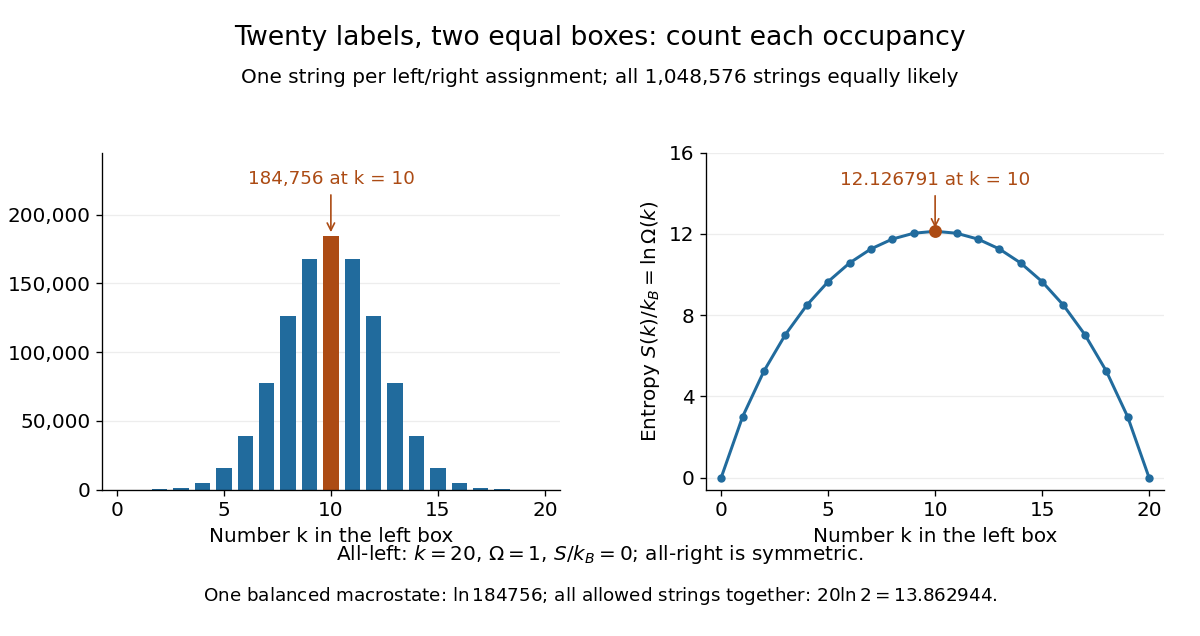
Counts and Boltzmann entropies of the occupancy macrostates of twenty labeled particles
. Details. Four fair, independent coins give a smaller worked example with the same binomial distribution. If is the number of heads, the five macrostates contain respectively microstates. Their probabilities are respectively . In particular, two heads is one macrostate containing six ordered coin sequences, with Boltzmann entropy in this counting analogy. A prescribed ordered sequence has one realization. The next diagram enumerates the same sixteen strings as left/right assignments.
In Boltzmann entropy of a two-box occupancy, impose an initial restriction that all labels are left. There is one allowed coarse microstate. Remove that restriction, allowing all occupancy values: the allowed set is now the union of every occupancy macrostate, containing strings. If the final description assigns equal probability to this whole set, its Boltzmann entropy change isThe counting identity is the binomial theorem. For twenty labels, . This final description fixes neither box occupancy; it is coarser than the particular macrostate , whose Boltzmann entropy is . The two counts answer different questions, so substituting the balanced macrostate for the full allowed set would change the calculation.
For four labels, the initial all-left string is
0000; removing the restriction makes all sixteen strings available. The column has only six strings. Accordingly, the whole allowed set has Boltzmann entropy , while the balanced macrostate has Boltzmann entropy .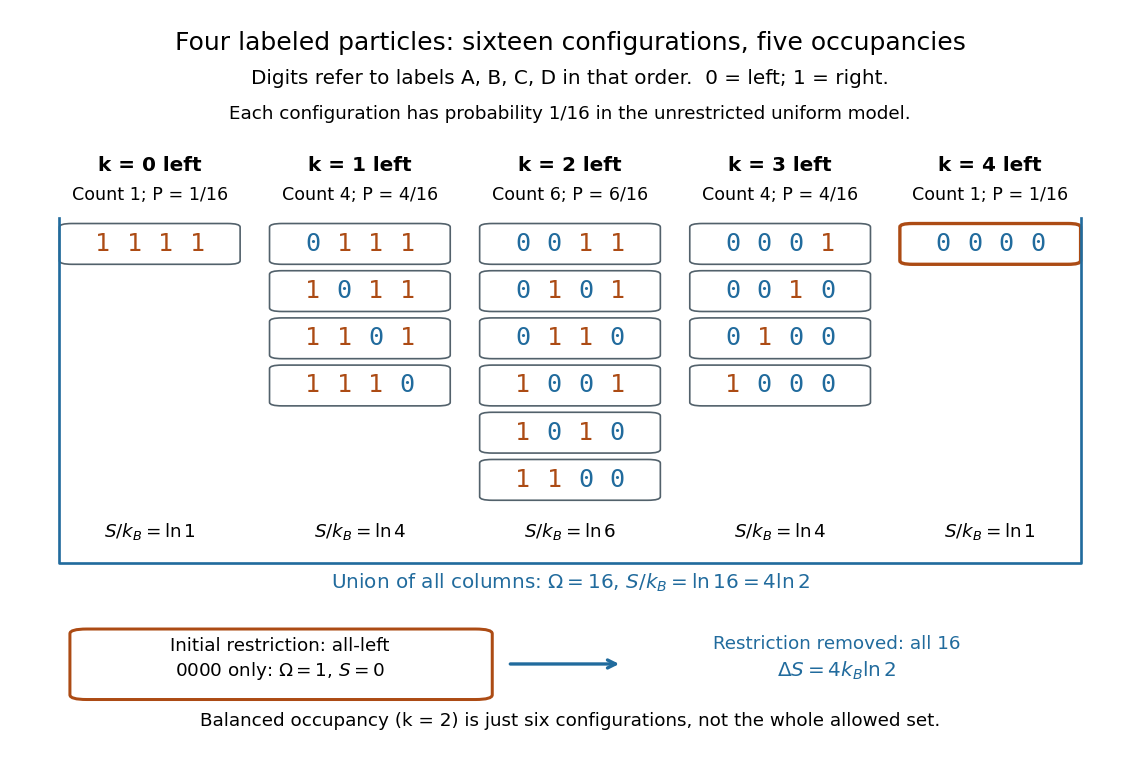
Sixteen configurations of four labeled particles grouped by left occupancy, compared with the all-left restriction
. Details. Removing a barrier changes the allowed set immediately, but it does not instantaneously randomize the actual probability distribution. Motion and equilibration must make those configurations accessible. The counting result illustrates the configurational contribution to free expansion; it does not describe the relaxation time or every contribution to the entropy of a real gas.
For two subsystems with independently specified macrostates, suppose every allowed microstate of can be paired with every allowed microstate of . Their allowed set is a Cartesian product. With equal probability for each pair, Boltzmann's entropy formula givesFor example, take two independent copies of the toy model, each with two labels choosing between its two boxes. Each copy has four configurations and Boltzmann entropy . Combining their independent labels gives sixteen configurations and Boltzmann entropy . This explains why entropy adds even though microscopic counts multiply. [ref]
https://web.mit.edu/16.unified/www/FALL/thermodynamics/notes/node57.html. MIT, §7.4, equation 7.17: independent state counts multiply
The product assumption matters. A constraint shared between the subsystems can forbid some pairs; for example, fixing only their combined energy generally requires summing over its possible divisions. See entropy maximization under thermal contact for how thermal equilibrium selects the dominant division. Statistical independence cannot be inferred merely from drawing a boundary between two parts.
The strings in Boltzmann entropy of a two-box occupancy are complete microstates only within the binary toy model. They retain a coarse-grained variable for each particle and omit its exact position within a box and its momentum. An actual classical gas instead occupies continuous phase space; obtaining a dimensionless count from a phase space volume requires a specified cell convention and the appropriate treatment of particle identity. A quantum state count must respect the allowed quantum states and quantum statistics. Thus is not a general count of microstates for a gas obeying quantum ideal-gas statistics. [ref]
https://ocw.mit.edu/courses/8-333-statistical-mechanics-i-statistical-mechanics-of-particles-fall-2013/0cdb670a825c6aaea7e229ac40776cbf_MIT8_333F13_Lec13.pdf. Kardar, MIT 8.333 (2013), lecture 13, §§IV.D–E: gas phase space and particle counting
For a discrete probability distribution with unequal weights, use the existing Gibbs entropy article; its equal-weight case gives Boltzmann's entropy formula. Shannon entropy uses the corresponding information measure, with the logarithm base setting its units. A count alone cannot replace the specified probability distribution, as the Boltzmann distribution examples demonstrate. [ref]
https://web.mit.edu/16.unified/www/FALL/thermodynamics/notes/node56.html. MIT, §7.3: statistical entropy for general microstate probabilities
Overwhelming multiplicity explains why thermodynamic equilibrium is overwhelmingly probable in macroscopic systems under the appropriate statistical assumptions. It does not make low-entropy thermal fluctuations logically impossible. Nor does counting alone derive irreversible macroscopic evolution: one also needs dynamics, an initial preparation, and a reason the system samples the allowed microstates on the timescale of interest. [ref]
https://ocw.mit.edu/courses/8-333-statistical-mechanics-i-statistical-mechanics-of-particles-fall-2013/0cb99318c2ed889316cdcff839759e8d_MIT8_333F13_Lec12.pdf. Kardar, lecture 12, §§IV.A–B: statistical equilibrium and the limits of counting arguments
Historically, Boltzmann's 1877 paper counted microscopic arrangements, called complexions, and related the natural logarithm of their number to entropy. The Sharp and Matschinsky translation appeared in Entropy 17 (2015), pages 1971–2009, DOI 10.3390/e17041971. Its notation differs from ours: Boltzmann's permutability measure is already logarithmic, whereas here is the count. [ref]
https://gilles.montambaux.com/files/histoire-physique/Boltzmann-1877-entropy.pdf. Boltzmann (1877), translated by Kim Sharp and Franz Matschinsky (2015), §III after equation 34 and §V
Josiah Willard Gibbs's Elementary Principles in Statistical Mechanics (1902) developed the statistical ensemble framework; Chapter XIV compares several statistical definitions of entropy with thermodynamics. [ref]https://en.wikisource.org/wiki/Elementary_Principles_in_Statistical_Mechanics. Gibbs (1902), title page and preface
[ref]https://en.wikisource.org/wiki/Elementary_Principles_in_Statistical_Mechanics/Chapter_XIV. Gibbs (1902), Chapter XIV: discussion of thermodynamic analogies
For a homogeneous equilibrium system with energy density , pressure , chemical potential , and number density , the entropy density is
Comoving entropy is the entropy density multiplied by the physical volume factor for a fixed comoving region in an expanding homogeneous universe. In adiabatic expansion it is conserved. Separate decoupled radiation sectors conserve their own comoving entropy, so disappearance of massive species can heat the still-equilibrated sector relative to a decoupled species.
For an extensive equilibrium system, the thermodynamic Euler relation gives . At zero chemical potential, divide by to obtain . Equivalently, makesThe first law of thermodynamics identifies this as ; the thermodynamic Euler relation fixes the entropy normalization. For adiabatic expansion satisfying the cosmological perfect-fluid continuity equation, the numerator on the right vanishes, proving cosmological entropy conservation.
For a dilute nonrelativistic gas with and zero chemical potential, the Bose-Einstein distribution approaches the Maxwell-Boltzmann distribution. Expanding in the number density integral gives . Since and , the entropy density at zero chemical potential gives and hence the displayed leading expression. This includes the internal multiplicity ; a single real scalar field has .
Articles by others on the same topic

Entropy is a concept that appears in various fields, such as thermodynamics, information theory, and statistical mechanics. Its meaning can vary slightly depending on the context, but generally, it refers to a measure of disorder, uncertainty, or randomness in a system. 1. **Thermodynamics**: In thermodynamics, entropy is a measure of the amount of energy in a physical system that is not available to do work. It is often associated with the degree of disorder or randomness in a system.



OK, can someone please just stop the philosophy and give numerical predictions of how entropy helps you predict the future?
The Unexpected Side of Entropy by Daan Frenkel
. Source. 2021.- www.quantamagazine.org/what-is-entropy-a-measure-of-just-how-little-we-really-know-20241213/ What Is Entropy? A Measure of Just How Little We Really Know. on Quanta Magazine attempts to make the point that entropy is observer dependant. TODO details on that.