Chemostat steady state
ID: chemostat-steady-state

A chemostat steady state has constant nutrient concentration and biomass concentration even while nutrient and cells flow through the vessel. It is an equilibrium of the chemostat ordinary differential equations, rather than a culture in which all growth has stopped. Assume and the Monod equation. Setting both derivatives to zero gives the always-existing chemostat washout equilibrium . A positive biomass concentration instead requires growth to balance removal, , whenceThe positive chemostat steady state exists exactly whenThe weaker condition only makes the denominator positive; it does not ensure or . Because the Monod equation is increasing, the feed must permit a specific growth rate greater than . At a positive chemostat steady state, increasing feed nutrient concentration at fixed increases the biomass concentration without changing , within the one-nutrient assumptions.
For a concrete chemostat, let , , and . At ,The nutrient supply minus outflow is , matching nutrient consumption . Biomass production and removal both equal . The chemostat washout threshold is . For example, formally gives and , which cannot describe a physical culture.
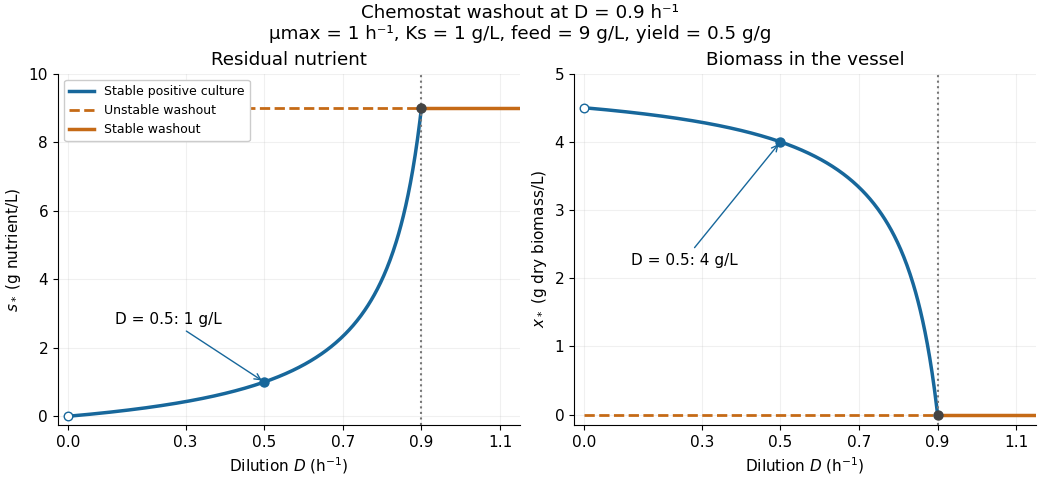

There is a useful exact simplification: the nutrient-equivalent concentration satisfies , so . This combines dissolved nutrient and the nutrient equivalent of biomass; it does not assert that these two variables account for every chemical constituent. In coordinates , the Jacobian matrix at the positive chemostat steady state has eigenvalues and , both negative. Hence the positive chemostat steady state is locally asymptotically stable. In the worked example the eigenvalues are and .
New to topics? Read the docs here!