The Monod equation is an empirical saturating law for the specific growth rate of a culture limited by one nutrient. Write for its residual nutrient concentration, for the limiting specific growth rate, and for the nutrient concentration at half that rate:Here and have units of inverse time, whereas has the same units as . The notation in the title denotes the same growth function, with , and . For , ; for , approaches . Its derivative is positive: more nutrient increases the specific growth rate, with progressively smaller increments.
For example, take and . Nutrient concentrations of , and give specific growth rates , and . In a chemostat with dilution rate , the intersection selects the residual nutrient concentration , provided the feed can supply enough nutrient for a positive biomass concentration.
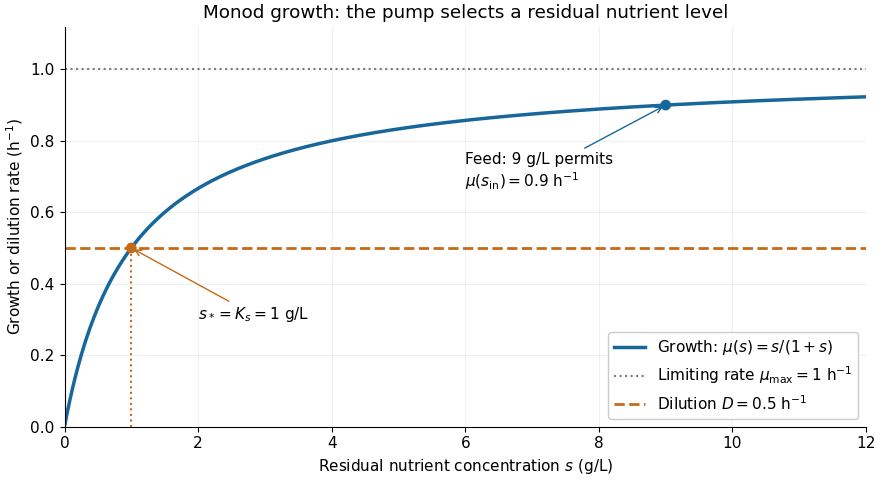
The Monod equation is useful because two measurable parameters describe both nutrient scarcity and saturation. It assumes the other conditions affecting growth remain controlled and does not represent inhibition at high nutrient concentration. Although its formula resembles the Michaelis-Menten equation, a whole culture's specific growth rate combines many processes; the resemblance alone does not derive it from Michaelis-Menten kinetics or identify with a Michaelis constant.
In his 1949 review, Monod presents the hyperbolic rate law as an empirical fit in equation (2), pp. 383-384, and discusses the difficulty of identifying a single growth-controlling reaction. His reported division rates use doublings per unit time; the natural-exponential specific growth rate used here is that division rate multiplied by . [ref]
https://garcialab.berkeley.edu/courses/papers/Monod1949.pdf. Jacques Monod, The Growth of Bacterial Cultures, Annual Review of Microbiology 3 (1949), 371-394, DOI: 10.1146/annurev.mi.03.100149.002103
. Articles by others on the same topic


The Monod equation is a mathematical model that describes the growth rate of microbial populations as a function of the concentration of a limiting nutrient. It is commonly used in microbiology and environmental engineering to understand how microorganisms grow in response to nutrient availability. The equation is expressed as follows: \[ \mu = \mu_{max} \cdot \frac{S}{K_s + S} \] Where: - \( \mu \) is the specific growth rate of the microorganism (e.