COBE DMR sky anisotropy experiment
ID: cobe-dmr-sky-anisotropy-experiment

In 1992 the COBE DMR team, including George F. Smoot and Charles L. Bennett, used radiometer antennas to compare antenna temperatures between sky directions apart at , and , with two nearly independent channels per frequency. Repeated sky coverage supported least-squares solution map reconstruction.[ref]
The analysis fitted magnetic response and removed the assumed kinematic angular dipole and its second-order Doppler effect contribution. Channel sums retained sky structure; channel differences estimated noise. Cross-channel correlations, different frequency maps and Milky Way latitude cuts tested the interpretation. Residual large-angle structure supported Cosmic microwave background anisotropy; Galactic contamination particularly limited the cosmic microwave background quadrupole. Brightness fluctuations alone were not sufficient evidence of primordial structure.[ref]
Structure in the COBE Differential Microwave Radiometer First-Year Maps by George F. Smoot and others. §§2–3.1, p.L2: controls, motion subtraction, Table1
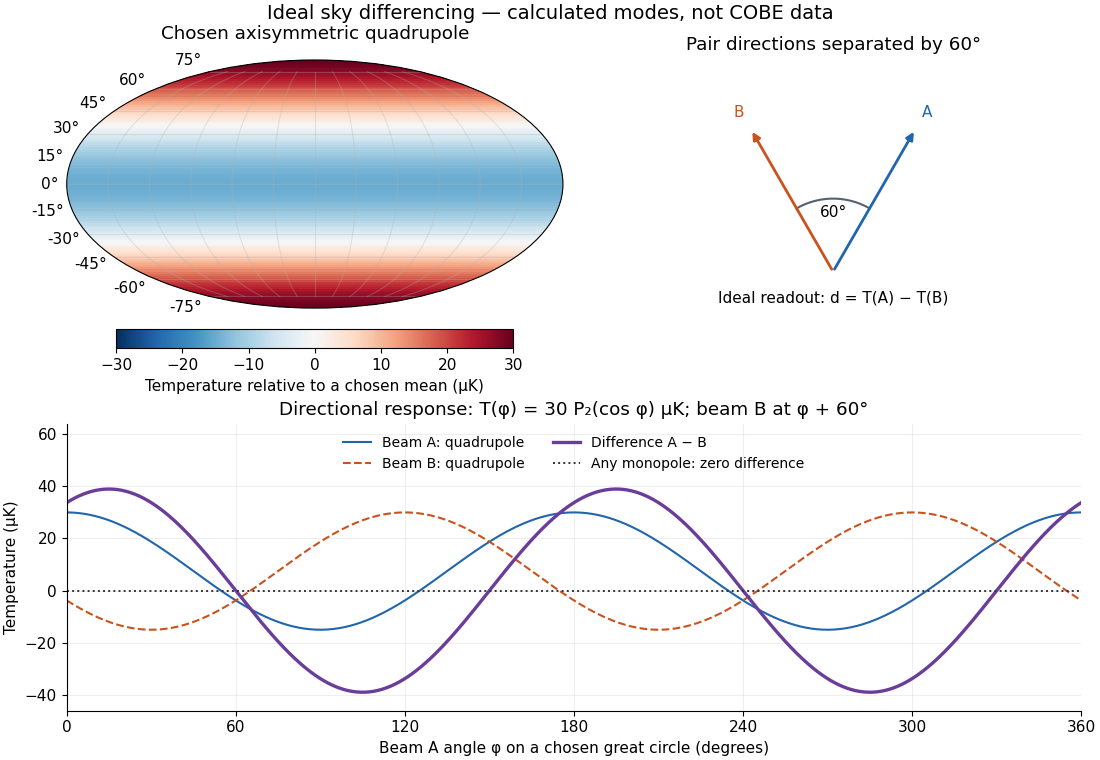

The two differences serve different purposes. Comparing two sky directions measures angular variation. Comparing two independently calibrated receiver maps observing the same sky tests noise and consistency. A common sky signal cancels in the latter comparison if their antenna beam patterns and response scales match; a systematic error shared by both channels need not cancel. Separating observer motion, local emission and intrinsic Cosmic microwave background anisotropy requires these additional tests.
New to topics? Read the docs here!