In 1992 the COBE DMR team, including George F. Smoot and Charles L. Bennett, used radiometer antennas to compare antenna temperatures between sky directions apart at , and , with two nearly independent channels per frequency. Repeated sky coverage supported least-squares solution map reconstruction.[ref]
The analysis fitted magnetic response and removed the assumed kinematic angular dipole and its second-order Doppler effect contribution. Channel sums retained sky structure; channel differences estimated noise. Cross-channel correlations, different frequency maps and Milky Way latitude cuts tested the interpretation. Residual large-angle structure supported Cosmic microwave background anisotropy; Galactic contamination particularly limited the cosmic microwave background quadrupole. Brightness fluctuations alone were not sufficient evidence of primordial structure.[ref]
Structure in the COBE Differential Microwave Radiometer First-Year Maps by George F. Smoot and others. §§2–3.1, p.L2: controls, motion subtraction, Table1

The two differences serve different purposes. Comparing two sky directions measures angular variation. Comparing two independently calibrated receiver maps observing the same sky tests noise and consistency. A common sky signal cancels in the latter comparison if their antenna beam patterns and response scales match; a systematic error shared by both channels need not cancel. Separating observer motion, local emission and intrinsic Cosmic microwave background anisotropy requires these additional tests.
An ideal differential measurement constrains two sky temperatures through . Represent every observed pair by a row of a matrix , with in column , in column and zeros elsewhere. Then and : adding any constant to the entire map changes no measurement. This null space is the angular angular monopole ambiguity, explaining why a directional comparison alone cannot measure the absolute blackbody temperature established by FIRAS.
For an original three-pixel example choose relative to an unspecified mean. Measurements and determine the third difference . The zero-mean condition recovers the chosen map, but adding to every pixel gives identical differences. The closure sum checks consistency without establishing the mean.
More generally, the graph joining measured pixel pairs must be a connected graph. If , each edge forces equal endpoint temperatures; a path propagates that equality throughout each connected component. Thus a connected observation graph leaves exactly one undetermined constant, whereas disconnected coverage leaves one per component. Fixing the mean makes an ideal connected reconstruction unique; real noise calls for least-squares solution fitting and uncertainty analysis.
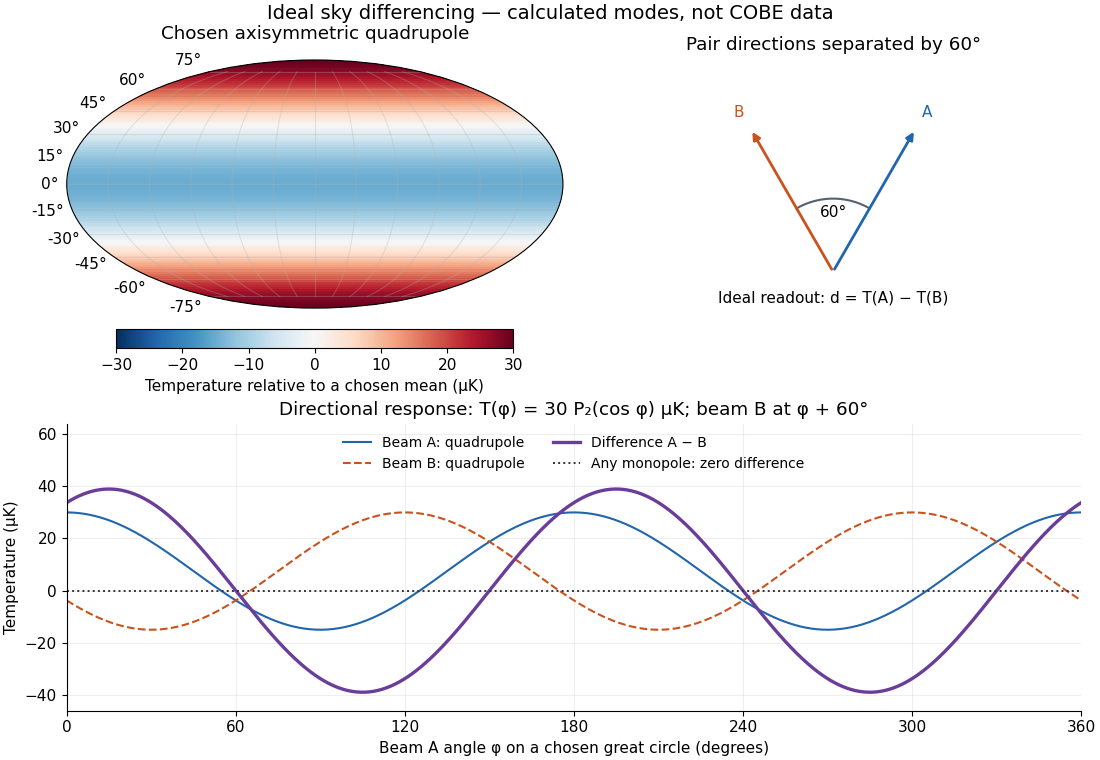
The figure chooses a cosmic microwave background quadrupole sky , with and Legendre polynomial . On a great-circle scan, with measured from the chosen symmetry axis and ideal beams separated by ,Expanding proves the formula; its peak magnitude is . A constant sky gives zero. This deliberately restricted scan also misses some angular patterns, so rejecting the angular monopole is not a proof of complete sky reconstruction. Broad, overlapping coverage supplies the missing constraints; finite antenna beam patterns additionally smooth small angular features.
Articles by others on the same topic
There are currently no matching articles.