
The current density describes the amount and direction of local electric charge transport per area per time. Its SI unit is . Through a small area element with unit normal , the contribution to electric current is : the dot product selects transport through the surface. A current density tangent to the surface contributes zero. If current density is uniform and perpendicular to a wire's transverse slice, its magnitude satisfiesHere is the wire cross-sectional area. For nonuniform current density, is only the average normal component, and the surface integral is needed. [ref]
https://openstax.org/books/university-physics-volume-2/pages/9-2-model-of-conduction-in-metals. Ling, Sanny and Moebs, §9.2: local current density
.Consider two separate uniform-flow cases, each carrying electric current . A wire cross-sectional area of gives ; doubling the wire cross-sectional area to gives . Equal electric current can therefore mean different local transport intensity. This distinction matters for Joule heating, whose local power per volume depends on current density and electric field.
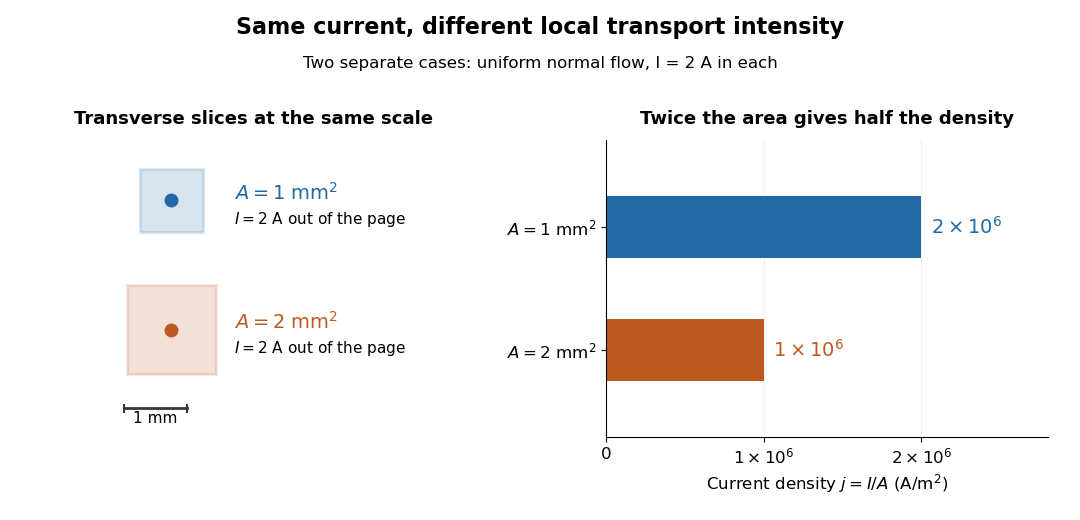
Equal electric current through different wire cross-sectional areas gives different current densities
. Both cases carry with uniform normal current density. The transverse slices use the same spatial scale; the bars compare . Source. Details.
For a toy Electron transport model, stipulate mobile electron number density and drift velocity , with the positive unit normal . Each Electron has electric charge , where the elementary charge is exact in SI. These are defined model inputs, rather than measured parameters of a particular material. [ref] The current density and its magnitude areFor wire cross-sectional area and constant transport over time , this givesThe two minus signs make conventional current point opposite to the Electron drift velocity. A small drift velocity can carry an appreciable electric current because many charge carriers contribute; it does not specify the propagation speed of an electrical disturbance.
New to topics? Read the docs here!