The current density describes the amount and direction of local electric charge transport per area per time. Its SI unit is . Through a small area element with unit normal , the contribution to electric current is : the dot product selects transport through the surface. A current density tangent to the surface contributes zero. If current density is uniform and perpendicular to a wire's transverse slice, its magnitude satisfiesHere is the wire cross-sectional area. For nonuniform current density, is only the average normal component, and the surface integral is needed. [ref]
https://openstax.org/books/university-physics-volume-2/pages/9-2-model-of-conduction-in-metals. Ling, Sanny and Moebs, §9.2: local current density
.Consider two separate uniform-flow cases, each carrying electric current . A wire cross-sectional area of gives ; doubling the wire cross-sectional area to gives . Equal electric current can therefore mean different local transport intensity. This distinction matters for Joule heating, whose local power per volume depends on current density and electric field.
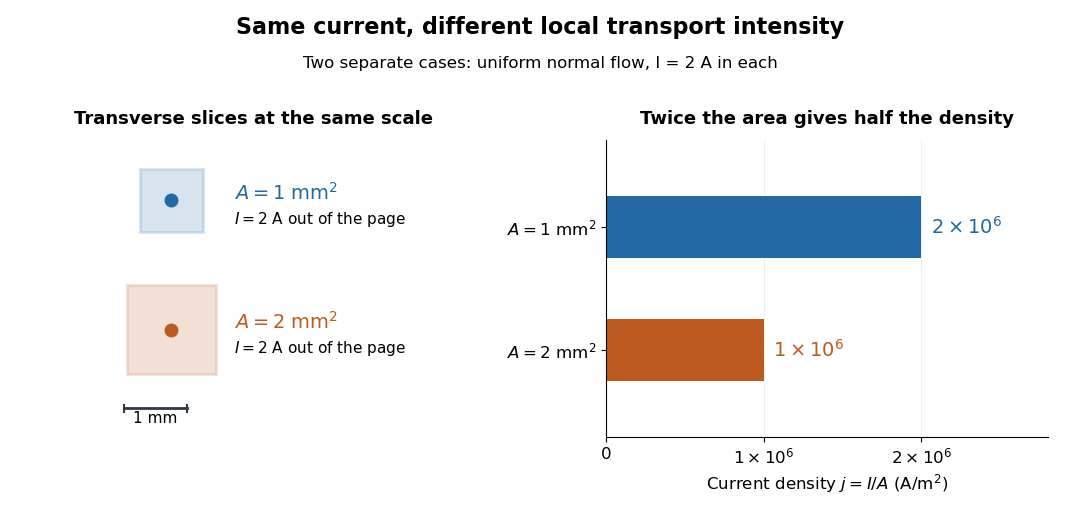
Equal electric current through different wire cross-sectional areas gives different current densities
. Both cases carry with uniform normal current density. The transverse slices use the same spatial scale; the bars compare . Source. Details.
For a toy electron transport model, stipulate mobile electron number density and drift velocity , with the positive unit normal . Each electron has electric charge , where the elementary charge is exact in SI. These are defined model inputs, rather than measured parameters of a particular material. [ref] The current density and its magnitude areFor wire cross-sectional area and constant transport over time , this givesThe two minus signs make conventional current point opposite to the electron drift velocity. A small drift velocity can carry an appreciable electric current because many charge carriers contribute; it does not specify the propagation speed of an electrical disturbance.
The wire cross-sectional area is the area of a slice perpendicular to the wire's axis. For a round wire of radius , it is . It enters both the uniform-flow formula for current density and the formula for the electrical resistance of a uniform Ohmic conductor.
A charge carrier transports electric charge by moving: electrons are one example, and ions are another. For species with number density , electric charge and mean velocity , the transport contributions add as . A stationary charged background contributes to charge density but not to this current density. [ref]
https://openstax.org/books/university-physics-volume-2/pages/9-1-electrical-current. Ling, Sanny and Moebs, §9.1: positive and negative carriers
.The drift velocity is a charge carrier population's mean velocity relative to its material's rest frame. It describes the net transport superposed on microscopic motion. For a single species, current density is ; for electrons, reverses the direction. It is distinct from the propagation speed of an electrical disturbance. [ref]
https://openstax.org/books/university-physics-volume-2/pages/9-2-model-of-conduction-in-metals. Ling, Sanny and Moebs, §9.2: drift and transport
.The mean velocity of the electron population associated with a net electric current, distinct from random thermal or Fermi motion. Its sign is opposite to conventional current for negative charge carriers. Its usually small magnitude is not the propagation speed of an electromagnetic signal in a transmission line.
For sinusoidal current density and constant carrier density , the electron drift velocity is . Its displacement has amplitude and zero net change over a full cycle. The distance accumulated by this drift alone in one cycle is . With an RMS current, . This does not measure the much larger microscopic path due to Fermi velocity and electron-phonon scattering.
A charge carrier population per unit volume or, for a sheet, per unit area. The dimensional convention and whether different carrier species are counted separately must be specified.
Charge carrier mobility is the magnitude of steady drift velocity per unit weak electric field in a scalar transport model. In the Drude model, and . The positive charge carrier mobility separates ease of motion from the sign of electric charge; its SI unit is .
A transport quantity obtained by combining longitudinal electrical conductivity and a Hall coefficient. It equals single-carrier drift mobility only under the corresponding one-carrier and scattering assumptions. This does not independently determine effective mass and scattering time.
The positive hole mobility is the magnitude of an electron hole's weak-field drift velocity per unit electric field. In an isotropic relaxation-time model, , and its contribution to electrical conductivity is . The sign is opposite to an electron's drift because the electron hole has positive charge.
The positive electron mobility relates the drift velocity of conduction electrons to an electric field: . In the isotropic Drude model, , where is the momentum relaxation time and the band effective mass. The minus sign describes negative charge; the electron mobility itself is positive.
A current dipole idealizes a localized impressed electric current density by the displayed Dirac delta function distribution. Its moment has units of current times length. In a homogeneous volume conductor of conductivity , its primary electric potential is .
A radial current dipole has moment parallel to its displacement from the sphere centre. The Sarvas formula gives identically zero exterior magnetic field for such a source in a spherical volume conductor model, although its electric potential need not vanish. This is a nonuniqueness mechanism for the inverse problem in magnetoencephalography.
The four-current combines charge density and current density into the four-vector . With , its four-divergence vanishes by the charge continuity equation: . It is the source in the covariant Maxwell equations.
A surface current density is electric current per unit transverse length confined to a surface. Integrating a thin layer's current density through its thickness gives .
A current sheet idealizes electric current as supported on a surface. It produces a jump in the tangential magnetic field.
Two broad perfect conductors of width , separated by gap , carry opposite steady electric currents and connect through a terminating resistor . Away from edges, Ampère's circuital law and the superposition principle give gap magnetic field magnitude . Each conductor is an equipotential, and Ohm's law sets their electric potential difference to . Planar symmetry and charge-free Gauss's law then give uniform gap electric field magnitude . Injection parallel to the upper current makes the electric and magnetic Lorentz forces opposite. Their cancellation selects speed independent of nonzero electric charge and of operating current; nonrelativistic kinetic energy is .
The Lorentz force per unit area on an ideal current sheet is computed using the mean of its limiting magnetic fields. The sheet's own local magnetic field is equal and opposite on its two sides and cancels in this mean. Equivalently, integrate the Lorentz force density through a thin regularized layer: its self-field contribution averages to zero, leaving the external field acting on the surface current density.
For a surface current density on an interface with unit normal , Ampère's law givesin Gaussian units, or in SI units.
For a thin layer with essentially uniform tangential electric field, integrating electrical conductivity through its thickness gives the sheet conductivity tensor . The two-dimensional form of Ohm's law is , with surface current density . Its SI unit is : amperes per metre divided by volts per metre. When response is the same in every in-plane direction, the sheet conductivity reduces to a scalar ; for uniform bulk electrical conductivity and thickness , .
Articles by others on the same topic
There are currently no matching articles.