Differential thermal model of a sun valve
ID: differential-thermal-model-of-a-sun-valve

Take a stipulated pair of effective rods with common length , linear thermal expansion coefficient , heat capacity , projected illuminated area , and thermal conductance to an environment at constant temperature . One reference represents the symmetric polished-rod assembly. Write and . Let their effective radiometric absorptances be for a fixed incident optical spectrum, and let be the common irradiance. A spatially uniform, linear heat-balance model givesHere includes a linear approximation to the relevant losses; changing the surface treatment can also change those losses in a real device. We stipulate equal and to isolate the response to absorbed illumination, with thermal coupling from the burner neglected. Small, mechanically unconstrained extensions then give a differential displacementThe time constant describes thermal memory. A common imposed temperature shift cancels from the extension difference under the matched-coefficient assumptions; mismatched materials, geometry or thermal coupling can spoil that cancellation.
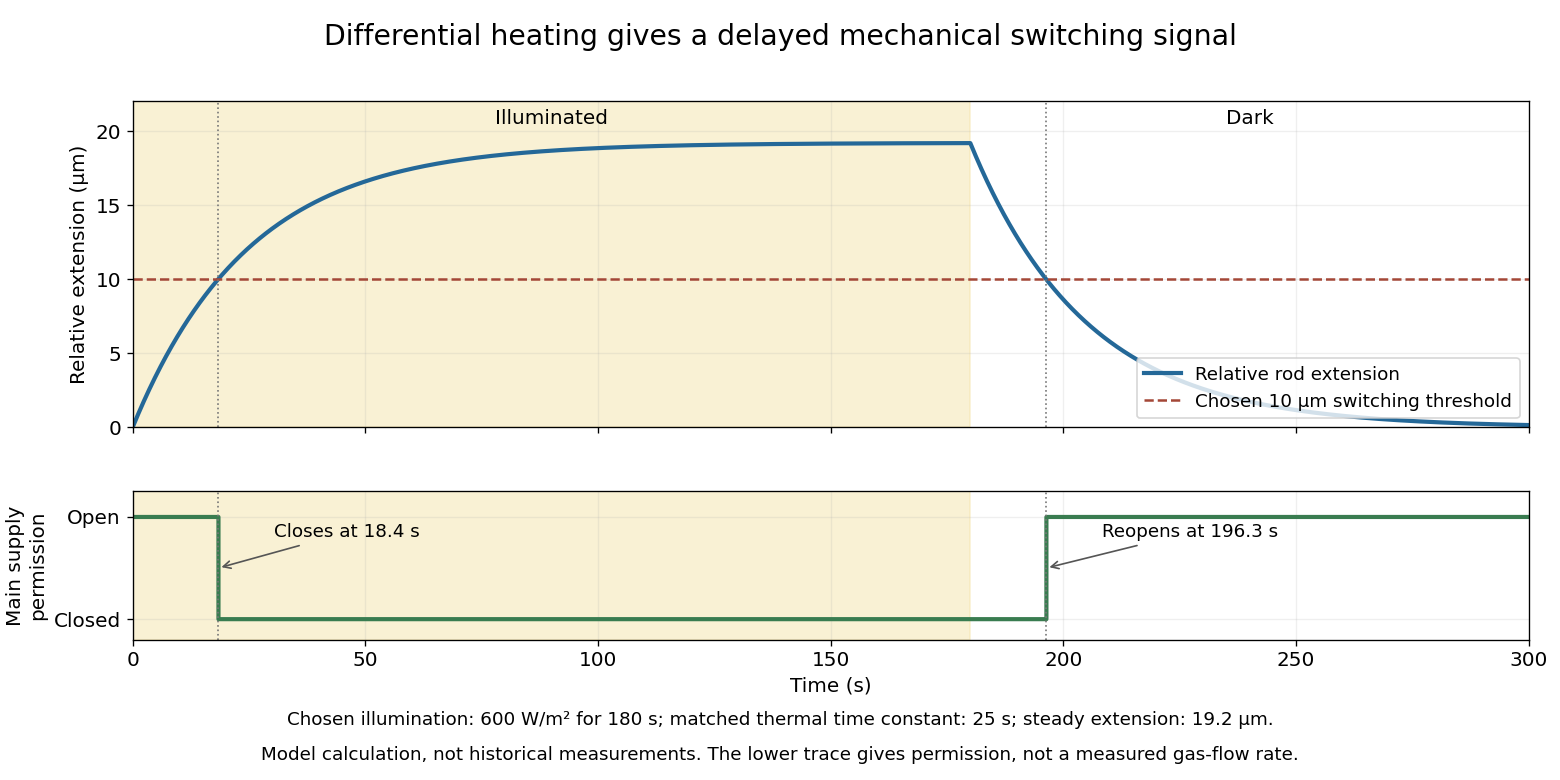
For a step from darkness to constant irradiance , with initially equal rod temperatures, the first-order linear differential equation givesChoose , , , , , , and . The calculated difference of absorbed powers is , givingFor an illustrative ideal valve that closes at , the closing time isThis threshold is crossed only when . These are chosen model parameters, not a fit to a historical valve.

New to topics? Read the docs here!