Doppler frequency along a trajectory
ID: doppler-frequency-along-a-trajectory

In the same uniform stationary sound model, let be emission time, reception time, and and source and receiver positions. The direct-path propagation condition and its direction areThe unit vector points from the source's old emission position to the receiver's reception position. With velocities and , taking a derivative of the propagation condition givesHere the dot products project onto the actual propagation direction. The last equality counts source wave phase cycles at reception for constant emitted frequency . It assumes both speeds are below , a unique direct arrival and smooth motion; interpreting a measured short-window frequency spectrum additionally requires little frequency change within that window. The source velocity must be evaluated at emission, not at reception. This delayed geometry matters when the direction changes.
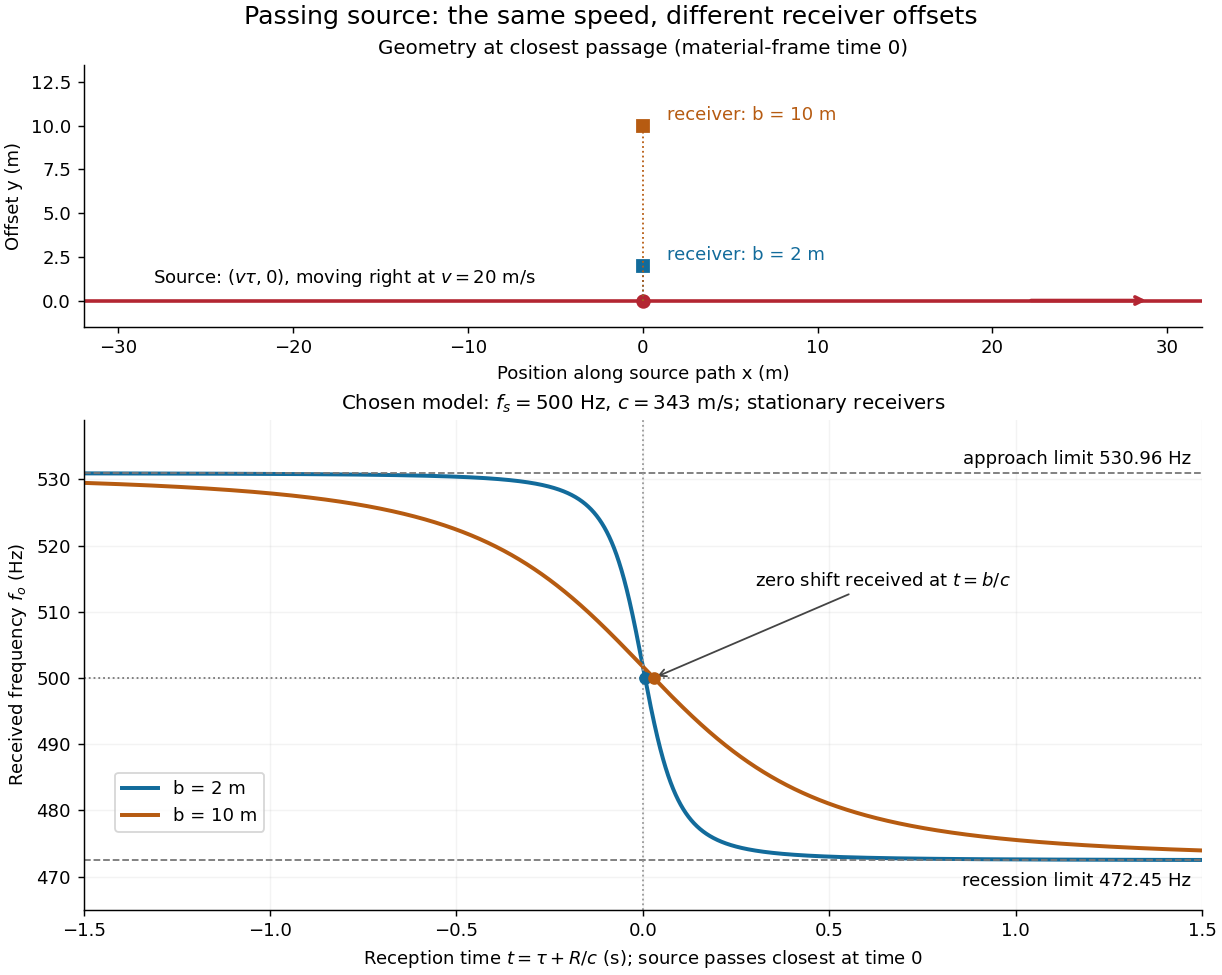
For an original pass-by model, a source follows and a stationary receiver is at with . The source passes its closest position at emission time . ThenThese parametric equations give received frequency against reception time. For the shift is positive, for negative, and the unshifted emission at reaches the receiver at . Thus zero shift occurs after the source's geometric closest passage in the material's reference frame. Increasing spreads the transition over a longer interval even though is unchanged. Far before and after passage, the frequency approaches and respectively.

New to topics? Read the docs here!