Effective noise bandwidth
ID: effective-noise-bandwidth

For a linear filter with chosen nonzero reference voltage gain , define its effective noise bandwidth byThis is the width of an ideal rectangular linear filter with gain magnitude passing the same mean square of input white noise. ConsequentlyUse the full voltage transfer from the open-circuit voltage source to the readout, including any electrical load, when applying this formula. A nominal signal bandwidth stated between two cutoff frequencies does not specify the integral: gradual tails and a nonuniform passband matter. For an ideal rectangular unit-gain passband , . For an unloaded RC low-pass filter with and cutoff frequency ,The last equality follows by substituting and integrating as . Using the nominal as the noise bandwidth underestimates the variance by a factor , or the root mean square voltage by .
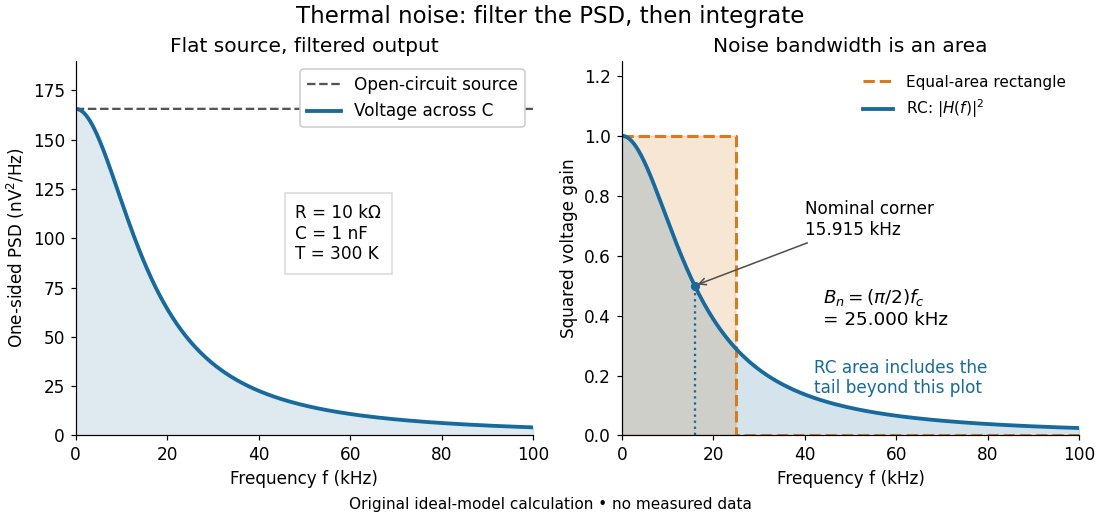
Equal-area bandwidth for filtered thermal electrical noise
. Original analytical illustration for , , and . The left panel shows the one-sided open-circuit voltage power spectral density and the output spectrum of an unloaded RC low-pass filter. The right panel compares the squared frequency response with an equal-area ideal rectangular linear filter; the shaded RC area continues beyond the plotted range. The nominal corner is , whereas the effective noise bandwidth is . Calculated curves, not measured data. Details.
New to topics? Read the docs here!